
Apple, a Timeline
Apple's history is usually told as a run of inventions. Laid out by date it is something else: a company that has almost never gone first, that twice came close to ending, and whose rescue the second time was not a machine but a shop.
This is the timeline, in order, with the dates attached.
1976, a circuit board on a kitchen table at $666.66, about two hundred made. 1979, and the spreadsheet somebody else wrote that made the Apple II worth owning. The twenty-fourth of January 1984 and a $2,495 Macintosh carrying an interface Xerox had built first. 1985, and a thirty-year-old co-founder losing a board fight and leaving. The decade nobody retells, when a long product list, a stalled operating system and licensed clones took the company to the ordinary kind of trouble where a finite amount of cash meets a rate of loss.
Then the turn. The twentieth of December 1996 and $400 million for NeXT, eleven years after removing the man who ran it. The sixth of August 1997, and Microsoft's $150 million in non-voting stock, a patent cross-licence and a commitment to keep shipping Office for the Mac — booed in the hall, and the answer to the only question corporate buyers were asking.
Then the shop. The iPod on the twenty-third of October 2001. The iTunes Music Store on the twenty-eighth of April 2003, 200,000 songs at 99 cents, all five majors signed — and the first time Apple took a cut of a transaction between two other parties. The iPhone on the ninth of January 2007, with no third-party applications at all. And the App Store on the tenth of July 2008, 500 applications, which is the moment a computer company became a landlord.
Then the consequences. The trillions, and the order they arrived in. And the two courts now asking whether the company that builds a platform is entitled to be the only route onto it — the European Commission's €500 million anti-steering fine of 23 April 2025, and the Department of Justice's monopolisation suit, whose motion to dismiss was largely denied on 30 June 2025.
And then the ninth of September 2026, and a folding phone seven years after somebody else's.
Every figure in this film carries its date and its source. Nothing here is a prediction.
Educational documentary. Not financial or investment advice.
In these topics
Chapters
- A board on a kitchen table
- The program that sold the machine
- The twenty-fourth of January, 1984
- The founder is removed
- The decade that nearly ended it
- Buying the future back
- The sixth of August, 1997
- Fewer things, one shape
- A thousand songs
- The twenty-eighth of April, 2003
- The ninth of January, 2007
- The tenth of July, 2008
- The succession
- The trillions
- The argument about the toll
- The ninth of September, 2026
Video notes
1. A board on a kitchen table
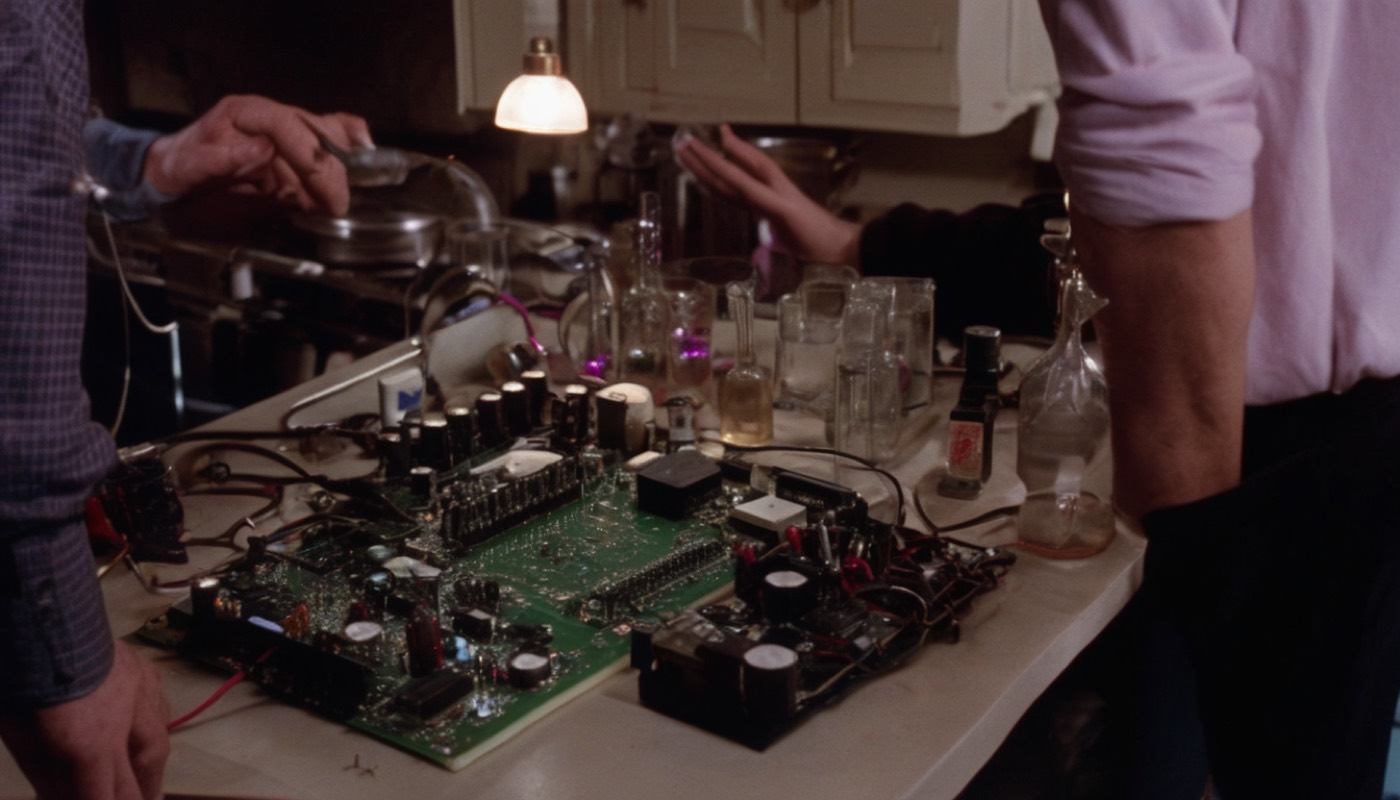
Most company histories are told as a line of inventions. One clever object after another, each arriving on schedule, each explaining the next.
Apple's history does not read like that when you lay it out by date. Laid out by date it has two near-deaths in it, one of them so close that the company was counting weeks. And the thing that pulled it out the second time was not a machine at all. It was a shop — a way of selling other people's work — and that shop is the reason Apple is now arguing with governments on two continents.
So this is the timeline, in order, with the dates attached.
It starts with a circuit board on a kitchen table.
In 1976 a board was not a computer. It was the part you bought and then spent a month turning into a computer, if you could solder, and if you could find a keyboard and a case and a power supply of your own. What Steve Wozniak designed was a board that already did the hard part — you supplied the rest.
It went on sale that year at six hundred and sixty-six dollars and sixty-six cents. The Smithsonian's record of the machine, which holds one, gives the reason for the price without embarrassment: Wozniak liked repeating digits. About two hundred were made.
Two hundred boards is not a company. It is a hobby with an invoice attached. But the reception it got among the people who understood what it was — the Homebrew Computer Club, in the same valley — is what persuaded Wozniak and Steve Jobs that there was a company in it.
Hold on to the shape of that first object, because the pattern repeats for fifty years. Somebody else had the idea first. Apple arrived slightly later with the version that did not require you to be an enthusiast, charged more for it, and set the terms everyone else then had to argue with.
2. The program that sold the machine
The Apple II arrived in 1977, and this time it was a whole machine — case, keyboard, power supply, colour on a television screen. It sold steadily to schools and to hobbyists, and it would have stayed a machine for schools and hobbyists except for something Apple did not make.
In 1979 a program called VisiCalc appeared, and for its first year it ran on the Apple II and nowhere else. It was a spreadsheet: a grid of numbers where changing one figure changed every figure that depended on it, instantly, without anyone recalculating a column by hand.
That is a dull sentence describing a violent change. A business that had a person whose job was recalculating columns could now buy a computer instead, and the computer paid for itself in a season.
So people bought an Apple II to run VisiCalc. The machine was the accessory. The shop counter went quiet when somebody typed a figure into the grid and watched forty other figures move.
This is the first time the pattern shows clearly, and it is worth naming now because it comes back in 2008 with enormous force. Apple's hardware sells hardest when somebody else's software is the reason to want it. The company that has spent its life being described as a hardware company has repeatedly been rescued by things it did not write.
3. The twenty-fourth of January, 1984
Xerox had the graphical interface first. Researchers at its Palo Alto centre built machines with windows, icons and a mouse through the 1970s, and Apple's engineers saw them. None of what follows is a claim that Apple invented the idea.
What Apple did was put it on a desk, at a price a company might actually pay, with a mouse in the box.
The Macintosh was introduced on the twenty-fourth of January 1984 at two thousand four hundred and ninety-five dollars. It had a small monochrome screen, one floppy drive, and no hard disk. By the standards of the machine it wanted to replace it was slow and it was cramped.
It was also the first computer most people ever used that did not require them to learn anything before it would do something. You pointed at a thing and the thing happened. The instruction manual stopped being a prerequisite and became a fallback.
The launch is remembered now mostly for its advertisement, which ran once during the American football final two days earlier and never properly again. That is a fair measure of how much of Apple's history is marketing and how much is engineering: the advertisement is famous, and the mouse is the part that changed everything.
Sales were disappointing against the plan. The machine was too expensive for homes and too underpowered for the businesses that were buying the alternative. It took years and several revisions before the Macintosh was a durable business, and the founder who had pushed it hardest was not there to see that happen.
4. The founder is removed
In 1985, after a year of open conflict over the direction of the company and who ran which part of it, Steve Jobs lost a board fight and left the company he had co-founded.
It is worth being plain about what this was, because it gets softened in the retelling. He was not promoted sideways into a role he chose. He was stripped of operational control, given a title with nothing under it, and he resigned.
He was thirty years old. He took a small group of Apple people with him and started a company called NeXT, building expensive workstations for universities and research, which sold in small numbers. He also bought a computer graphics division from Lucasfilm that year, which became Pixar.
For the company he had left, the eleven years that follow are the part of the timeline everybody skips.
5. The decade that nearly ended it
Through the early 1990s Apple did the reasonable thing and it very nearly killed the company.
The reasonable thing was to compete on the terms the market was setting. More models, aimed at more segments, at more prices. Printers, cameras, a handheld organiser, a games console. By the middle of the decade the product list was long enough that Apple's own dealers could not reliably explain the difference between two machines sitting on the same shelf.
At the same time the operating system that had been the whole advantage in 1984 had stopped moving. A replacement was attempted and abandoned. Meanwhile the alternative on the other side had caught up on the thing Apple had been ahead on, and it ran on hardware from dozens of manufacturers competing each other's prices down.
Then Apple licensed its system to clone makers, who built machines that were faster and cheaper than Apple's own, and took sales from the only part of the business that made money.
By 1996 the company was losing money at a rate that made the arithmetic obvious to anyone who could read a filing. Apple was not in trouble in the way that large companies are often said to be in trouble. It was in the ordinary, unglamorous kind of trouble, where a finite amount of cash meets a rate of loss and you can work out the date.
6. Buying the future back

On the twentieth of December 1996 Apple announced it was acquiring NeXT for about four hundred million dollars.
Read as a product decision it was straightforward. Apple needed a modern operating system, had failed to build one twice, and NeXT had one — built on Unix foundations, mature, and running. It became the basis of Mac OS X, and, much later and after a great deal of further work, of the software in every Apple device sold today.
Read as anything else it is one of the stranger corporate events of the century. The company bought a business whose main asset, in hindsight, was the man who ran it, and it did so eleven years after removing him.
Gil Amelio, Apple's chief executive at the time, called the acquisition the start of a new chapter. Jobs, in the same announcement, said the NeXT software would be married to Apple's high-volume hardware. Both statements were true and neither described what actually happened, which is that within seven months Jobs was running the company again.
The clones were cancelled. Most of the product list was cancelled. And then, in the summer, the company did something that at the time looked like surrender.
7. The sixth of August, 1997
At a Macworld conference in Boston, in front of an audience of Apple's most loyal customers, Steve Jobs announced an agreement with Microsoft. Bill Gates appeared on a large projection above the stage to be part of it, and the audience booed.
The terms, from Microsoft's own announcement that day: Microsoft would invest one hundred and fifty million dollars in non-voting Apple stock. The two companies signed a broad patent cross-licensing agreement. Microsoft committed to continue developing and shipping its Office suite for the Macintosh. And Apple would bundle Internet Explorer with the Mac operating system, making it the default browser.
Every part of that deal has been mythologised since, in both directions. So here is what it was and was not.
It was not a rescue in the sense of keeping the lights on. A hundred and fifty million dollars was real money and it was not the difference between solvency and administration by itself.
What it was, was the end of a question. The question every corporate buyer was asking in 1997 was whether Apple would exist in three years, because nobody signs off on a fleet of machines from a company that might not be there to support them. A public, funded, patent-settled commitment from the largest software company in the world, that Office would keep coming to the Macintosh, answered that question in a way no press release from Apple could have.
Microsoft had its own reasons. It was being pursued by antitrust authorities and a visibly alive competitor was worth something to it. Both companies got what they came for, which is the usual reason deals happen.
The booing in that hall was, at the time, the most reported thing about the day. It was also completely wrong.
8. Fewer things, one shape

In 1998 Apple released the iMac: one machine, in a translucent blue-green case, with a handle moulded into the top of it.
The handle mattered more than it should have. Almost nobody carried an iMac anywhere. What the handle said was that this object was allowed to be touched, and that somebody had thought about what it would feel like to pick it up — in a category where the design question had been how many drive bays fit in a beige box.
The engineering decision that drew the complaints was the ports. Apple removed the floppy drive and the legacy connectors and fitted USB, which almost no peripheral used yet. Reviewers called it arrogant. Within two years USB was how everything connected to everything.
That is the second pattern in this timeline, and it is less flattering than the first: Apple removes a thing people are using before the replacement is ready, takes a year of criticism, and is retrospectively described as visionary if the replacement wins. When the replacement does not win, the episode quietly disappears from the story. Both outcomes have happened repeatedly and only one of them gets retold.
The wider point about 1998 is subtraction. The product list went from dozens of machines to four. Apple stopped trying to have something for everyone, which is what every struggling company is advised to do and almost none of them do.
9. A thousand songs
On the twenty-third of October 2001 Apple announced the iPod: a five gigabyte hard drive in a case that weighed six and a half ounces, holding, in Apple's own words, up to a thousand CD-quality songs, with up to ten hours of battery. It cost three hundred and ninety-nine dollars.
Digital music players already existed. They held a few dozen tracks, they were awkward to fill, and nobody outside the enthusiast press cared. Apple's claim was not that this was new. Jobs's line in the announcement was that the whole music collection now went in a pocket.
Three hundred and ninety-nine dollars was a great deal of money for a music player in 2001 and it was widely said to be too much. Reviewers pointed out, correctly, that it only worked with a Macintosh at first, in a market where Macintoshes were a small minority of computers.
What the iPod actually did for the timeline is easy to state and was hard to see at the time. It took Apple out of the computer industry. Until 2001 every argument about Apple was an argument about a small share of one market against a dominant alternative. The music player was not in that market. It was sold to people who had never considered which computer to buy, and it gave them a reason to walk into an Apple shop.
But a player full of music needs the music, and where the music came from in 2001 was not a place any record company had agreed to.
10. The twenty-eighth of April, 2003
Apple opened the iTunes Music Store with just over two hundred thousand songs, at ninety-nine cents each, with all five of the major record companies of the day signed up — BMG, EMI, Sony Music Entertainment, Universal and Warner.
The context is what makes this a hinge in the timeline. The recorded music industry at that moment was watching its revenue fall while file-sharing networks moved enormous volumes of music that nobody paid for. The industry's response had been lawsuits. It had not been a shop anybody wanted to use.
Jobs's pitch in the announcement was about rights rather than catalogue: you could burn what you bought to an unlimited number of CDs for your own use, and put it on as many iPods as you owned. That sounds like small print. It was the product. Every legitimate competitor at the time sold music that stopped working if you stopped paying, and people could tell.
And here is the structural thing, the one that determines the rest of this film. Apple was now taking a cut of a transaction between two other parties. It did not record the music. It did not own the music. It ran the counter, set the price, and kept a share of every sale.
In 2003 that was a rounding error against the hardware. It was also the template.
11. The ninth of January, 2007
Apple announced the iPhone at four hundred and ninety-nine dollars for four gigabytes and five hundred and ninety-nine for eight, on sale in the United States that June and in Europe late in the year. Jobs called it five years ahead of any other mobile phone.
Smartphones existed. They had physical keyboards, stylus-driven screens, and they were sold on specifications to people who had to justify the purchase. The iPhone had one button on its face and a screen you touched with a finger, and it was sold to everybody.
What it did not have at launch is the part most people have forgotten, and it matters for the chapter that follows. It had no third-party applications at all. Apple's stated position in 2007 was that developers should write web pages that looked like applications. The device shipped with what Apple put on it, and nothing else.
That position lasted about a year, and abandoning it was the single most consequential decision in this entire timeline.
12. The tenth of July, 2008
The App Store opened on the tenth of July 2008, the day before the second iPhone went on sale. Apple's announcement that day counted more than five hundred native applications available, of which more than a hundred and twenty-five were free.
Five hundred is a small number. Within a few years the figure was in the hundreds of thousands, and the interesting thing is not the growth — any open shop attached to a popular device grows. The interesting thing is the arrangement Apple wrote underneath it, because that arrangement is what the last decade of this timeline is a long argument about.
A developer could not reach an iPhone by any route except Apple's. Apple reviewed what went in. Apple set the rules about what an application could do and say. Apple processed the payment, and kept a share of it.
Note what this is in business terms. It is not a computer company selling computers. It is a landlord. Apple built the only high street in the neighbourhood, and it takes a percentage of the takings of every shop on it.
For developers the deal was genuinely good at first and it is worth saying so. A one-person software business could reach tens of millions of devices without a distributor, a retailer, a box, or a single negotiation. Enormous businesses exist that could not have existed before it.
But an arrangement where one company is simultaneously the landlord, the planning authority, the payment processor and a competing shopkeeper on the same street is going to attract attention eventually. It took about fifteen years.
13. The succession
On the twenty-fourth of August 2011 Steve Jobs resigned as chief executive. His letter said that if the day ever came when he could no longer meet his duties as Apple's chief executive, he would be the first to tell them. It recommended Tim Cook as his successor.
He died on the fifth of October 2011. Tim Cook's message to Apple staff said the company had lost a visionary and creative genius, and the world had lost an amazing human being.
Almost every prediction made about Apple in the following year was wrong in the same direction. The argument ran that the company's advantage was one person's judgment about products, and that without him it would drift into competence and decline.
What actually happened is that the company grew larger than it had ever been, and it did so by becoming a different kind of company than the one the prediction was about. Cook's Apple is an operations and services business at a scale Jobs's Apple never reached. Whether it has produced a category-defining object on the scale of the ones in this timeline is a fair question and people argue about it honestly.
But the growth is not in dispute, and the next chapter is what it looks like written down.
14. The trillions

The market value milestones make the shape of the last eight years visible in a way revenue figures do not.
On the second of August 2018 Apple became the first company in the United States to be worth a trillion dollars. On the nineteenth of August 2020, the first to be worth two trillion. On the third of January 2022, the first to reach three trillion.
Then the ordering changes, and the change is the story.
Apple crossed four trillion dollars on the twenty-eighth of October 2025 — third to that mark, behind Nvidia and Microsoft, not first. It crossed five trillion on the twenty-eighth of July 2026, second to that mark, behind Nvidia, which had got there on the twenty-ninth of October 2025.
First, first, first, then third, then second. The company that had defined each of those thresholds was now arriving at them after companies selling the machinery that trains artificial intelligence systems.
The underlying business, meanwhile, was not weak. In the quarter that ended on the twenty-seventh of June 2026, reported on the thirtieth of July, Apple recorded revenue of a hundred and nine point four billion dollars, up sixteen per cent on the same quarter a year earlier, with diluted earnings per share of two dollars and two cents, up twenty-nine per cent, and a gross margin of fifty point one per cent. Apple noted that roughly two percentage points of that margin came from tariff refunds.
Those are very good numbers. They are also the numbers of a company that grew sixteen per cent in a year when the market's attention had moved to companies growing considerably faster.
15. The argument about the toll
The shop that saved the company is now the thing it defends in court, on two continents at once.
On the twenty-third of April 2025 the European Commission fined Apple five hundred million euros for breaching the anti-steering obligation in the Digital Markets Act. The finding was that Apple imposed technical and commercial restrictions preventing developers from telling their own customers about cheaper offers available outside the App Store. Meta was fined two hundred million euros the same day on a separate point. Apple has appealed.
In the United States the Department of Justice sued Apple in March 2024, alleging monopolisation of the smartphone market. Apple moved to dismiss. On the thirtieth of June 2025, Judge Julien Xavier Neals of the District of New Jersey largely denied that motion, finding the government had adequately alleged monopoly power and anticompetitive conduct. That ruling decides nothing about whether the allegations are true. It decides that they get tested.
Both cases are about the same thing, stripped of their legal language: whether a company that builds a platform is entitled to be the only route onto it, and to price that route.
Apple's answer is that the control is the product — that review, a single payment path and one set of rules are why the platform is safe, and that unbundling them removes something customers are actually buying.
The answer on the other side is that a great deal of what is defended as safety is indistinguishable from a toll, and that the party collecting the toll is not a neutral judge of how necessary it is.
Nothing in this film resolves that. What the timeline shows is that it was always going to be asked. A business model that began as a rounding error on music sales in 2003 became the thing the company is most valuable for, and regulators arrive late but they do arrive.
16. The ninth of September, 2026
Which brings the timeline to a week ago.
At an event on the ninth of September 2026, Apple announced the iPhone 18 Pro and iPhone 18 Pro Max, the Apple Watch Series 12, AirPods 5 — and the iPhone Duo, its first folding phone.
The Duo has a seven point six inch inner display and a five point four inch outer display, runs the same A20 Pro chip as the iPhone 18 Pro, and starts at one thousand nine hundred and ninety-nine dollars for two hundred and fifty-six gigabytes. Pre-orders open on the sixteenth of October 2026 and it goes on sale on the twenty-third, in more than seventy countries, with a further twenty-eight following on the thirtieth.
Look at that against chapter one and the pattern is exactly the one this film started with.
Folding phones were not new. Other manufacturers had been selling them for years, through several generations of creased screens and failed hinges, taking the criticism and doing the engineering. Apple did not go first. It went late, at two thousand dollars, with a claim about being the thinnest, into a category somebody else had spent seven years making viable.
That is the whole fifty years in one object. Arrive late. Charge more. Set the terms.
The open question in 2026 is whether that still works when the terms are the thing being litigated. Apple's power has never rested on being first — the Apple I was not first, the graphical interface was not first, the music player was not first, the smartphone was not first, and the folding phone is not first. It has rested on being the company that decided what the finished version of a category looked like, and then owning the route to it.
The route is what is now in dispute. And a timeline, unlike a story, does not get to say how it ends.
Sources and credits
Primary sources
- Apple, 'Apple Presents iPod', apple.com newsroom, 23 October 2001 — 5 GB, up to 1,000 CD-quality songs, 6.5 ounces, up to 10 hours of battery, $399, and the Jobs quote about the collection going in a pocket.
- Apple, 'Apple Launches the iTunes Music Store', apple.com newsroom, 28 April 2003 — over 200,000 songs at 99 cents, BMG, EMI, Sony Music Entertainment, Universal and Warner, and the burn/copy rights Jobs led on.
- Apple, 'Apple Reinvents the Phone with iPhone', apple.com newsroom, 9 January 2007 — 4 GB at $499 and 8 GB at $599, US availability June 2007, Europe late 2007, and the 'five years ahead' quote.
- Apple, 'iPhone 3G on Sale Tomorrow', apple.com newsroom, 10 July 2008 — the App Store opening with more than 500 native applications, more than 125 of them free.
- Apple, 'Letter from Steve Jobs', apple.com newsroom, 24 August 2011, and Apple's media advisory of 5 October 2011 — the resignation wording, the recommendation of Tim Cook, and Cook's message to staff.
- MacRumors, '25 Years Ago, Apple Acquired NeXT and Brought Back Steve Jobs', 20/22 December 2021 — the 20 December 1996 announcement, the approximately $400 million price, and the Amelio and Jobs quotes. Apple's own 1996 release is no longer served from a stable public URL; this reproduces it.
- CNBC, 2 August 2018; CNBC, 19 August 2020; CNBC, 3 January 2022 — Apple first to $1 trillion, $2 trillion and $3 trillion respectively.
- CNBC and Bloomberg, 28 October 2025 — Apple crosses $4 trillion, third to that mark after Nvidia and Microsoft. 9to5Mac, 28 July 2026 — Apple crosses $5 trillion intraday, second to that mark after Nvidia, which reached it on 29 October 2025.
- Apple, 'Apple reports third quarter results', apple.com newsroom, 30 July 2026 — quarter ended 27 June 2026: revenue $109.4 billion, up 16 per cent year over year; diluted EPS $2.02, up 29 per cent; gross margin 50.1 per cent, including approximately 2 percentage points from tariff refunds.
- European Commission, press release IP/25/1085, 23 April 2025 — €500 million fine on Apple for breach of the DMA anti-steering obligation (technical and commercial restrictions preventing developers from informing customers of cheaper offers outside the App Store), and €200 million on Meta on a separate point.
- Mintz, 'Judge Allows Justice Department's iPhone Monopolization Suit to Proceed', 2 July 2025 — DOJ filed March 2024 in the District of New Jersey; Judge Julien Xavier Neals largely denied Apple's motion to dismiss on 30 June 2025.
- Apple, 'Apple unveils iPhone Duo', apple.com newsroom, 9 September 2026 — 7.6-inch inner display, 5.4-inch outer display, A20 Pro, from $1,999 for 256 GB, pre-orders 16 October 2026, on sale 23 October 2026 in more than 70 countries with 28 more on 30 October. Apple newsroom archive for September 2026 — iPhone 18 Pro and iPhone 18 Pro Max, Apple Watch Series 12 and AirPods 5, all 9 September 2026.
Not regulated financial advice.