
CP/M: From Z80 to 8086
In 1974, Gary Kildall demonstrated an operating system called CP/M in a backyard workshop in Pacific Grove, California. Within a decade it was the standard software running the microcomputer business - and within another two years, the company that built it had lost the operating system contract that defined the next thirty years of computing to Microsoft.
This video follows that history chip by chip and company by company. Kildall's CP/M split into a fixed core and a swappable hardware layer, letting it run on incompatible machines from different manufacturers - which is why the Osborne 1 (3 April 1981) and the Kaypro II (20 May 1982), both built around the Z80 processor, could both run it. A retail trade in boxed floppy-disk software, including WordStar and dBASE II, grew up around CP/M's shared interface.
Then Intel's shift to 16-bit processors - the 8086 (1978) and the cheaper 8088 (1979) - pushed the industry toward machines CP/M had not been built for. In 1980, IBM approached Digital Research about an operating system for its secret Project Chess personal computer. The meeting that followed, on 22 August 1980, did not produce a deal: Dorothy Kildall balked at IBM's non-disclosure agreement, and the circumstances of that day remain disputed in the historical record, which this video treats as disputed rather than settled.
IBM went to Microsoft instead. Microsoft licensed, then bought outright, an operating system called 86-DOS from Tim Paterson at Seattle Computer Products - itself modelled closely on CP/M's own published interface - and supplied the result to IBM as PC-DOS. When the IBM PC launched on 12 August 1981, PC-DOS cost $40 against CP/M-86's $240, and Digital Research's own version for the IBM PC specifically did not arrive until April 1982, eight months later. Pricing, timing and the relationship IBM had already built with Microsoft combined to hand the PC operating system market to Microsoft by the mid-1980s.
No figure appears without its date and source.
Educational documentary. Not financial or investment advice.
In these topics
Chapters
- A world with no shared operating system
- Kildall builds CP/M
- The idea that let one system run on incompatible hardware
- The clone explosion
- The software and disk economy
- Intel moves to 16-bit
- IBM approaches Digital Research
- The meeting that didn't happen
- Microsoft buys 86-DOS
- The IBM PC ships, August 1981
- CP/M-86 arrives too late
- Why Digital Research lost
Video notes
1. A world with no shared operating system
In the early nineteen seventies, a new kind of computer was arriving on the market: small enough to sit on a desk, cheap enough for a business to actually buy. Each one still had a problem nobody had solved yet.
Every one of these early microcomputers ran its own private software, written specifically for its own hardware. A program built for one machine would not run on another, even a similar one, because there was no common operating system underneath them - no shared layer of software managing the machine's disks and screen that different programs could all rely on. Buy a program for one computer, and it worked on that computer alone.
That made the microcomputer business small, fragmented, and expensive to write software for. It would take one programmer, working largely alone, to change it.
2. Kildall builds CP/M
Gary Kildall was a computer scientist who had been consulting for Intel, the company that made the processor chip going into many of these new machines. He thought the industry's fragmentation was a solvable problem, and he set out to solve it himself.
In the fall of nineteen seventy-four, Kildall and a colleague, John Torode, demonstrated a working operating system for the first time, in a backyard workshop in Pacific Grove, California. They called it CP/M, for Control Program for Microcomputers, and booted it from a floppy diskette on a machine built around Intel's 8080 processor. Z80 support, for the rival chip most of CP/M's later customers would actually use, came soon after.
Pacific Grove sits on California's Monterey Peninsula, a quiet coastal town rather than a technology centre. Kildall built and sold his new operating system from there, not from Silicon Valley to the north.
Kildall and his wife, Dorothy McEwen Kildall, incorporated the company the same year, first under the name Intergalactic Digital Research, soon shortened to Digital Research. He wrote the code; she ran the business.
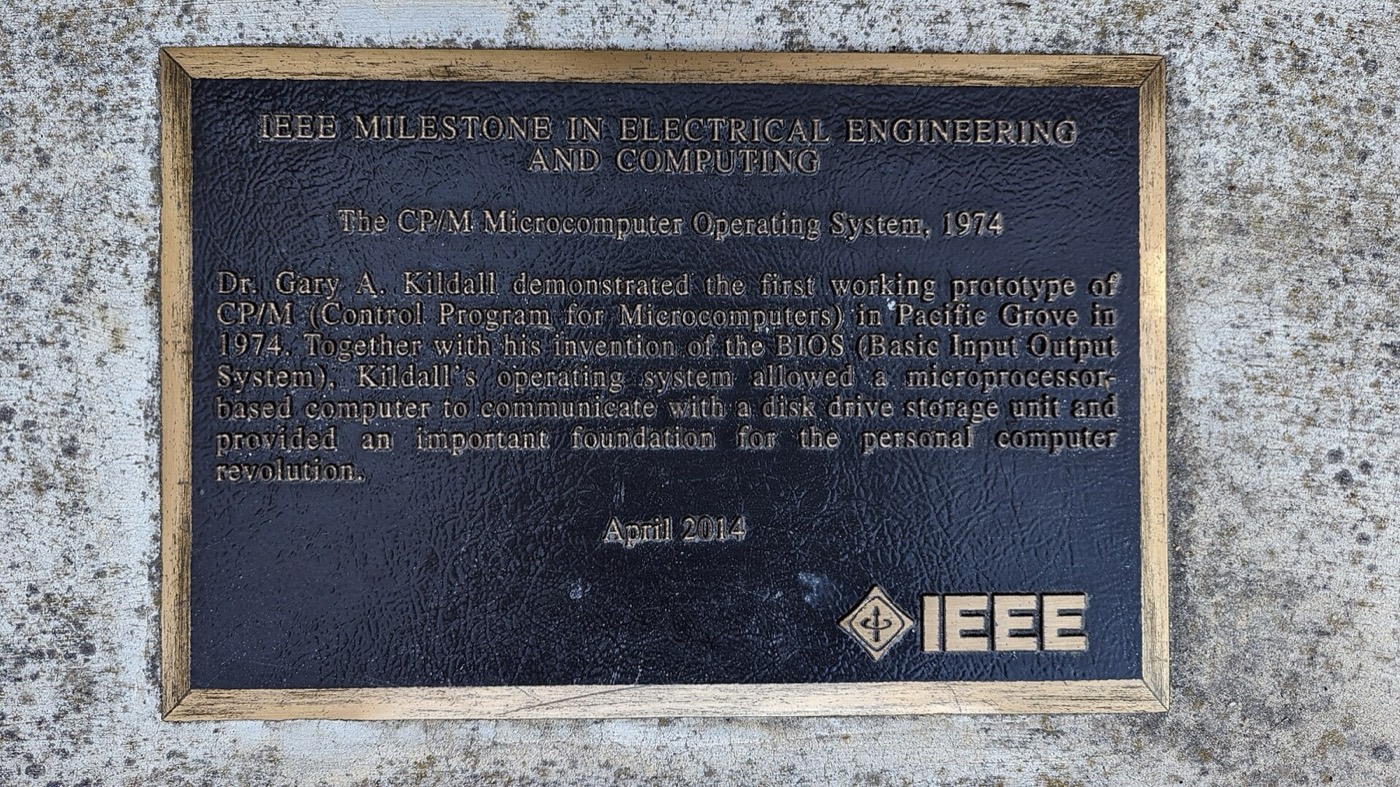
This plaque now marks 801 Lighthouse Avenue in Pacific Grove, the site connected to Kildall's early work on CP/M. It is one of the few physical traces left of where this story actually began.
3. The idea that let one system run on incompatible hardware
Writing an operating system once was the easy part. Selling it to a market of machines that all disagreed with each other about their own hardware was the hard part, and it is where Kildall's design turned out to matter most.
Kildall split CP/M into two pieces. The BDOS - short for Basic Disk Operating System - handled the parts of the job that stayed the same on every machine. It organised files, ran programs, and provided the core logic any computer needs. The BIOS - Basic Input/Output System - handled only the parts that differed from one machine to the next. It covered exactly how this particular computer talked to its screen, its keyboard, its disk drive. The BDOS never changed. Only the thin BIOS layer had to be rewritten for each new machine.
That one decision meant Digital Research did not have to build a different operating system for every manufacturer's hardware. A manufacturer could write its own small BIOS, bolt it onto Digital Research's unchanged BDOS, and have a working CP/M machine. CP/M stopped being one company's product tied to one piece of hardware, and became something closer to a standard that any hardware maker could adopt.
4. The clone explosion
Through the late nineteen seventies, that BIOS trick let a wave of manufacturers build CP/M machines of their own, each with different hardware underneath but running the same software on top.
Two of those machines mattered more than the rest. The Osborne 1, built around a Z80 processor and running CP/M, shipped on the third of April, nineteen eighty-one. The Kaypro II, also Z80 and CP/M, followed on the twentieth of May, nineteen eighty-two.
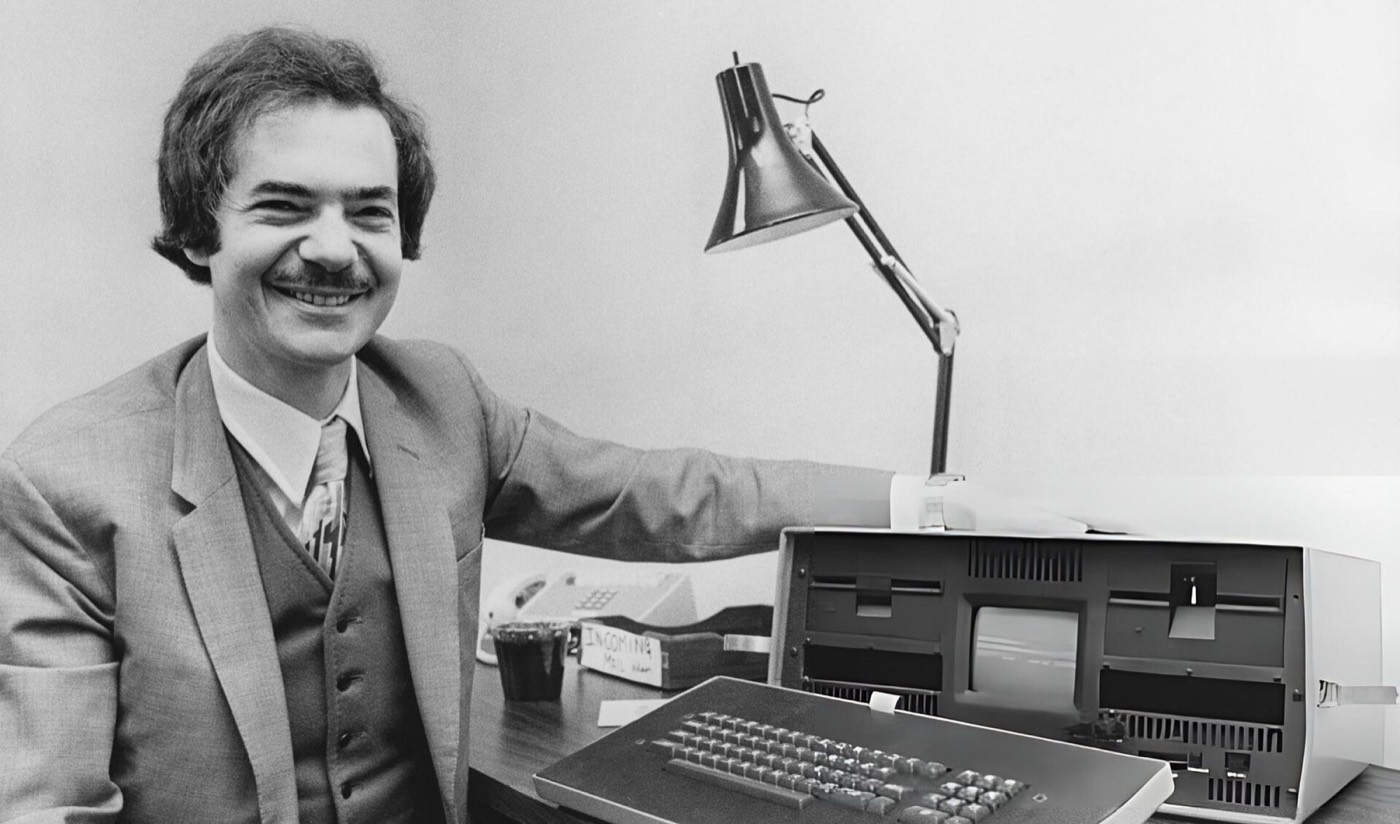
This is the Osborne 1 itself, pictured with its designer, Adam Osborne, shortly after launch. It was one of the first computers sold as a complete, portable package rather than a collection of parts a buyer assembled separately.
It sold for one thousand, seven hundred and ninety-five dollars, bundled with the software a small business actually needed already included in the price, rather than sold separately.
That bundling, on top of CP/M's common software, was the real innovation. A buyer no longer had to shop for software and hardware from different companies and hope they worked together. CP/M had become the thing that let an entire industry of small, competing hardware makers sell into one shared software market.
5. The software and disk economy
A shared operating system is only valuable if real software gets written for it, and through the late nineteen seventies and into the nineteen eighties, CP/M got plenty.
WordStar, a word processor from a company called MicroPro, was released for CP/M in September nineteen seventy-eight. dBASE II, a database program from Ashton-Tate, followed for CP/M in nineteen eighty. Both became two of the best-selling programs of the era, and both ran, unmodified, on any machine that could run CP/M at all.
That last point was the whole business model. A software company wrote one version of a program for CP/M's shared interface, rather than a separate version for every manufacturer's hardware, and it worked everywhere CP/M did.
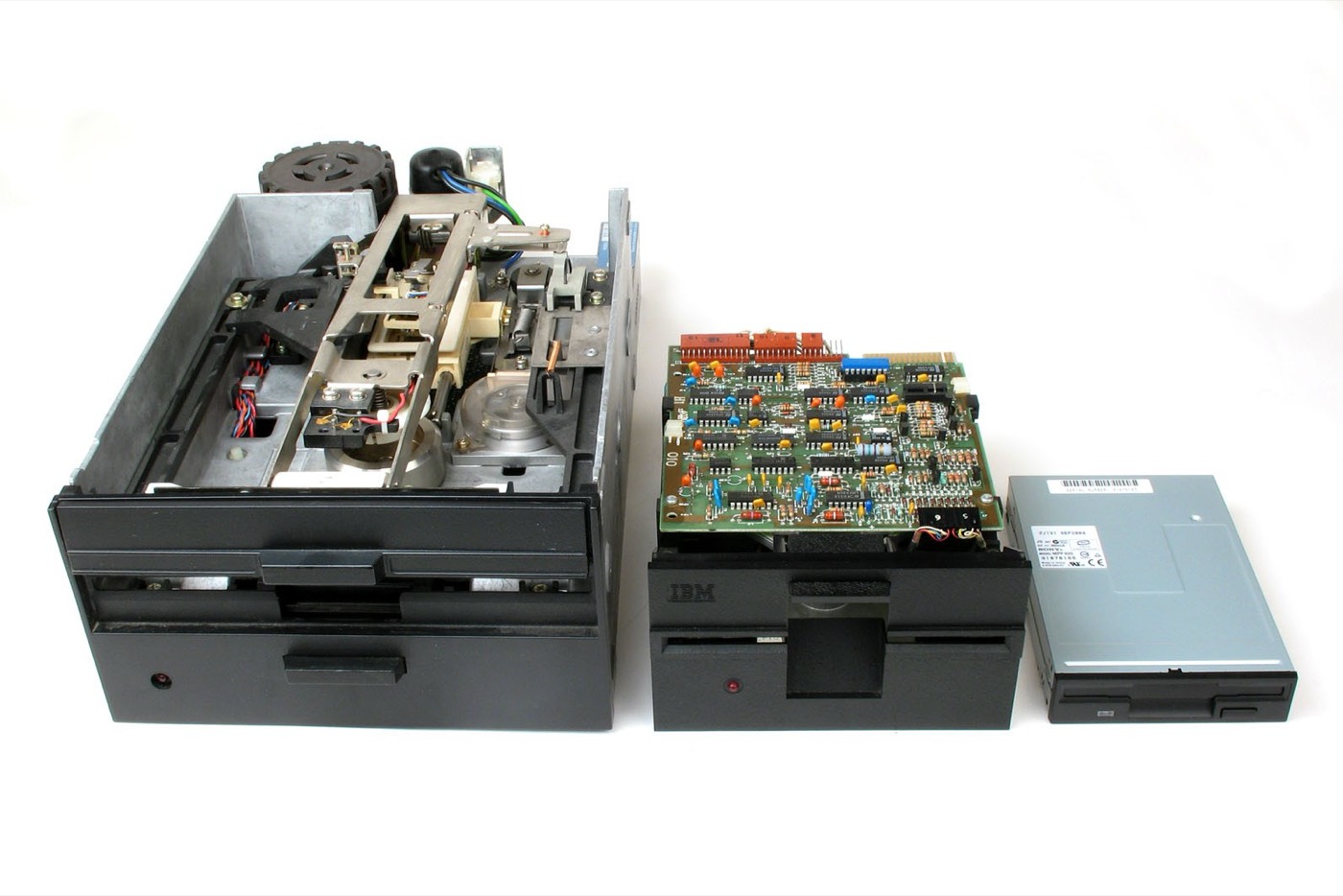
Software like that reached customers on floppy disks, sold through shops and mail order, much like these period disk drives. A retail trade in boxed, shrink-wrapped software grew up specifically because CP/M had made one disk work in machines from a dozen different companies.
By the early nineteen eighties, CP/M was the de facto standard operating system for 8-bit business microcomputers. Then the processors underneath it started to change.
6. Intel moves to 16-bit
Everything so far ran on 8-bit processors - chips that moved information through the machine eight digits at a time. Intel was already building something wider.
Intel released its 8086 processor in nineteen seventy-eight. A cheaper, narrower version, the 8088, followed in nineteen seventy-nine. Both were 16-bit processors, wider than anything CP/M had run on before. CP/M's own world had been 8-bit from the start. It ran first on the 8080, from nineteen seventy-four. Then came the Z80, from nineteen seventy-six.
A wider processor is not simply a faster one. Moving sixteen digits at a time instead of eight lets it address far more memory, and handle larger numbers, in a single step - which is exactly what a more ambitious generation of business software was starting to need.
That shift pushed the whole microcomputer industry toward 16-bit machines, and CP/M, built for an 8-bit world, did not control what came next.
7. IBM approaches Digital Research
In nineteen eighty, IBM was secretly developing its own personal computer, under the project name Project Chess, and it needed an operating system to put on it.
IBM did not design and manufacture every part of its new machine itself. It bought a processor from Intel, the 8086's cheaper sibling, the 8088, and it went looking outside the company for software to run on it, including an operating system.
The search led IBM to Digital Research, in Pacific Grove, California, the company whose CP/M had already made it the standard operating system of the previous generation of business microcomputers. IBM's own development work was based in Boca Raton, Florida, nearly three thousand miles away, and the two sides had to meet to talk about adapting CP/M for IBM's new machine.
Digital Research looked like the obvious choice to supply the new machine's operating system. The meeting that followed did not go the way either side expected.
8. The meeting that didn't happen
On the twenty-second of August, nineteen eighty, an IBM team arrived at Digital Research to discuss licensing CP/M for the new PC. What happened next is one of the most disputed afternoons in computing history, and this video is not going to pretend it is settled.
Dorothy Kildall, who ran Digital Research's business side, handled the opening of the meeting and balked at the strict non-disclosure agreement IBM wanted signed before talks could even begin - a legal promise not to repeat anything discussed. She stopped to consult the company's attorney rather than sign on the spot. Accounts differ on exactly where Gary Kildall was that day. He later said he was flying a business trip, delivering software to a customer, and that he returned to take part in the talks. IBM's own representative maintained for years that he never met Kildall in person at all.
No single documented account settles what actually happened in that room. What both sides agree on is this: the talks over an NDA stalled, and Digital Research did not come away from that meeting with a deal to supply IBM's new personal computer.
IBM left Pacific Grove without the operating system it had come for, and went looking elsewhere.
9. Microsoft buys 86-DOS
IBM's next stop was Microsoft, a much smaller software company that, at the time, had never sold an operating system of its own.
Microsoft did not have one to offer, so it went looking for one, and found it at Seattle Computer Products, a hardware company in the Seattle area. An engineer there, Tim Paterson, had begun writing his own operating system in April nineteen eighty. He built it to deliberately match CP/M's command structure, working from Digital Research's own published manual rather than its code. That way, software written for CP/M could be adapted to it with little trouble. He called it QDOS at first; it was later renamed 86-DOS.
Microsoft took a non-exclusive license to market 86-DOS in December nineteen eighty, paying twenty-five thousand dollars. Then, in July nineteen eighty-one, it bought all remaining rights to the system outright, for fifty thousand dollars more. Microsoft supplied the result to IBM as PC-DOS.
The licensing chain ran in one direction: Digital Research's published CP/M interface shaped how Paterson built 86-DOS, and 86-DOS, once bought by Microsoft, became the basis of PC-DOS and MS-DOS. The operating system IBM eventually shipped was modelled on the one Digital Research had already spent six years building a market around.
Digital Research had turned away from the deal that history remembers; Microsoft had not even had to write an operating system from nothing to take its place.
10. The IBM PC ships, August 1981
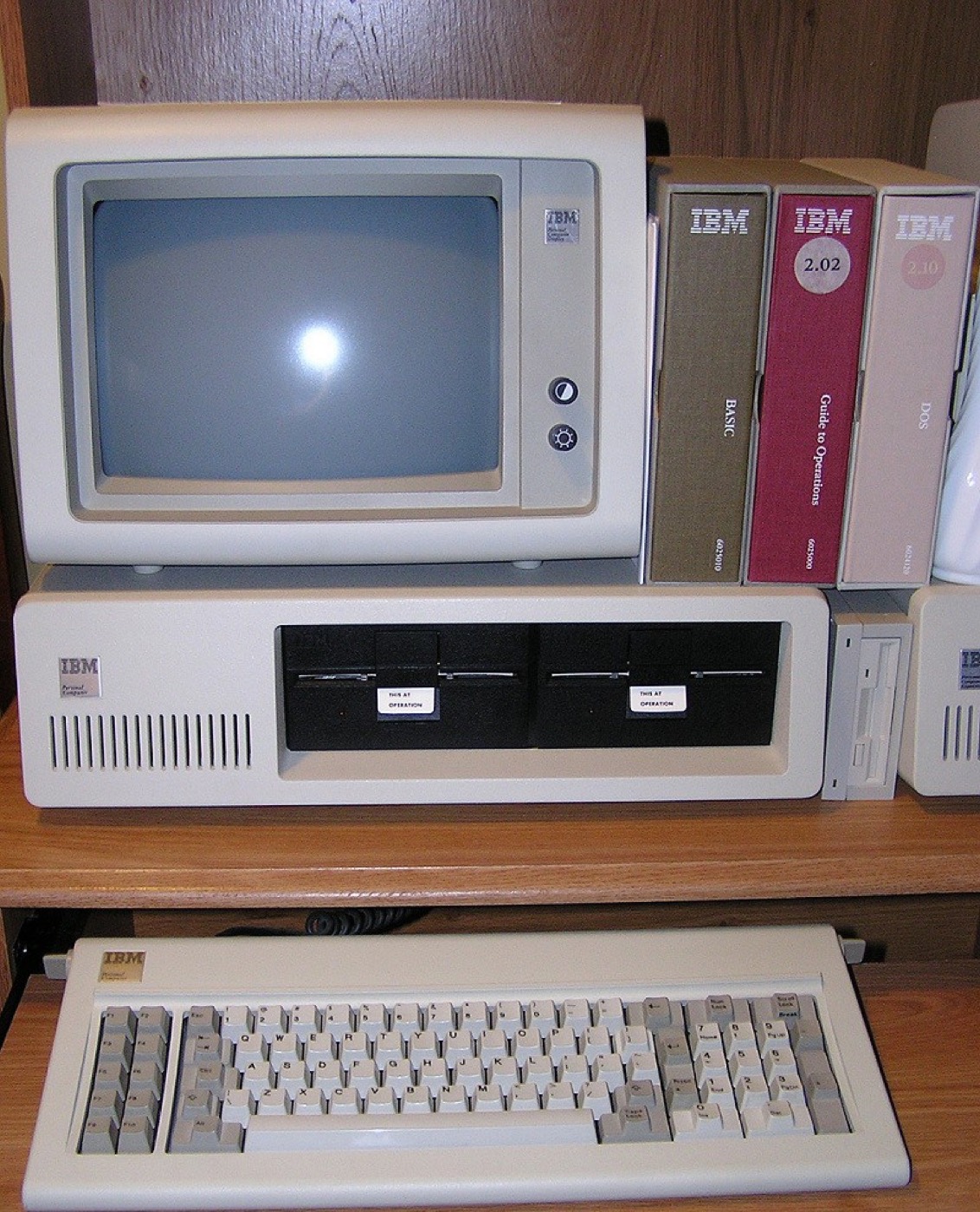
On the twelfth of August, nineteen eighty-one, IBM launched its Personal Computer. After everything that had happened over the previous year, Digital Research's operating system was still part of the story - just not the main part.
This is the IBM Personal Computer as it actually shipped: the system unit, keyboard and monochrome display sold as a package to businesses and, increasingly, to homes.
IBM offered buyers a choice of operating systems for the new machine. PC-DOS, Microsoft's system, cost forty dollars. CP/M-86, a Digital Research product, cost two hundred and forty dollars - six times as much. Buyers overwhelmingly chose the cheaper option.
There was a reason for that price gap, and it had nothing to do with which system worked better.
11. CP/M-86 arrives too late
Digital Research had not simply lost on price. It had also lost on time, in a way the pricing alone does not explain.
Digital Research released CP/M-86 in November nineteen eighty-one, three months after the IBM PC had already launched. The specific version built to run on IBM's own machine did not arrive until April nineteen eighty-two - eight months after PC-DOS had been shipping as the PC's standard operating system, bundled with every machine IBM sold.
By the time a buyer could actually choose CP/M-86 on an IBM PC, almost every one of those machines already had PC-DOS installed and working.
An eight-month head start, on the operating system every new IBM PC buyer already owned, was not a gap CP/M-86's later arrival could close - whatever its price had been.
12. Why Digital Research lost

None of this came down to one bad decision. It came down to several, stacked on top of each other, each one making the next harder to recover from.
Trace the chain through. An NDA dispute at a single meeting sent IBM to Microsoft instead of Digital Research. Microsoft's purchase of 86-DOS gave IBM an operating system modelled closely on CP/M, without Digital Research's involvement at all. IBM then priced that system at a sixth of CP/M-86's cost. And Digital Research's own version of CP/M-86 for the IBM PC did not even exist until eight months after the PC shipped.
Each link alone might have been survivable. A missed meeting, a late product, a high price - any one of those happens to companies that recover. Together, in sequence, on the one machine that would define the next decade of personal computing, they were not survivable.
By the mid-nineteen eighties, MS-DOS had become the personal computer industry's standard operating system, in the position CP/M had once held on 8-bit machines. The company that had spent the previous decade building that position, machine by machine, meeting by meeting, had lost it to the one rival that had simply been willing to show up on time with something cheap enough to ship.
Sources and credits
Photo credits (Wikimedia Commons)
- Gary A. Kildall historical plaque, 801 Lighthouse Avenue, Pacific Grove, California - site of Digital Research's origin: Piotr J. Flatau, Public domain - https://commons.wikimedia.org/wiki/File%3AKildall_801lighthouse.jpg
- Adam Osborne posing with the Osborne 1, Oakland Tribune press photo, April 1981: Bill Crouch (-1998), Public domain - https://commons.wikimedia.org/wiki/File%3AAdam_Osborne_and_Osborne_1.jpg
- IBM 5150 Personal Computer with IBM 5151 monochrome display and keyboard: Vintageibmmt, Public domain - https://commons.wikimedia.org/wiki/File%3AIBM_5150_PC.JPG
- Period 8-inch and 5.25-inch floppy disk drives (Qume, Tandon), early 1980s: Swtpc6800 en:User:Swtpc6800 Michael Holley, Public domain - https://commons.wikimedia.org/wiki/File%3AFloppy_Disk_Drives_8_5_3.jpg


Primary sources
- ETHW, 'Milestones: The CP/M Microcomputer Operating System, 1974' () - fall 1974 demonstration, Pacific Grove backyard workshop, John Torode, Intel 8080.
- Wikipedia, 'Digital Research' and 'Dorothy McEwen Kildall' () - 1974 incorporation, co-founded by Gary and Dorothy Kildall.
- Wikipedia, 'Osborne 1' () - shipped 3 April 1981, Z80, CP/M, $1,795 launch price.
- dfarq.homeip.net, 'Kaypro II launched May 20, 1982' ().
- Wikipedia, 'WordStar' and 'dBASE' () - CP/M releases, 1978 and 1980.
- Wikipedia, 'Intel 8086' and 'Intel 8088' () - 1978 and 1979 releases.
- Wikipedia, 'Gary Kildall' () - Project Chess, the IBM approach, the 22 August 1980 meeting.
- IEEE Spectrum, Bob Zeidman, 'Did Bill Gates Steal the Heart of DOS?', 31 July 2012 () - the disputed Kildall-whereabouts story, Jack Sams's account.
- Wikipedia, 'Tim Paterson' and '86-DOS' () - QDOS begun April 1980 at Seattle Computer Products, modelled on CP/M's published interface; Microsoft's December 1980 $25,000 license and 27 July 1981 $50,000 outright purchase.
- Windows Central, 'Microsoft bought MS-DOS... July 27, 1981' () - corroborating the purchase date and figure.
- The Register, 'The IBM PC on 12 August 1981' () - launch date, PC-DOS $40 vs CP/M-86 $240.
- Wikipedia, 'CP/M-86' () - CP/M-86 released November 1981; IBM PC version available April 1982.
Not regulated financial advice.