
Industrial Heat Pumps: Can Factories Stop Burning Gas?
A dairy's chillers reject heat all day. Elsewhere in the same building, a gas burner heats wash water. Those two streams rarely meet - and the gap between them is where industrial heat pumps are being pitched.
This video explains how a heat pump upgrades waste heat using electricity-driven compression (evaporator, compressor, condenser, expansion valve), illustrated with an energy balance where two units of recovered heat plus one unit of electricity deliver three units of useful heat - a coefficient of performance of three. It traces the idea back to Peter von Rittinger's 1853 patent and 1856-57 prototype at the Ebensee saltworks in Austria, long before it could be built at factory scale.
Then the hard limit: temperature. A smaller lift from a warmer source performs far better than a large one, and steam's own pressure-temperature link adds a further constraint. That puts real industrial jobs - food washing and pasteurisation, paper drying, chemical hot-water and steam duties - inside reach, while high-temperature furnaces for steel and cement stay firmly out of scope.
Two real, dated projects anchor the second half. On 15 September 2026, Johnson Controls launched its Sabroe HitemHP line, advertising output up to 122C and a site-specific saving of over 91% that this video reads carefully rather than generalising. At BASF's Ludwigshafen site in Germany, a heat pump under construction will turn steamcracker cooling water into steam for formic acid production, with commissioning planned for mid-2027.
Finally the economics: why a heat pump at COP 3 can still cost more to run than a gas boiler, depending entirely on the price of electricity against the price of gas - illustrated with worked, labelled figures, not real plant data - and the retrofit costs (capital, grid connection, storage, backup, refrigerant safety, electricity's own carbon) that sit beyond the compressor. The verdict: suitable heat duties can switch today where source, temperature and economics line up; whole-site gas elimination is a longer story.
Educational documentary. Not financial or investment advice.
In these topics
Chapters
- The factory throwing heat away
- An industrial idea from the saltworks
- How electricity upgrades waste heat
- Close the factory heat loop
- Temperature lift is the hard part
- Which industrial jobs fit?
- The September 2026 equipment launch
- From steamcracker cooling to useful steam
- Three times efficient can still cost more
- The retrofit beyond the compressor
- Can factories stop burning gas?
Video notes
1. The factory throwing heat away
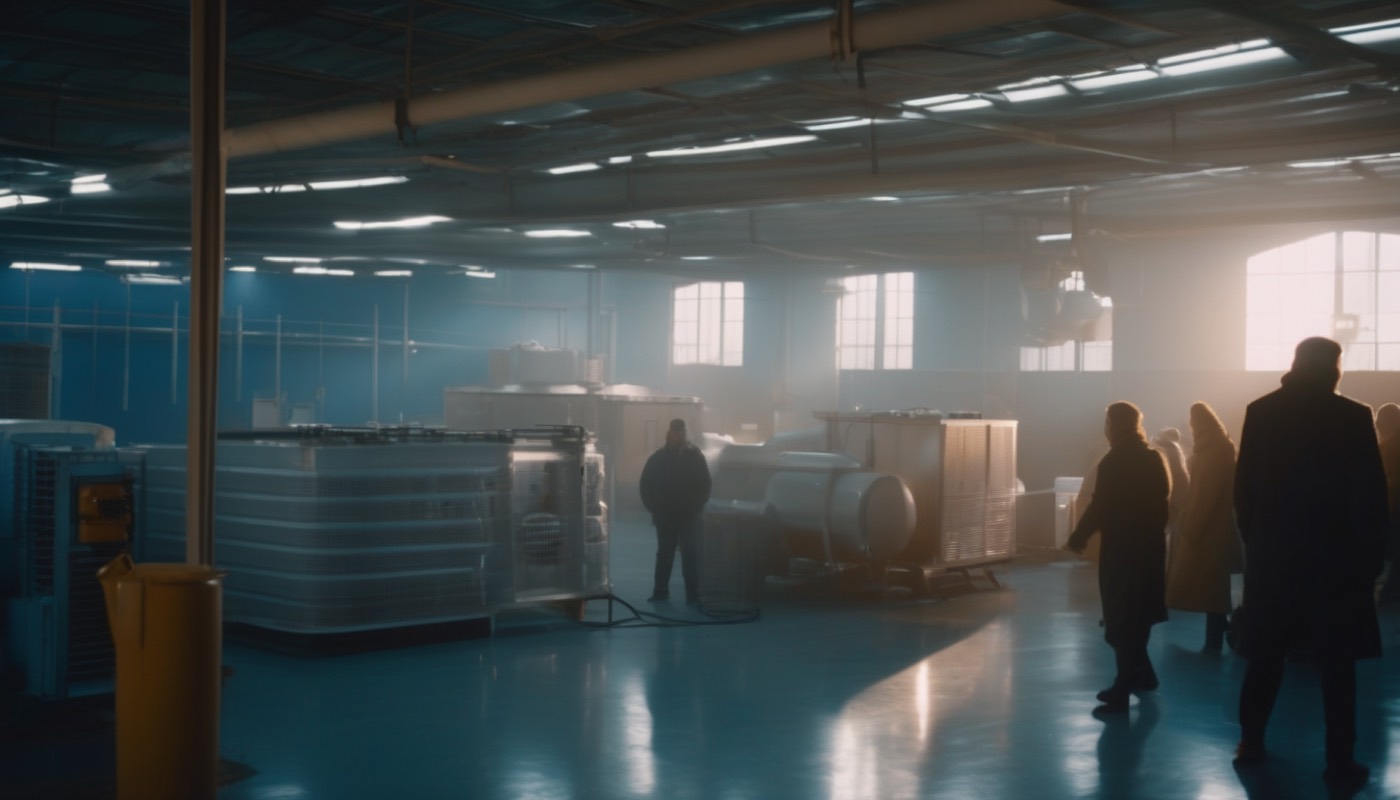
Picture an ordinary dairy. Milk is chilled all day, and the chillers that do it have to dump the heat they pull out somewhere. At the same time, elsewhere in the same building, water is heated with a gas burner so tanks and pipework can be washed down.
This is not a named factory. Call it an illustrative dairy — a stand-in for a pattern many food and drink plants share, not a report on one real site.
One stream of heat is thrown away. Another stream of heat is bought and burned. The question this video asks is whether the heat going to waste could be the same heat the gas is paying to make.
Refrigeration rejects heat to keep milk cold. Wash water needs heat to clean tanks and pipework. In most dairies today, those two streams never meet.
That gap, between heat rejected and heat bought, is where industrial heat pumps are being pitched. Over the next eighteen minutes, this video traces one illustrative example of a plant closing that gap, works out what the physics allows, and asks what has actually been built.
The route ahead: how a heat pump upgrades waste heat, and how the dairy closes its own loop. Then temperature, the hard limit, and which industrial jobs actually fit. A September 2026 product launch, a real steam project in Germany, and a verdict on the economics.
2. An industrial idea from the saltworks
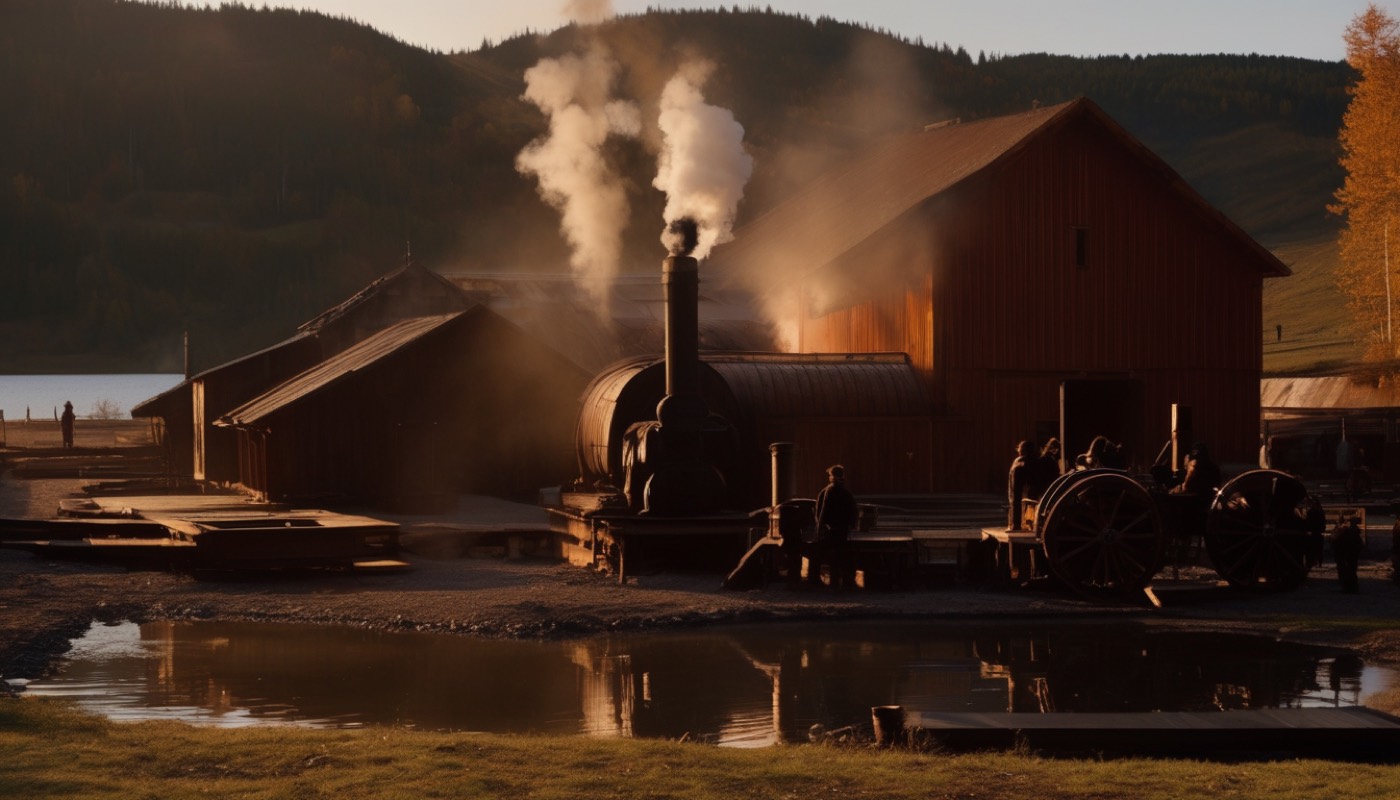
The idea of using mechanical work to move heat uphill is not new. It is over a century and a half old, and it began in a saltworks, not a laboratory.
The saltworks was at Ebensee, Austria, not far from Salzburg, where the earliest known industrial use of this idea was built.
Peter von Rittinger worked out the principle there, and the dates are what anchor this chapter.
Rittinger patented his heat-pump principle in 1853, for evaporating brine. He built and started a prototype at Ebensee, going into operation in 1856 and 1857.
Rittinger's machine was not a dairy heat pump, and it did not win the saltworks a quick commercial victory. What it proved was the principle underneath everything that follows: that compressing a vapour can push heat from somewhere cooler to somewhere hotter, using far less energy than burning fuel for the same job.
This video does not claim Rittinger's prototype was a commercially mature machine. It claims only that the patent and the prototype happened, in 1853 and in 1856 to 1857, at Ebensee.
That is the idea modern industrial heat pumps still use. What has changed since Rittinger's day is the hardware: compressors, refrigerants and controls good enough to do this at factory scale, and reliably enough for a plant manager to trust.
3. How electricity upgrades waste heat
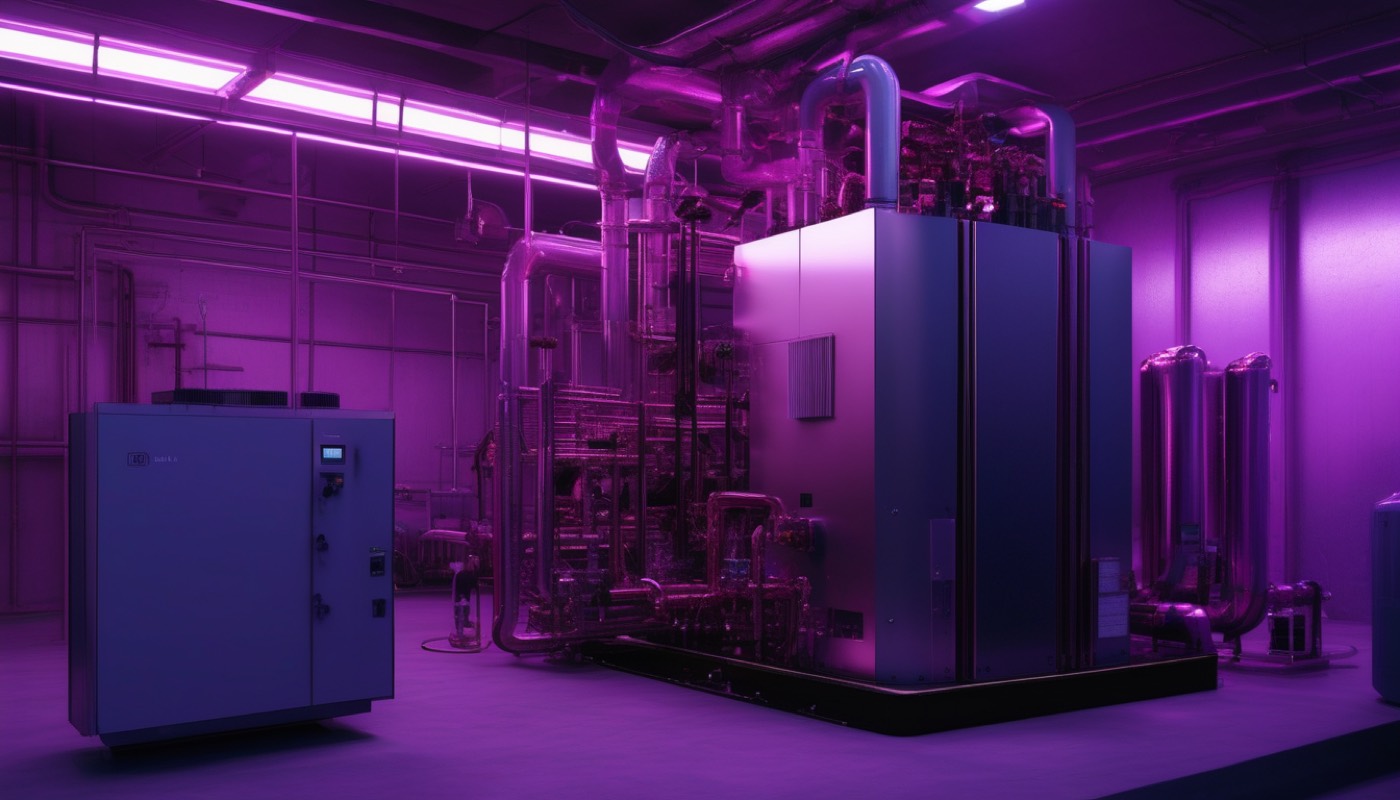
So how does a heat pump actually turn rejected heat into something useful? Four steps, repeated continuously.
A liquid refrigerant evaporates by absorbing the waste heat, turning to vapour. A compressor squeezes that vapour, which raises its pressure and its temperature. The hot vapour then condenses, giving up its heat to water or steam, and an expansion valve drops the pressure again, ready to absorb more waste heat.
That compression step is where electricity does its work, and it is also the reason the output is hotter than the waste heat that went in.
Here is the balance, as an illustration calculated on 6 October 2026. Two units of recovered waste heat combine with one unit of electrical work. Together, they deliver three units of useful heat.
That ratio — three units of heat out for one unit of electricity in — is called the coefficient of performance, or COP. This energy balance leaves out the real losses a working plant has; it is not a guarantee of what any specific machine will hit.
A heat pump is not creating energy from nothing. It is using a small amount of electrical work to move a much larger amount of heat from where it is unwanted to where it is wanted.
4. Close the factory heat loop
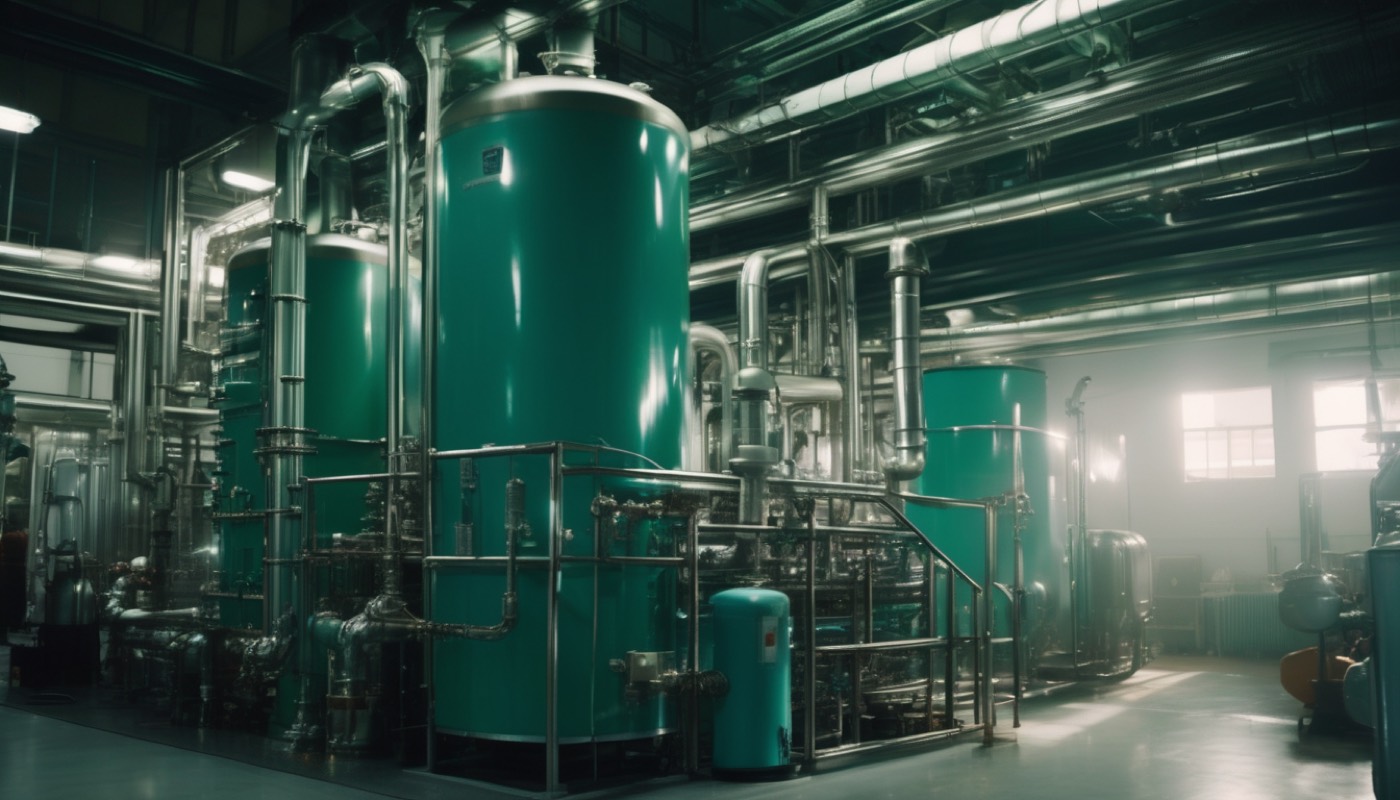
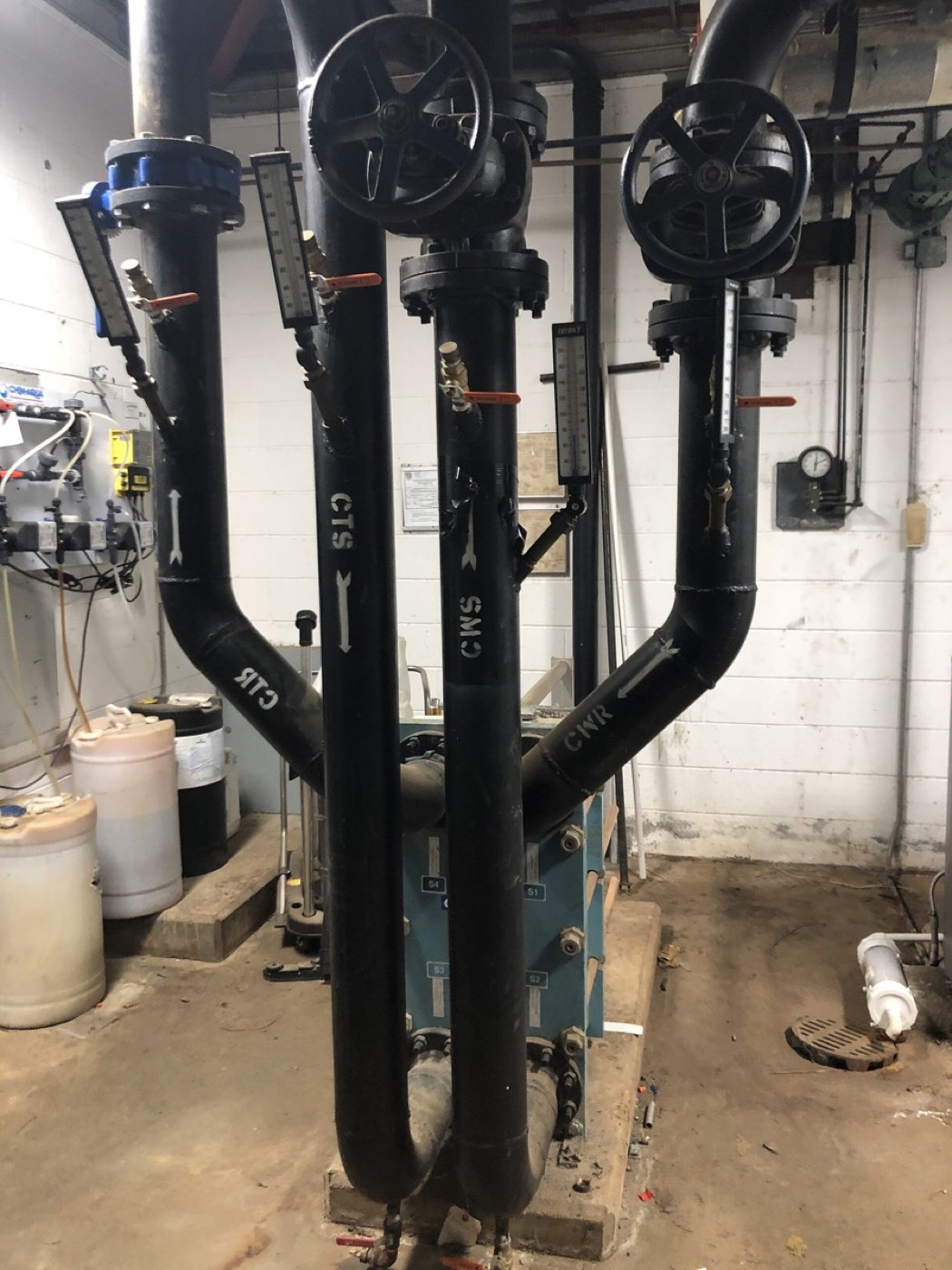
Back to the illustrative dairy, now that the mechanism is on the table. Before adding any machine at all, the sensible first move is to check whether the waste heat can be used directly.
Warm water leaving the chillers passes through isolated heat exchangers — sealed units that let heat cross from one water circuit to another without the two streams mixing. If that is hot enough for the wash water on its own, no heat pump is needed yet.
Direct heat recovery like this is cheap, because it has no compressor and no electricity bill of its own. It only works, though, when the waste stream is already hotter than the water it needs to warm.
This is a real water-source heat-pump shell-and-tube heat exchanger, the kind of hardware that does this job. Warm water runs through one side, process water through the other, kept apart by a wall of tubes.
Where direct exchange falls short of the temperature the wash water needs, that is precisely the gap a heat pump is built to close — lifting the recovered heat the rest of the way, instead of reaching for the gas burner.
So the loop runs: rejected heat into a heat exchanger, topped up by a heat pump where needed, and out as clean hot water for washing. The gas boiler becomes a backup, not the main supply.
5. Temperature lift is the hard part
Not every waste-heat stream is equally useful, and the reason is temperature lift — the gap between the heat source and the heat a process actually needs.
A smaller lift, from a warmer starting point, lets a heat pump work more efficiently. Lifting a 40°C source up to 80°C is one job. Lifting that same 40°C source all the way to 140°C is a much harder one.
As the lift grows, the compressor works harder for each unit of heat delivered, so performance falls away. That decline is real but it is qualitative here: this video does not plot an unsupported COP curve, because no single curve applies to every machine and every refrigerant.
Industry doesn't need one temperature. It needs a ladder: low-temperature hot water, higher-temperature steam, and — above both — furnace heat, which is a different problem entirely.
Steam adds a complication of its own. Steam temperature is tied to its pressure, so reaching a given steam temperature means reaching the matching pressure too, and exchangers have to carry enough heat-transfer margin to actually hit that target reliably, not just on paper.
Steam pressure and steam temperature move together. Heat-transfer margin — extra capacity built into an exchanger beyond the bare minimum — is what lets a real plant hit its target consistently.
So two things decide whether a heat pump fits a given job: how warm the waste heat already is, and how far it still has to be lifted. Everything in the next two chapters follows from that.
6. Which industrial jobs fit?
Put that temperature ladder next to real industrial jobs, and a pattern appears immediately.
Four kinds of industrial heat demand, roughly in order of how hard they are to reach: food washing and pasteurisation, paper drying, chemical hot-water and steam duties, and high-temperature furnaces.
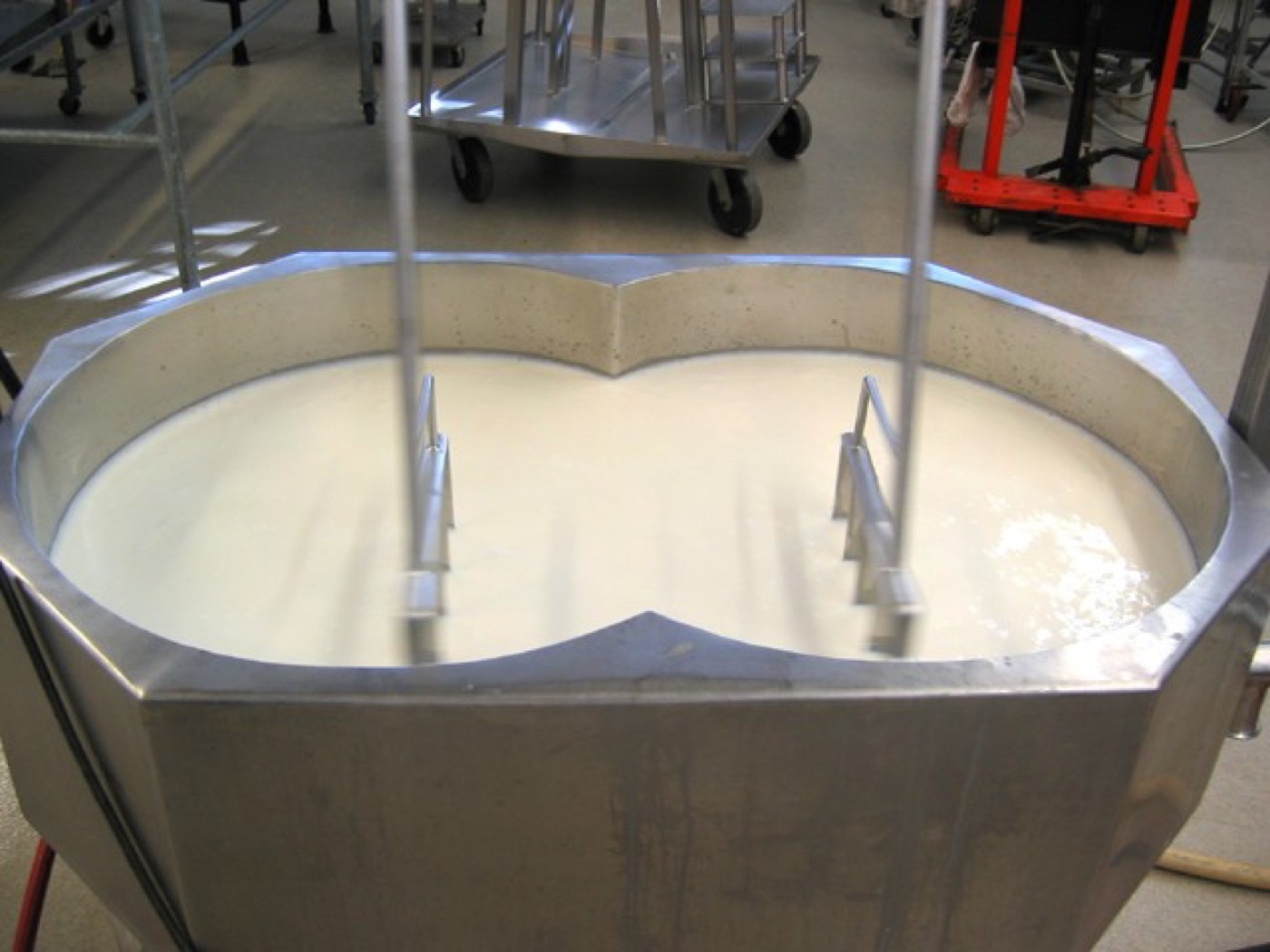
Food washing and pasteurisation mostly need hot water or low-pressure steam, often well under 100°C. That sits squarely inside what a heat pump can lift to today.
This is a pasteurisation vat, heating milk to a set temperature and holding it there — exactly the kind of hot-water duty a heat pump suits well.
Paper drying needs higher-temperature steam, and chemical plants run a mix of hot-water and steam duties depending on the process. Those sit further up the ladder, but inside reach for the newest high-temperature machines.
Chemical plants rarely run one duty. The same site can need low-temperature hot water for one process and higher-pressure steam for another, so a heat pump project there is sized duty by duty, not plant by plant.
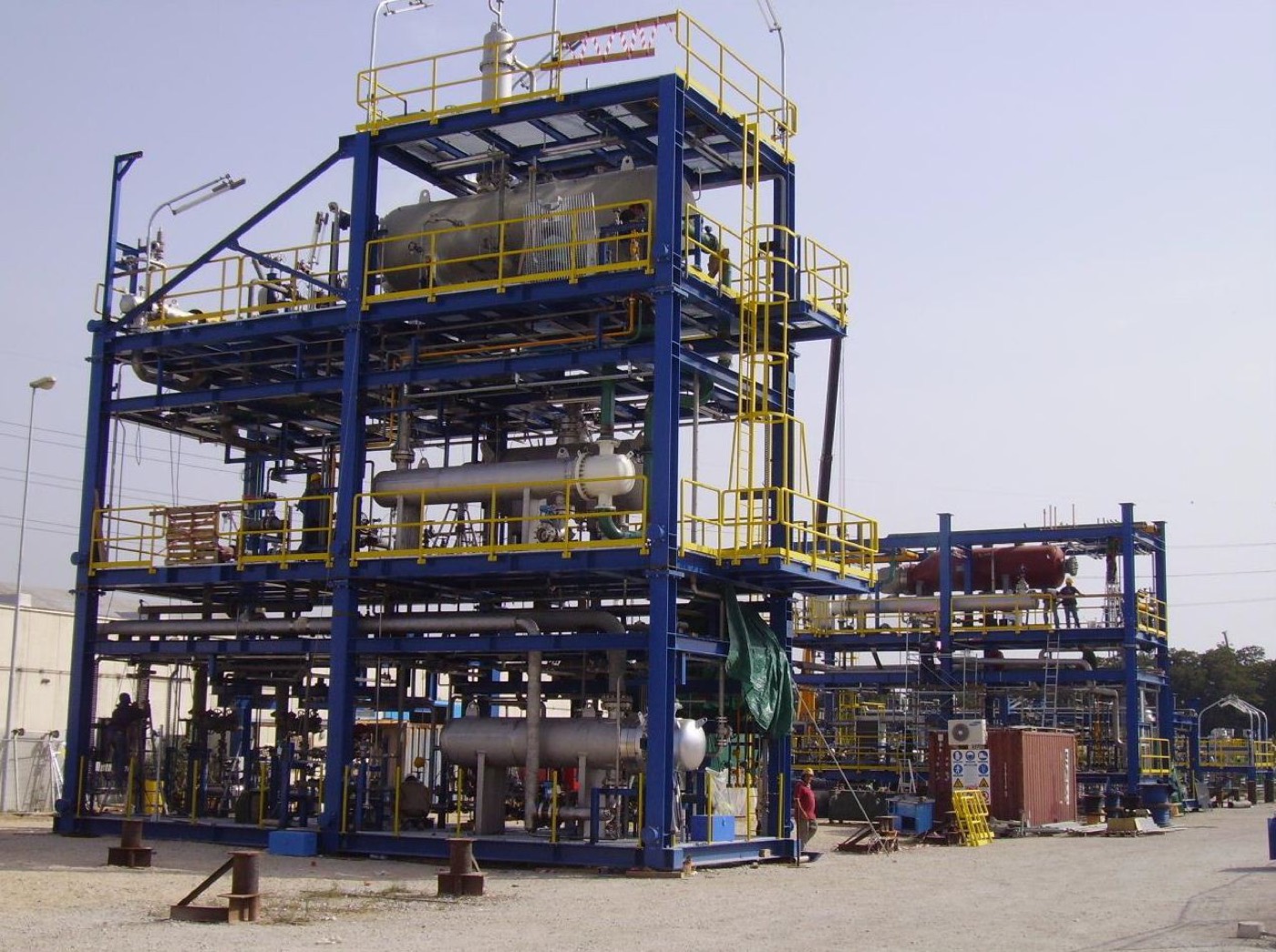
This is modular chemical plant pipework under construction — the kind of hot-water and steam infrastructure a heat pump can be plumbed into, once the temperature and pressure are known.
High-temperature furnaces are a different category altogether. Steelmaking and cement kilns need temperatures no heat-pump refrigerant cycle reaches, and they need other routes off gas entirely.
This video draws a line here. Furnace heat sits outside the scope of what a heat pump does — confusing the two oversells a technology on jobs it was never built for.
7. The September 2026 equipment launch

On 15 September 2026, Johnson Controls launched a new industrial heat-pump line for Europe, called Sabroe HitemHP, built at its Holme site in Denmark.
Sabroe HitemHP is advertised to deliver output up to 122°C, using low-impact refrigerants — butane and isobutane — rather than the high-warming gases older machines often use.
That is a real product, with a real published temperature. It sits well inside the ladder from chapter five — closer to steam than hot water, but nowhere near furnace heat.
This heat-pump line is built at Holme, near Aarhus in Denmark, for European process-heat customers in pharmaceuticals, food and beverage, and manufacturing.
The launch also carries a striking savings number, and it needs reading carefully. Johnson Controls advertises reducing energy costs by more than ninety-one per cent.
That saving describes one specific customer's refrigeration-waste-heat application — its own waste-heat temperature, its own electricity price, its own gas price. It is not a promise for replacing a gas boiler at any factory.
A single site's result is not a rate every factory should expect, which is why chapter nine works through the economics on its own illustrative numbers rather than a manufacturer's example.
Readiness varies by temperature. Below about 120°C, heat pumps like this are commercially established. Below about 160°C, they are increasingly commercial. Above that, the technology — including the 200°C systems some projects are now demonstrating — is still at the development stage.
So the honest framing of this launch is a real commercial product, at a temperature that matters for a meaningful slice of industry, carrying a manufacturer's own savings claim that applies to one case rather than a universal rule.
8. From steamcracker cooling to useful steam
The clearest real project behind this video's claims is not a dairy at all. It is a chemical plant on the Rhine, at BASF's Ludwigshafen site in Germany.
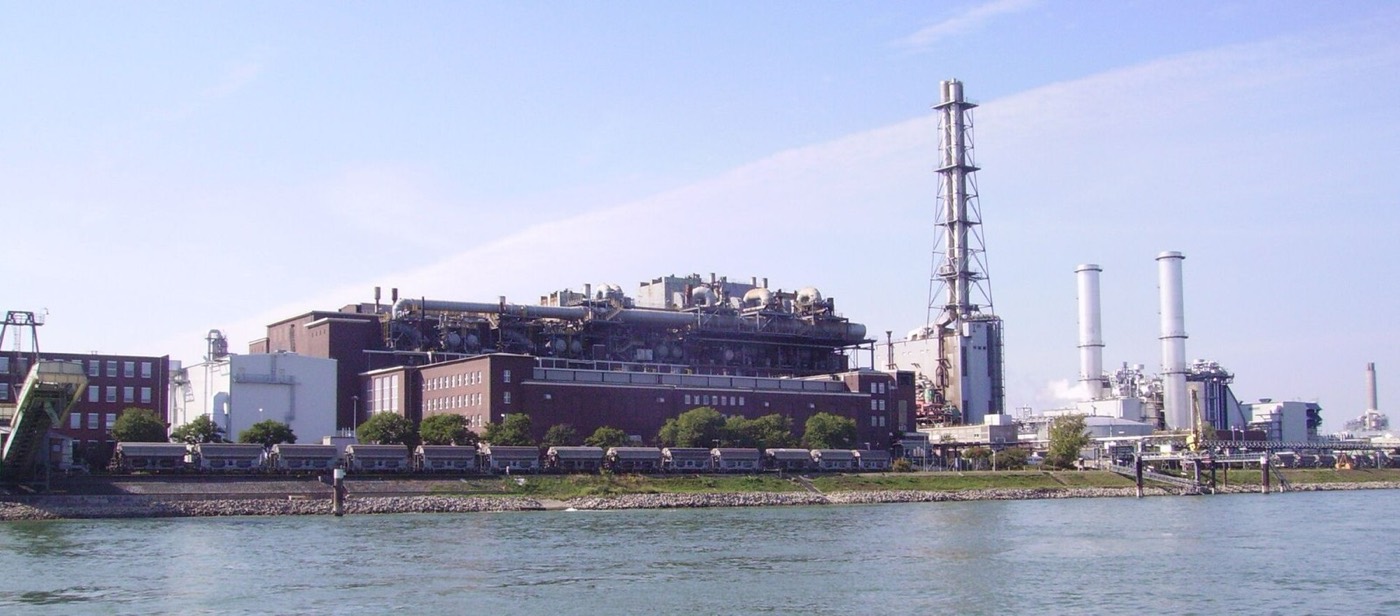
BASF's Ludwigshafen site sits on the Rhine opposite Mannheim — one of the largest integrated chemical complexes in Europe, and the location of the heat-pump project this chapter follows.
A steamcracker there produces ethylene and other chemicals, and its cooling water carries away a huge amount of waste heat, much like the dairy's chillers do on a vastly larger scale.
This is BASF's Ludwigshafen site on the Rhine, photographed in 2008 — location context only, not the 2026 heat-pump construction itself.
On 8 April 2026, BASF reported that a core component of the heat pump, a ninety-five tonne evaporator, had arrived on site.
Cooling water from one of the site's steamcrackers feeds the heat pump. Electricity drives the compression. The heat pump then delivers steam into the plant's steam network, which supplies formic acid production — a chemical used in animal feed, leather and textile processing.
That steam replaces fuel the site would otherwise burn to make it, which is the same substitution this whole video has been asking about — just at industrial scale, with a named company and a named date.
Construction progress in 2026 is a fact. Commissioning is a plan: BASF expects the heat pump running by the middle of 2027, not before.
BASF's own specifications: around 50 megawatts of thermal output, and up to 500,000 tonnes of steam a year. BASF also estimates up to 100,000 tonnes of CO2 avoided a year, a figure that depends on using renewable electricity.
9. Three times efficient can still cost more

A heat pump at COP three sounds like an easy win over a gas boiler. The truth depends on something the physics alone can't tell you: price.
This is an illustration calculated on 6 October 2026, not measured data from a real plant. A heat pump's running cost is the electricity price divided by its COP. A gas boiler's cost is the gas price divided by its efficiency.
Take a heat pump at COP three, against a boiler running at ninety per cent efficiency.
At COP three and ninety per cent boiler efficiency, the two running costs match only when electricity costs three point three three times as much as gas, unit for unit. That ratio is the whole hinge this chapter turns on.
Now put realistic prices against that ratio, still as illustration rather than any one plant's actual bill. Gas at forty pounds per megawatt-hour works out more expensive once the boiler's own losses are counted.
Gas at £40 per megawatt-hour of purchased energy costs £44.44 per megawatt-hour of useful heat, at ninety per cent boiler efficiency. Electricity at £100 per megawatt-hour, through a COP of three, costs only £33.33 — cheaper than that gas figure.
A price ratio under three point three three favoured the heat pump here. Raise the electricity price only a little, and the result flips entirely.
A small change in price, not in the machine, decides the winner. The heat pump did not get less efficient; the electricity simply got more expensive relative to gas.
Electricity at £160 per megawatt-hour, at the same COP, costs £53.33 per megawatt-hour of useful heat. That is now more expensive than the £44.44 gas figure from the earlier card.
Three times efficient did not mean three times cheaper, because the price of the two fuels was never fixed at three to one. Whether a heat pump saves money is a question about electricity and gas markets, not only about the machine.
10. The retrofit beyond the compressor
Buying a heat pump is the easy part of this decision. Fitting one into a real factory is where most of the actual cost and risk sits.
Beyond the machine itself sit several real costs: capital, and a strong enough grid connection. How many hours a day the plant runs matters, and so does whether the waste-heat source stays steady. Storage covers the gaps, and a backup boiler covers the rest. Refrigerant safety and the carbon content of the electricity supply round out the list.
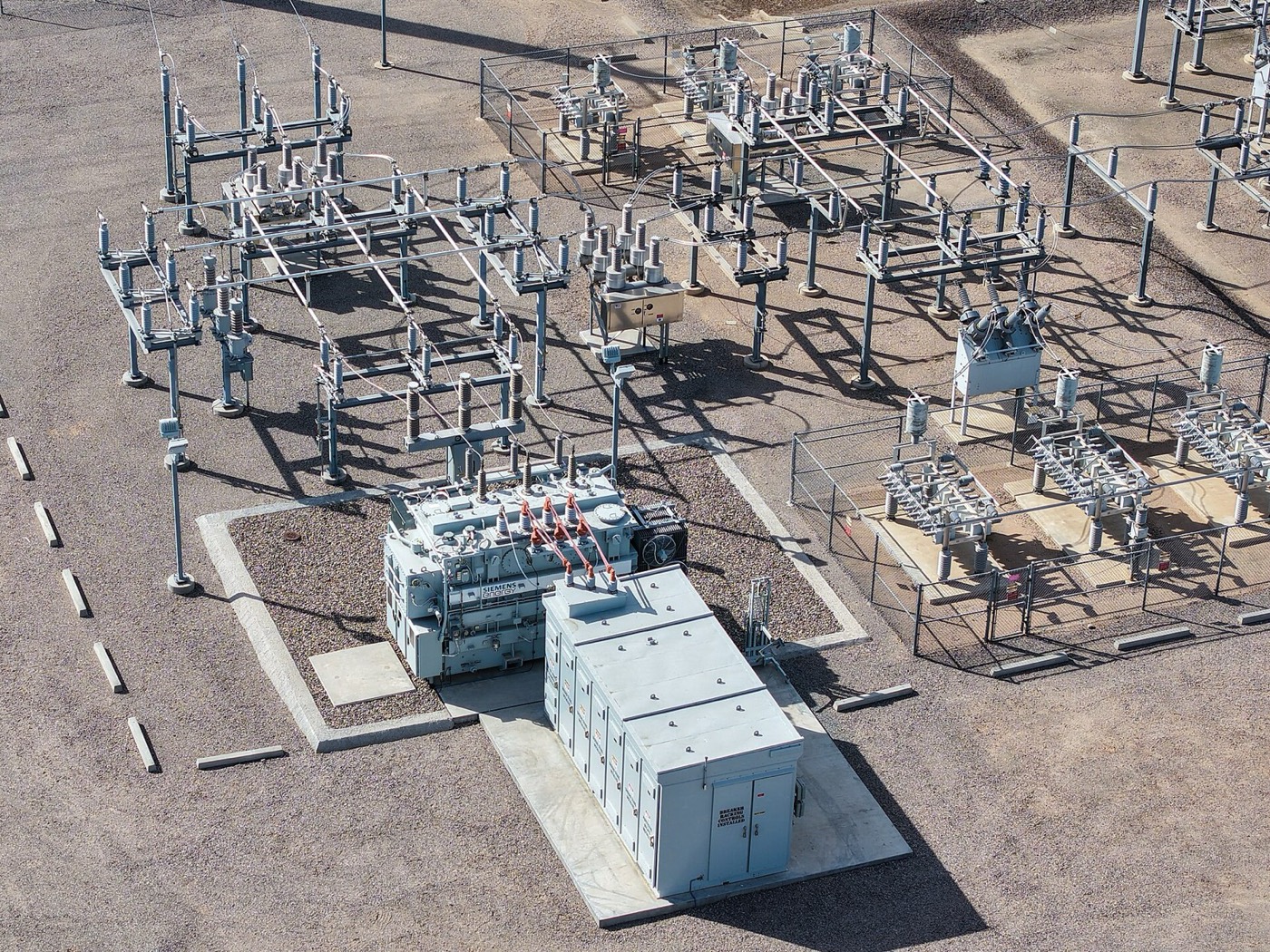
Grid connection matters because a heat pump this size draws real power, and in many places a new connection means a queue, not a quick upgrade.
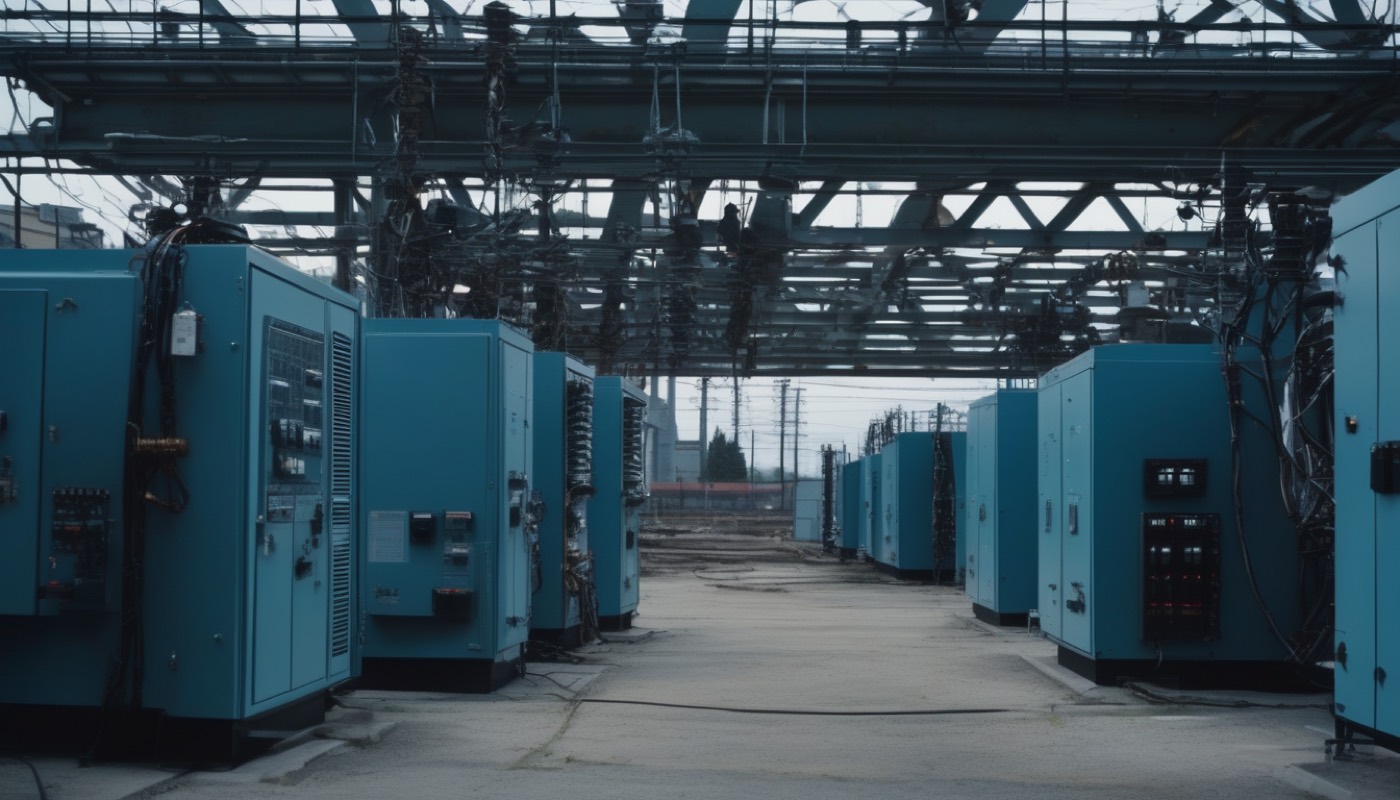
This is a distribution substation — the kind of grid infrastructure a factory may need strengthened or newly connected before a large heat pump can run.
None of that shows up in the simple energy-cost comparison from chapter nine, and all of it affects whether a project actually goes ahead.
A heat pump burns no fuel on site, but that is not the same as zero emissions. The electricity it draws carries the carbon of the grid that made it, and a leaking refrigerant can itself be a potent greenhouse gas.
So the decision a factory actually faces is not whether this heat pump is efficient. It is whether the whole retrofit — capital, grid, storage, backup and safety included — pays back faster than simply carrying on with gas.
11. Can factories stop burning gas?
Back to the illustrative dairy that opened this video. Its wash water no longer depends only on a gas burner. Rejected heat from refrigeration, recovered directly where it is hot enough and lifted the rest of the way by a heat pump, now does the job that gas used to do alone.
Before any factory makes that switch, five questions need an honest answer. What is the waste-heat source, and what temperature does the job actually need? What COP has been measured, rather than advertised? What do electricity and gas actually cost there, and can the whole thing be integrated reliably?
Where the answers line up, a heat pump can replace the fuel a process burns today. That means a warm enough source, a modest enough lift, and electricity that is not too expensive against gas. The Johnson Controls launch and the BASF project in chapter eight show this is no longer only a laboratory idea.
This video's verdict: forwards, for the heat duties where source, temperature and economics line up. Not yet forwards for whole-site gas elimination, because furnace heat and the hardest duties still need routes a heat pump does not provide.
Suitable jobs can switch, one duty at a time. Stopping a factory burning gas entirely is a longer project, and it runs through every process a heat pump still cannot reach.
Sources and credits
Photo credits (Wikimedia Commons)
- Milk undergoing pasteurisation in a cheese vat; illustrative process, not the unnamed European dairy: James.folsom at English Wikipedia, Public domain - https://commons.wikimedia.org/wiki/File%3AMilk_Vat.jpg
- Water-source heat-pump shell-and-tube heat exchanger pipework, photographed 5 April 2021; illustrative isolated circuit: Ivangiesen, CC0 - https://commons.wikimedia.org/wiki/File%3AShell_and_Tube_Heat_Exchanger_Piping_1.jpg
- Modular chemical plant pipework under construction, photographed 26 December 2012; illustrative process equipment: LNCSRG, CC0 - https://commons.wikimedia.org/wiki/File%3AMod_chem_plant.jpg
- BASF Ludwigshafen Rhine-side chemical plant, September 2008; location context only, not 2026 construction: Immanuel Giel, Public domain - https://commons.wikimedia.org/wiki/File%3ABASF_am_Rhein_03.jpg
- Distribution substation switchgear, photographed 14 March 2026; illustrative grid infrastructure: Rsparks3, CC0 - https://commons.wikimedia.org/wiki/File%3ADistribution_substation_switchgear.jpg


Primary sources
- Waermepumpe Austria, '165 Jahre Waermepumpe - eine oesterreichische Erfolgsgeschichte' (undated); re- - Rittinger's 1853 patent and 1856-57 Ebensee prototype. Not presented as a commercial success.
- IEA, 'The Future of Heat Pumps', 'How a heat pump works', 2022 - the compressor-driven mechanism and the basis for the 2+1=3 COP illustration (calculated 6 Oct 2026).
- IEA HPT TCP, Annex 58 Task 2: Integration Concepts (HPT-AN58-3), 25 Apr 2024 - 12 industrial systems, 27 integration points; hot water, steam and large-glide duties need distinct designs.
- IEA, 'Renewables for Industry', executive summary, 2025 - large heat pumps up to 150C as established; price ratios and grid lead times restricting deployment.
- IEA, 'Heat Pump Monitor 2026', key findings, 2026 - readiness bands below 120C (commercial), below 160C (entering commercial) and up to 200C (development); lifetime-economics factors.
- Danish Technological Institute, 'European experts: High-temperature heat pumps are the future of process heating', 2 Mar 2026 - 200C systems framed as development and demonstration.
- Johnson Controls, 'Johnson Controls electrifies energy-intensive industries with new heat pumps...', 15 Sep 2026 - Sabroe HitemHP, 122C, butane/isobutane, Holme Denmark, >91% one-site saving.
- BASF, press release P-26-068, 8 Apr 2026 - 95-tonne evaporator delivered, ~50 MW thermal, up to 500,000 t steam/yr, mid-2027 commissioning, up to 100,000 t CO2/yr avoided (BASF's own estimate).
Not regulated financial advice.