
Small Nuclear Reactors: Can Fission Make a Comeback?
In 2026 nuclear power is making a different kind of news. On 13 April the UK signed a contract for three Rolls-Royce small modular reactors at Wylfa, on Anglesey. Ten days later TerraPower began building its Natrium reactor at Kemmerer, Wyoming. And Three Mile Island's undamaged Unit 1 is being restarted as the Crane Clean Energy Center, with Microsoft buying its power.
This video explains how a fission reactor turns splitting atoms into electricity, and why the West almost stopped building them: the boom that began at Calder Hall in 1956, and the accidents at Three Mile Island (1979), Chernobyl (1986) and Fukushima (2011). It shows why big reactors became so expensive, with Vogtle, Flamanville and Hinkley Point C, now estimated by EDF at £35bn in 2015 prices with Unit 1 in 2030.
Small reactors could fix some of nuclear's problems, but not waste, fuel supply or the cost of the first of a kind. The video ends with the dates to watch to 2030. Photos are public domain, credited on screen.
Educational documentary. Not financial or investment advice.
In these topics
Chapters
- Why fission is back in the news
- How a reactor makes electricity
- The atomic age boom
- Three accidents
- Why big nuclear got so expensive
- Hinkley Point C
- The small modular idea
- The designs racing to be first
- The first warning: NuScale in Utah
- The builds now under way
- AI data centres as customers
- Forwards or backwards?
Video notes
1. Why fission is back in the news
For most of the last forty years, nuclear power made the news in the West for two reasons: an accident, or a closure. In twenty twenty-six, it started making news for a different reason. New reactors are being ordered, and some are being built.
Three places tell the story. At Wylfa, on the island of Anglesey in north Wales, the British government's nuclear company signed a contract in April for three reactors from Rolls-Royce. At Kemmerer, in Wyoming, TerraPower began building a new kind of reactor ten days later. And in Pennsylvania, a reactor at Three Mile Island is being brought back into service, with Microsoft buying its power.
Here is how big each one is. A megawatt is a million watts, and a gigawatt is a thousand megawatts, about the output of one large power station. The three Wylfa reactors together are meant to make at least one point four gigawatts. The Wyoming reactor is rated at three hundred and forty-five megawatts. The Pennsylvania restart is eight hundred and thirty-five.
Three Mile Island is not a name anyone in the industry chose lightly. It is where America's most serious commercial nuclear accident happened, in nineteen seventy-nine. That a tech company now wants power from the same site says something about how much has changed.
Most of the new projects share one idea: the small modular reactor, or SMR for short. Instead of one giant power station designed and built on site, the reactor is made small enough to be built largely in a factory. It is shipped in pieces, bolted together, and built again and again to the same design.
And the orders keep coming. On the twenty-second of September, GE Vernova, Hitachi and Samsung signed an agreement with the Polish firm Synthos Green Energy. The aim is to roll out one small reactor design across Central and Eastern Europe and the United Kingdom.
This video asks one question. After decades in which the West built very few reactors, is building them again a step forwards, towards clean electricity that runs day and night? Or is it a step back, to a technology whose costs and risks never went away? To answer it, we need to know what a reactor is, why the building stopped, why it got so expensive, and what the small reactors really change.
2. How a reactor makes electricity
Strip away the concrete, the fences and the control rooms, and a nuclear power station is a very large kettle attached to a generator. The nuclear part is only the way the water is heated.
It starts with uranium. Most uranium atoms are a kind called uranium two-three-eight, which is hard to split. About seven atoms in every thousand are a lighter kind, uranium two-three-five, which splits easily. Fuel for most reactors is enriched: that share is raised about five to seven times, so the fuel holds more of the atoms that split.
The splitting is called fission. A neutron, a tiny particle with no electric charge, strikes a uranium two-three-five atom. The atom breaks into two smaller atoms, and the pieces fly apart with enormous energy. It also throws out two or three fresh neutrons, and each of those can go on to split another atom.
That is the chain reaction. One split causes more splits, and those cause more again. Left alone, the numbers would climb very fast. The whole art of running a reactor is to hold that chain steady, so that each split causes, on average, exactly one more.
Two things do that job. Control rods are made of materials such as boron or cadmium, which soak up neutrons. Push the rods deeper into the core and the chain slows; pull them out and it speeds up. The other is the moderator, usually plain water, which slows the fast neutrons down so they split uranium more readily.
The energy of all those splits ends up as heat in the fuel. In the most common design, the pressurised water reactor, water is pumped through the core under very high pressure, so it gets extremely hot without boiling. That water is the coolant: it carries the heat away. In a steam generator, it heats a second, separate loop of water, and that loop boils. The steam spins a turbine, the turbine spins a generator, and the generator makes electricity.
The steam is then cooled back into water by the sea, a river or a cooling tower, and pumped round again. Everything after the steam generator is the same kind of machinery found in a coal or gas power station.
There are about four hundred and thirty working power reactors in the world, and about three hundred of them are pressurised water reactors. The design grew out of the reactors first built to drive submarines, and it has dominated ever since. Keep that in mind, because some of the new small reactors change the nuclear part, and some only change how the plant is built.
3. The atomic age boom
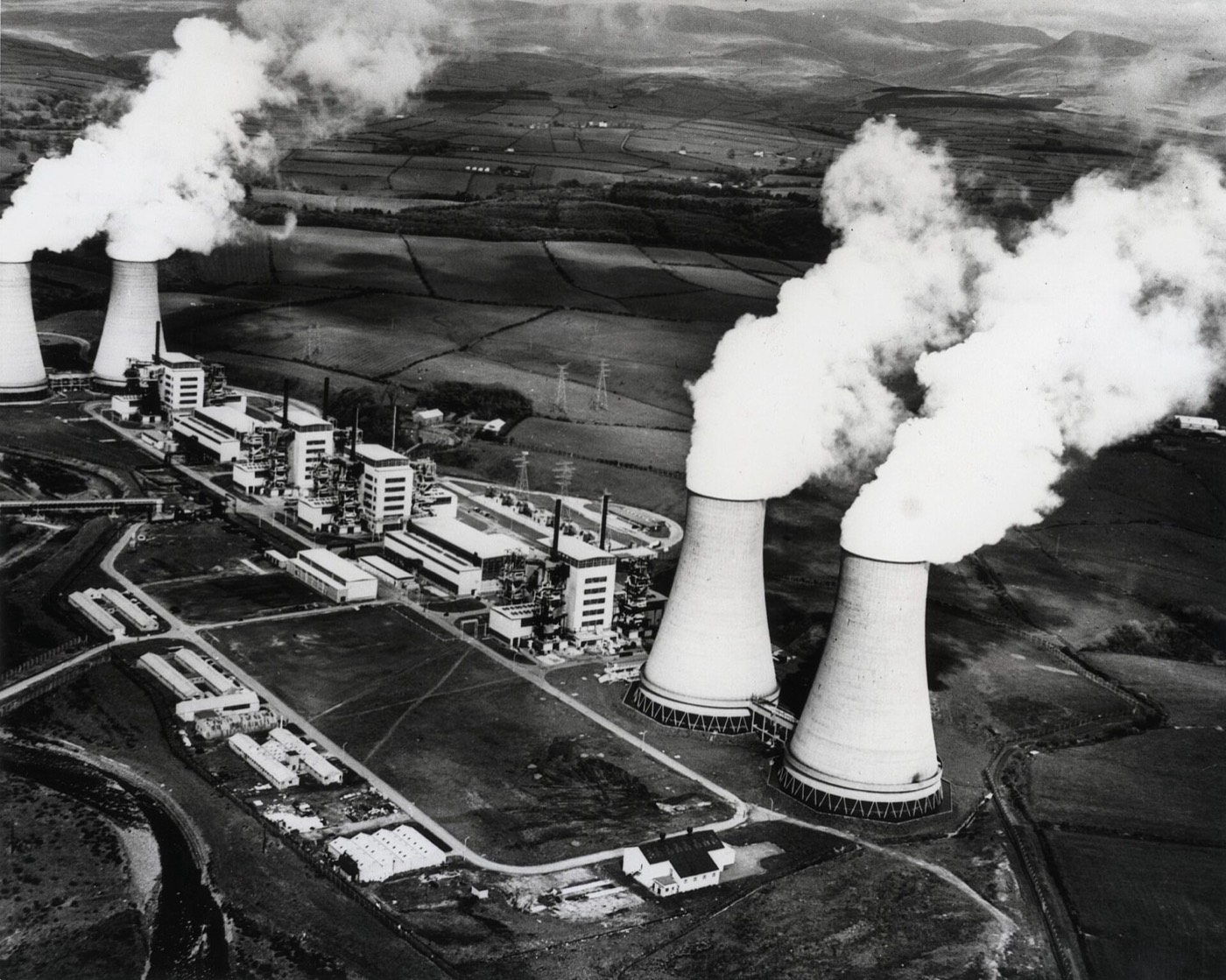
The first nuclear power station to supply a national grid on an industrial scale was not in America. It was on the coast of Cumbria, in the north-west of England.
Calder Hall, on the Cumbrian coast, was opened by the Queen on the seventeenth of October, nineteen fifty-six. Its first reactor made fifty megawatts, and three more of the same size followed within three years. It was not only a power station. At first it also made plutonium for Britain's nuclear weapons.
A year later, America had its own. The Shippingport station in Pennsylvania first sent power to the grid in December nineteen fifty-seven. Its reactor was a pressurised water design, adapted from work on naval reactors. Calder Hall and Shippingport were the first two steps of what came to be called the atomic age.
What followed was a building boom. Governments and power companies believed nuclear electricity would be cheap and plentiful, and in the nineteen sixties and seventies reactors were ordered in great numbers.
The line on screen shows how many reactors started construction around the world each year, from the International Atomic Energy Agency's records. It climbs steeply through the late nineteen sixties. It peaks in nineteen seventy-six, when forty-three reactors started building in a single year. And then it falls away, to a handful a year.
Part of that fall came from cost and slowing demand for electricity. But the sharpest break came in nineteen seventy-nine. After the accident at Three Mile Island, American utilities cancelled sixty-seven planned reactors over the next decade, up to nineteen eighty-eight. Calder Hall, meanwhile, kept running until two thousand and three, after nearly half a century.
So the boom was real, and so was the stop. To see why the stop happened, we need to look at three accidents.
4. Three accidents
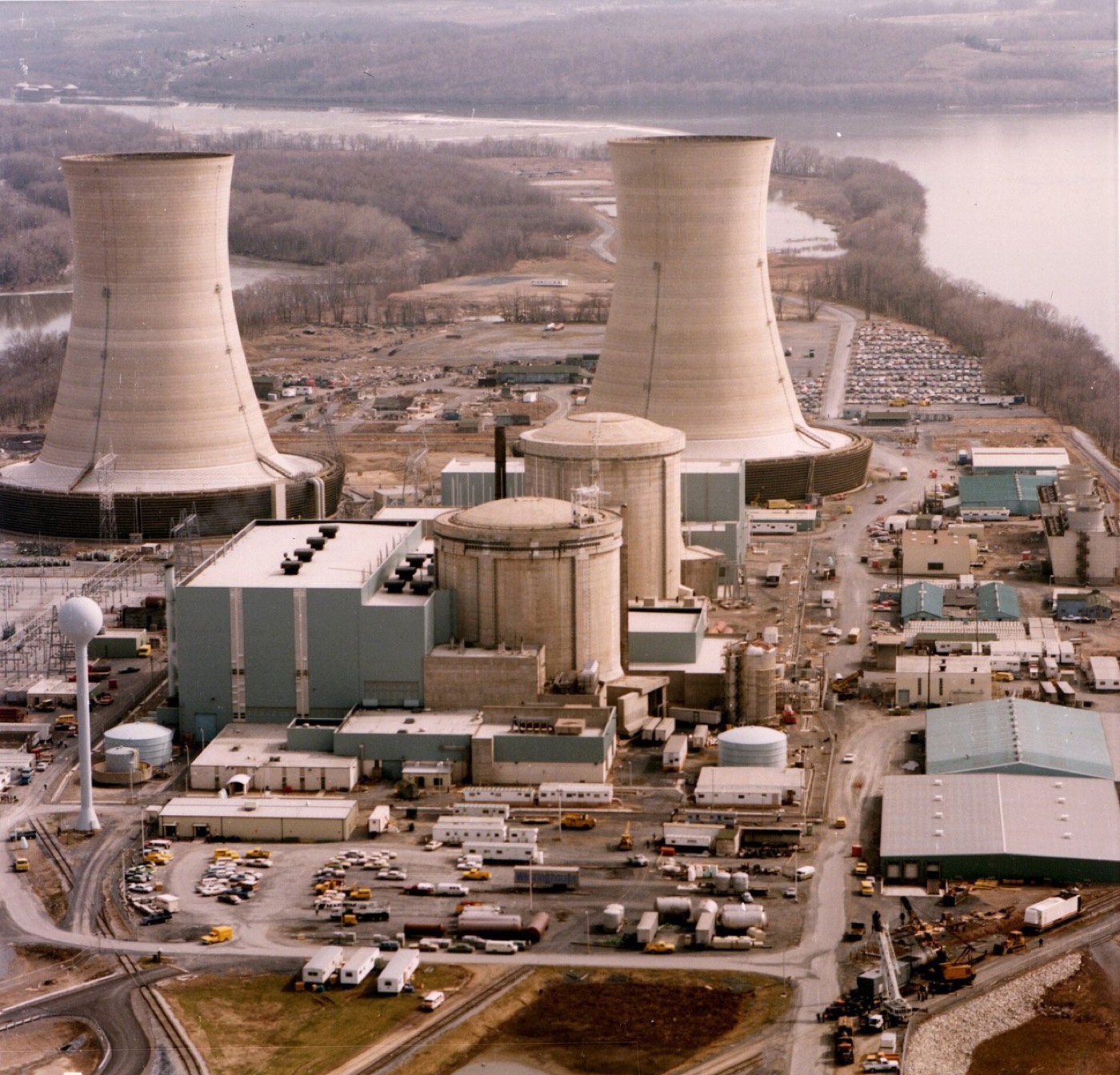
Three accidents, in three countries, across thirty-two years, shaped how the world thinks about nuclear power.
Three Mile Island, near Harrisburg in Pennsylvania, is the first. On the twenty-eighth of March, nineteen seventy-nine, a valve stuck open in Unit Two, cooling water drained away, and operators misread what was happening. At least forty-five per cent of the core melted.
The United States Nuclear Regulatory Commission, the NRC, calls it "the most serious accident in U.S. commercial nuclear power plant operating history". Yet very little radiation escaped. People nearby received an extra dose smaller than a chest X-ray, and no injuries or health effects have been found. The damage was to trust, and to the order books.
Chernobyl, in Ukraine, then part of the Soviet Union, was far worse. On the twenty-sixth of April, nineteen eighty-six, a test on Unit Four went wrong and the reactor exploded. Two workers died that night. Twenty-eight more died of radiation sickness within weeks, and about a hundred and sixteen thousand people were moved out of a zone thirty kilometres wide.
The Chernobyl reactor was a Soviet design, cooled by water but moderated by graphite, and it became harder to control as it got hotter. No reactor of that kind was ever built in the West. But the explosion spread radioactive material across Europe, and the fear it caused did not respect those differences.
Fukushima, in Japan, was the third. On the eleventh of March, twenty eleven, an earthquake of magnitude nine set off a tsunami. At the Fukushima Daiichi plant the largest waves reached fourteen to fifteen metres, against a sea wall built for five and a half. The cooling failed, the fuel in three reactors melted, and more than a hundred thousand people were evacuated.
The map shows how far apart these places are, and each accident changed policy well beyond its own country. After Three Mile Island, American orders dried up. After Chernobyl, Italy voted in a referendum to end its nuclear programme. After Fukushima, Japan shut its reactors for checks, and Germany decided to close all of its own. The last three German reactors shut on the fifteenth of April, twenty twenty-three.
So the story of the West's nuclear decline has a timeline, and it runs through these dates. First nineteen seventy-nine, then nineteen eighty-six. Then twenty eleven. Each accident arrived just as the industry was trying to recover from the one before.
5. Why big nuclear got so expensive
Accidents explain why people stopped wanting reactors. They do not fully explain why the reactors that were built cost so much. For that, look at the building sites.
Four things push the cost of a large reactor up, and they feed each other. Most were one-off designs, so every project learned on the job. Safety rules tightened after each accident, and design changes part-way through construction are slow and expensive. Slow building means long construction times. And every extra year means more interest on the money borrowed to build it, before a single unit of electricity is sold.
Two recent projects show how that works. Plant Vogtle, in the American state of Georgia, added two new reactors. Flamanville, on the coast of Normandy in France, added one. Both used new large designs, and both were meant to prove that the West could build nuclear again.
Here are their timelines. Vogtle's new units were due in twenty sixteen and twenty seventeen. They entered service in July twenty twenty-three and April twenty twenty-four. Flamanville's reactor began construction in two thousand and seven and was due in twenty twelve. It was connected to the grid in December twenty twenty-four, twelve years late.
And here are the costs. Vogtle's two units were expected to cost fourteen billion dollars. The US Energy Information Administration now puts the cost at more than thirty billion. France's national audit court put Flamanville's first estimate at three point three billion euros. Including the cost of financing, its final bill is twenty-three point seven billion.
Britain has its own version of this problem. In twenty twenty-five, a government taskforce led by the economist John Fingleton looked at how nuclear projects are regulated in the UK.
Its final report was blunt. "Today, it has become the most expensive place in the world to build nuclear projects." The taskforce blamed rules that pile up, and a system that rewards caution over results. No project shows that more clearly than the one being built in Somerset.
6. Hinkley Point C
Hinkley Point C is Britain's first new nuclear power station in a generation, and it is the clearest example of how a big reactor's cost can run away.
It is being built on the Somerset coast, one of several nuclear sites around Britain. Calder Hall is in the north-west. Wylfa, where the small reactors will go, is in north Wales. And at Sizewell, on the Suffolk coast, a copy of Hinkley's design has now been approved as well.
When the government gave the go-ahead in twenty sixteen, Hinkley Point C was expected to cost about eighteen billion pounds. It was due to start generating in twenty twenty-five. Estimates since then have climbed step by step. By twenty twenty-two the figure was twenty-five to twenty-six billion. In January twenty twenty-four, EDF, the French state company building it, put it at thirty-one to thirty-four billion.
Then, in February twenty twenty-six, EDF's annual results gave the latest figure. It is thirty-five billion pounds, counted in twenty fifteen prices. Counted in today's money, that is forty-eight billion. The first of its two reactors is now planned for twenty thirty, five years later than first promised. When both run, they are meant to supply about seven per cent of Britain's electricity.
What went wrong is a list the previous chapter would recognise. Britain had not built a reactor for twenty years, so skills and suppliers had to be rebuilt. Then came the pandemic, slower building work, shortages of workers and materials, and high inflation.
How Hinkley is paid for matters too. The deal gives it a guaranteed price for every unit of power it sells, called a strike price. When the market price is lower, bill-payers make up the gap, in top-up payments. In twenty seventeen the National Audit Office found that the expected value of those payments had risen from six billion pounds to thirty billion.
That is the problem the small reactor idea is trying to solve. A project this big takes more than a decade, and it carries all its risk in one place. EDF says that one more year of delay would add about a billion pounds. The question is whether building smaller changes that.
7. The small modular idea
The small modular reactor is not a new kind of physics. Most designs still split uranium, heat water and spin a turbine. What changes is the size, and the way the plant is built.
Start with small. The World Nuclear Association describes a small modular reactor as one of generally three hundred megawatts or less. Hinkley Point C's two reactors will make about three thousand three hundred megawatts between them. The bars on screen show how the new designs compare.
The Rolls-Royce reactor, at four hundred and seventy megawatts, is bigger than that definition, and the company still calls it an SMR. So small does not mean tiny. It means small enough for the next idea to work.
That idea is modular. The reactor and the plant around it are split into modules: sections that can be made on a factory floor, under controlled conditions, rather than in a muddy field. The modules travel to the site by truck, train or barge, and are joined together there, like very heavy flat-pack furniture.
Rolls-Royce says about ninety per cent of the manufacturing and assembly for its reactor would happen in factory conditions. It says a finished plant would take up an area about the size of two football pitches. Those are the company's own figures, for a design that has not yet been built.
The third part of the idea may matter most. It is repetition. The first unit of any design is expensive, because everyone is learning. The hope is that the tenth, built by the same team from the same drawings, costs much less.
That is the theory the industry calls learning by doing, and it has worked for other products, from aircraft to solar panels. Large reactors mostly never got there, because too few of any one design were built in any one country. SMRs are meant to be ordered in fleets, so that the savings arrive. Whether they do is the real test, and the first test did not go well.
8. The designs racing to be first
There are dozens of small reactor designs on paper. Four matter most for this story, because they have customers, sites or licences.
The first is the Rolls-Royce SMR, the design chosen for Wylfa. It is a pressurised water reactor, the same basic type as most of the world's fleet, just smaller: four hundred and seventy megawatts. It is going through the UK regulators' check on a new design, the Generic Design Assessment, which is due to finish in December twenty twenty-six.
The second is the BWRX-300, from GE Vernova and Hitachi. It is a boiling water reactor. The water boils inside the reactor itself, and the steam goes straight to the turbine, so there is one loop of water instead of two. That makes it simpler, and it is rated at three hundred megawatts, right at the edge of small.
The third is NuScale, an American company. Its modules are the smallest of the four, seventy-seven megawatts each, designed to be grouped several to a plant. NuScale holds the only American regulators' design certification for a small reactor. That should have made it the front runner, and for a while it was.
The fourth is the most different. Natrium, from TerraPower, a company founded by Bill Gates, is not cooled by water at all. It uses liquid sodium, a metal that stays liquid at very high temperatures. The heat goes into large tanks of molten salt, which store it. Steam is made from the stored heat when it is needed.
That storage is the clever part. The reactor runs steadily at three hundred and forty-five megawatts, but the plant can draw on the hot salt to push its output up to five hundred megawatts for a few hours, when demand peaks. Natrium is also a larger step from proven designs, and it needs a special fuel that is hard to buy, which we will come back to.
Two of these four use the most familiar kind of reactor, one simplifies it, and one changes almost everything. What they share is the promise of being built in series. The first of them to try that at a real site was NuScale.
9. The first warning: NuScale in Utah
The first serious small modular reactor project in America was never built. What happened to it is the best warning the industry has had.
The buyer was UAMPS, a group of small public power companies in Utah and neighbouring states. Their plan was the Carbon Free Power Project, a NuScale plant at the Idaho National Laboratory, in Idaho. It would have used six of NuScale's modules, seventy-seven megawatts each, for four hundred and sixty-two megawatts in all.
Price was the promise. In twenty twenty-one, the target price for its electricity was fifty-eight dollars per megawatt-hour. A megawatt-hour is a thousand kilowatt-hours, the units on a household bill. Then in January twenty twenty-three, the target rose to eighty-nine dollars. The reasons given included rising interest rates and the cost of steel.
That was a rise of more than half, before a single module had been built. For small utilities signing up to buy power for decades, it was too much.
The project needed enough members to commit to buying its power. By the autumn, it was clear they would not. On the eighth of November, twenty twenty-three, UAMPS and NuScale ended it. Their joint statement said: "Despite significant efforts by both parties to advance the CFPP, it appears unlikely that the project will have enough subscription to continue toward deployment."
The lesson was not that the reactor did not work. It was never built, so nobody knows. The lesson was that a small reactor, built for the first time, was not cheap. All the costs that hit big projects, interest, materials and first-of-a-kind engineering, hit small ones too.
NuScale carried on. In May twenty twenty-five its larger seventy-seven megawatt design won approval from the NRC. In September twenty twenty-five, a partner company announced a plan with the Tennessee Valley Authority for up to six gigawatts of NuScale plants. By August twenty twenty-six, that was still not a binding contract.
10. The builds now under way
Since that warning, small reactors have moved from paper to concrete in three places.
The first is at Darlington, in Ontario, Canada, on the shore of Lake Ontario. Kemmerer, in Wyoming, is the second. The third, not yet started, is Wylfa in Wales.
At Darlington, Ontario Power Generation is building four BWRX-300s. In May twenty twenty-five, the province approved the budget: twenty point nine billion Canadian dollars. The first reactor alone costs six point one billion. Add one point six billion for shared buildings and services. The fourth reactor is estimated at four point one billion, which is the learning the industry is counting on.
The foundation for the first reactor building was placed in April twenty twenty-six. The first unit is due to be in service in twenty thirty, and the other three by the mid twenty thirties.
In Wyoming, TerraPower's Natrium plant received its construction permit from the NRC on the fourth of March, twenty twenty-six. It was the first the NRC had ever issued for a commercial power reactor that is not cooled by water. Nuclear construction began on the twenty-third of April. TerraPower's chief executive, Chris Levesque, said: "This is the moment our industry has been working toward for a generation."
At Wylfa, the contract signed on the thirteenth of April, twenty twenty-six, is for three Rolls-Royce reactors, at least one point four gigawatts in all. Two point six billion pounds was set aside for it in the twenty twenty-five Spending Review. The final decision to invest is expected in twenty twenty-nine, with power in the mid twenty thirties.
So the dates on screen line up. A Canadian first unit by twenty thirty, a Wyoming first unit around the same year, and a Welsh decision in twenty twenty-nine. Those few years will show whether the promises on cost hold.
And Europe may follow. The agreement signed on the twenty-second of September is meant to spread the BWRX-300 across Central and Eastern Europe and the United Kingdom. Poland has already approved twenty-six of them in principle. None of those has started building.
11. AI data centres as customers
The most surprising new buyers of nuclear power are not utilities. They are the world's biggest technology companies.
The reason is data centres, the huge buildings full of computers that run cloud services and artificial intelligence. The International Energy Agency says data centres used about one and a half per cent of the world's electricity in twenty twenty-four. It expects their use to more than double by twenty thirty.
What these buildings need is power that is always there. A data centre runs day and night, whatever the weather, and wind and solar power come and go. A nuclear plant runs steadily for months at a time, and it does not burn fossil fuel. For a company with climate targets, that combination is hard to find.
In September twenty twenty-four, Microsoft signed a twenty-year deal to buy the power from the undamaged reactor at the same site, Unit One. That reactor was not the one that melted in nineteen seventy-nine; it had run safely until twenty nineteen and closed for economic reasons. Renamed the Crane Clean Energy Center, it is due back in twenty twenty-seven, a year earlier than first planned.
Constellation, which owns the plant, was clear about the symbolism. Its chief executive, Joe Dominguez, said: "We look forward to bringing it back with a new name and a renewed mission." In November twenty twenty-five, the US government backed the restart with a loan of one billion dollars.
Others went straight to small reactors. In October twenty twenty-four, Google agreed to buy up to five hundred megawatts from Kairos Power. Its first plant for Google is due by twenty thirty, in Tennessee. Two days later, Amazon led an investment in X-energy, which aims for five gigawatts of reactors by twenty thirty-nine. Its first plant is planned in Washington State.
The bars on screen compare the deals. In January twenty twenty-six, Meta announced agreements for up to six point six gigawatts of nuclear power. All of it is meant to be flowing by twenty thirty-five. That is larger than any single deal before it, and much of it depends on reactors that have not yet been built.
These deals do not build reactors on their own. But they give the builders something they have long lacked: customers with deep pockets, willing to sign for decades. That is exactly what NuScale's project in Utah did not have.
12. Forwards or backwards?
So is building fission reactors again a step forwards or a step back? The honest answer is that small reactors fix some of nuclear's problems, and not others.
Here is what they could fix. Smaller projects need smaller loans, so a delay costs less in interest. Factory building should make each unit more predictable. And a fleet of identical reactors lets builders learn, which large reactors in the West rarely managed. Every one of those is still a promise, not a result.
Here is what they do not fix. The first is waste. Used fuel stays dangerously radioactive for thousands of years, and the plan everywhere is to bury it deep underground. Britain has not chosen a site, and only two areas of Cumbria remain in its search. Finland is furthest ahead: its store deep in the rock at Olkiluoto could open by the end of twenty twenty-six, but it does not yet have its operating licence.
The second is fuel. Some advanced designs, Natrium among them, need a richer fuel called HALEU, which has between five and twenty per cent of the uranium that splits. The only commercial supplier was Russia. When Russia invaded Ukraine, TerraPower lost its fuel source, and in December twenty twenty-two it pushed Natrium's start back by at least two years.
The third is first-of-a-kind cost. NuScale's project died of it, and Darlington's first unit costs about half as much again as its fourth. Nobody has yet built a fleet of small reactors in the West, so nobody yet knows whether the savings come. That is the thing to watch.
And there is a lot to watch before twenty thirty. The Rolls-Royce design check is due to finish in December twenty twenty-six. Crane is due to restart in twenty twenty-seven. Wylfa's investment decision is expected in twenty twenty-nine. And the first reactors at Darlington and Kemmerer are due in twenty thirty.
Suppose those dates hold, and the later units cost less than the first. Then small reactors will be a step forwards: clean, steady power, built like a product instead of a monument. If they slip, and the bills climb the way Hinkley's did, it will look like a step back to the same old problem in a smaller box.
For now, the answer is not yet known, and it will not be decided by speeches. It will be decided on building sites in Ontario, Wyoming and Wales, by whether the fourth reactor really is cheaper than the first. That is the step this video will be watching.
Sources and credits
Photo credits (Wikimedia Commons)
- Calder Hall nuclear power station, the world's first commercial-scale nuclear plant (US DOE photo, c.1973): ENERGY.GOV, Public domain - https://commons.wikimedia.org/wiki/File%3ACalder_Hall_nuclear_power_station_%2811823864155%29.jpg
- Three Mile Island nuclear generating station, 1979 (US DOE): United States Department of Energy, Public domain - https://commons.wikimedia.org/wiki/File%3AThree_Mile_Island_%28color%29.jpg


Primary sources
- gov.uk, Great British Energy - Nuclear and Rolls-Royce SMR sign contract, 13 April 2026 - at least 1.4 GWe; £2.6bn in the 2025 Spending Review. Rolls-Royce release of the same date; WNN, 13 Apr 2026 (470 MWe units, FID 2029).
- ONR, Rolls-Royce SMR GDA Step 2 summary report, 29 July 2024 - GDA expected to complete December 2026 (re-); Environment Agency GDA Step 2 report, 30 July 2024.
- WNN, UK marks 60th anniversary of Calder Hall, 18 Oct 2016; US DOE, December 23, 1957: Shippingport; IAEA, Nuclear Power Reactors in the World, RDS-2, 2025 edition, Table 7; EIA Today in Energy, 27 Apr 2017.
- US NRC, Backgrounder on the Three Mile Island Accident (quoted); IAEA, The Fukushima Daiichi Accident, Report by the Director General, 2015; BASE (Germany), nuclear phase-out.
- EIA Today in Energy, 1 May 2024 (Vogtle); Georgia Power, 29 Apr 2024; Cour des comptes, La filiere EPR, 14 Jan 2025 (via AFP / Connaissance des Energies); Nuclear Regulatory Review 2025 (Fingleton), 24 Nov 2025 (quoted); MIT, The Future of Nuclear Energy in a Carbon-Constrained World, 2018.
- National Audit Office, Hinkley Point C, 23 June 2017; EDF, Hinkley Point C update, 23 Jan 2024; EDF 2025 annual results, 20 Feb 2026.
- Rolls-Royce, Small Modular Reactors (90% factory, truck/train/barge, two football pitches); TerraPower, 4 Mar 2026 and 23 Apr 2026 (quoted); US DOE, 9 Mar 2026; NuScale SEC filing, 5 Aug 2026.
- Utility Dive, 9 Nov 2023; UAMPS/NuScale joint release, 8 Nov 2023 (quoted).
- World Nuclear News, 23 May 2025 (Darlington costs); CNSC Darlington New Nuclear Project page (25 Aug 2026); ANS Nuclear Newswire, 5 Jun 2026; GE Vernova MoU release, 22 Sep 2026.
- IEA, Energy and AI, April 2025; Constellation, 20 Sep 2024 (quoted) and 18 Nov 2025; WNN, 1 Apr 2026; Google, 14 Oct 2024; X-energy, 16 Oct 2024; Meta, 9 Jan 2026.
- WNN, HALEU fuel availability delays Natrium reactor project, 15 Dec 2022; Posiva, 4 Aug 2026; Nuclear Waste Services (Mid and South Copeland).
Not regulated financial advice.