
How Cities Made Drinking Water Safe
Turn on a tap in most cities today and you can drink what comes out. That is one of the newest things about modern life. This video follows how cities got there.
In the early nineteenth century, London's water companies pumped from the same river its sewers emptied into. In 1829 James Simpson built a sand filter for the Chelsea Waterworks Company to make the water look cleaner. In 1854 John Snow traced a cholera outbreak that killed 420 people to a single pump on Broad Street, and showed that households drinking the Southwark and Vauxhall company's water died at fourteen times the rate of their neighbours. In 1892 cholera killed 8,605 people in Hamburg, while Altona next door, drinking filtered water from the same river, saw only a handful of cases.
Then chlorine: Maidstone in 1897, Lincoln in 1905, and on 26 September 1908 the Boonton Reservoir serving Jersey City, the first continuously chlorinated municipal supply in the United States. We explain what a modern treatment plant does, step by step: coagulation, flocculation, sedimentation, filtration and disinfection.
And what still goes wrong. Milwaukee, 1993: an estimated 403,000 people ill from a parasite that got through the filters. Flint, 2014: water without corrosion control, dissolving lead from old pipes. The EPA's October 2024 rule to replace lead service lines within ten years, now challenged in court. PFAS limits of four parts per trillion, set in April 2024, and the May 2026 proposal to give systems until 2031. Finally, the WHO/UNICEF 2025 count: 2.1 billion people still without safely managed drinking water.
No figure appears without its date and source.
Educational documentary. Not financial or investment advice.
In these topics
Chapters
Video notes
1. A glass of water
Turn on a kitchen tap in most cities today and you can drink what comes out without a second thought. That is one of the newest things about modern life, and one of the least noticed.
This video covers five things. How crowded cities came to drink their own waste. How two investigations proved that water carried disease. How sand and chlorine made water safe. How modern treatment plants work, step by step. And what still goes wrong, in the pipes and in the chemistry.
First, a reminder that the job is not finished.
In twenty twenty-five, the World Health Organization and UNICEF reported that one person in four still lacks safely managed drinking water. That is two point one billion people. Of those, one hundred and six million drink straight from rivers, lakes and ponds, with no treatment at all. Safely managed means water at home, available when needed, and free from contamination.
To see how cities got from there to here, we start with a river that was also a sewer.
2. A river that was also a sewer
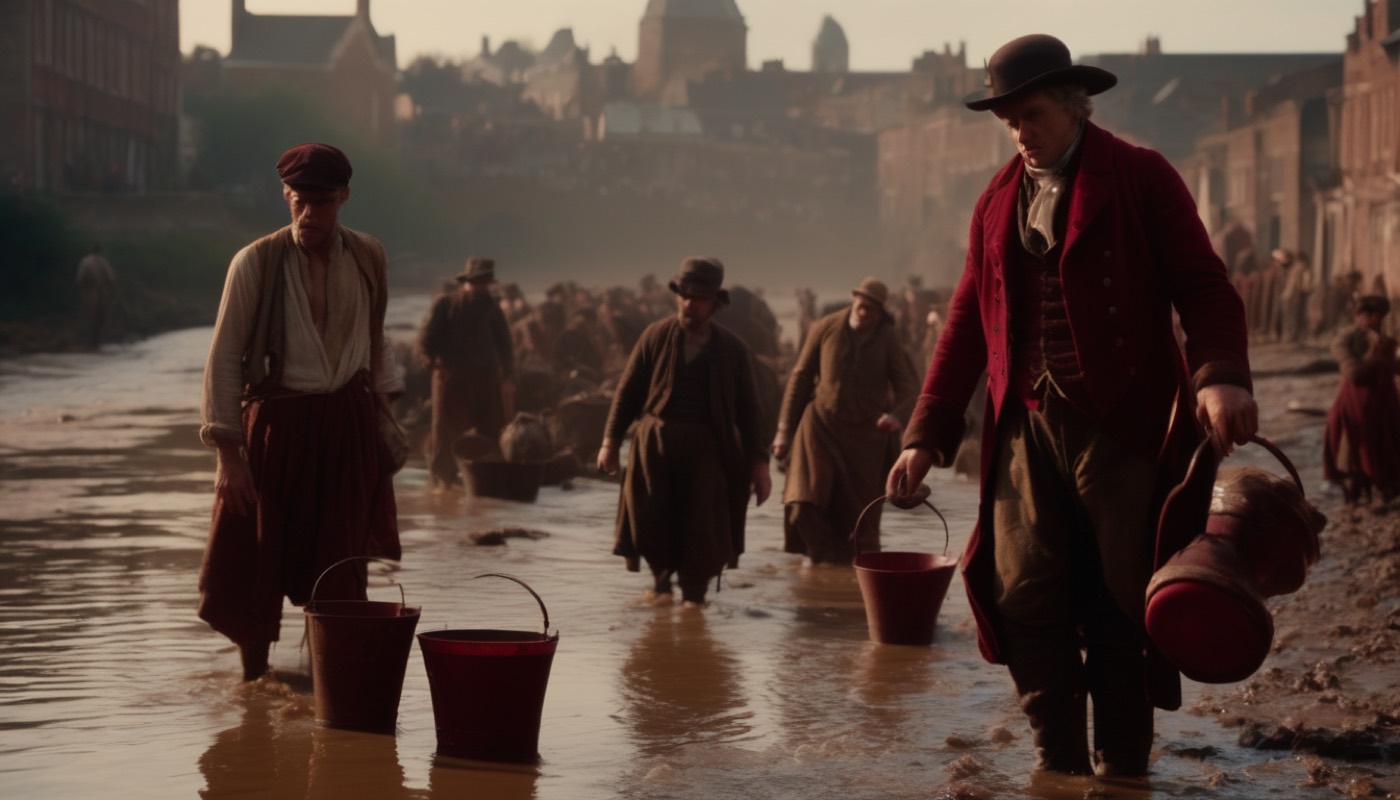
In the early nineteenth century, a growing city took its water from the nearest river. The same river carried away its sewage, its factory waste and its dead animals.
In London, water companies pumped straight from the Thames and sold it to households through pipes. The sewers and the factories emptied into that same river. The water that came out of the pipes was often cloudy, and sometimes it smelled. Nobody yet knew that the real danger in it could not be seen at all.
The first fix was aimed at what people could see.
In eighteen twenty-nine, the engineer James Simpson built a sand filter for the Chelsea Waterworks Company. It was a bed of broken brick, gravel and fine sand, about an acre in size. River water was let in on top and trickled slowly down through the layers. It came out clearer at the bottom, and the design was copied across the country.
Simpson built it to make the water look better. Nobody yet knew it was also making the water safer.
3. The pump on Broad Street
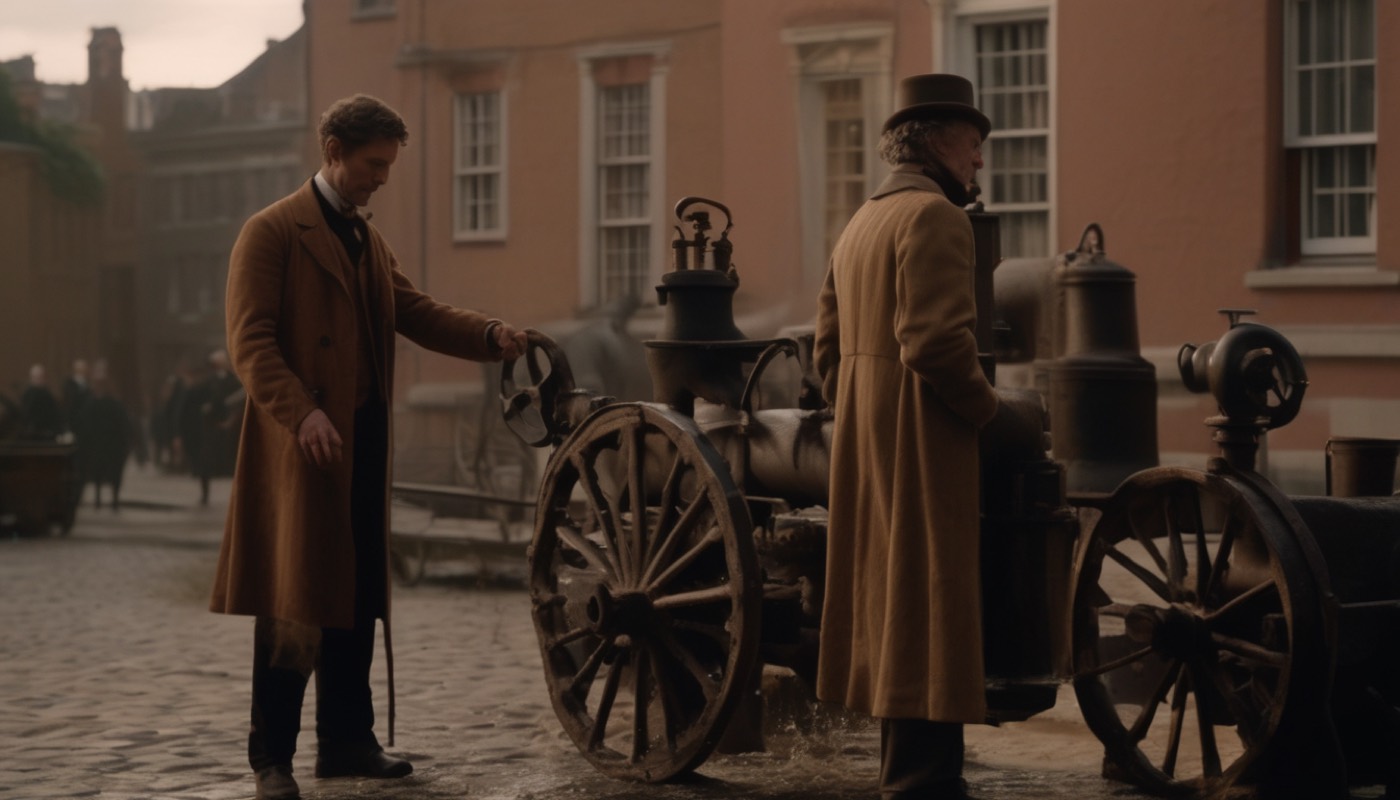
At the time, most doctors believed that diseases like cholera spread through bad air, a foul smell rising from filth. Cholera is a gut infection that drains the body of water, and it can kill within a day.
A London doctor named John Snow thought the bad air idea was wrong. He believed cholera was passed on through something people swallowed, most likely water. He first published that argument in eighteen forty-nine. Then, in eighteen fifty-four, an outbreak began near his home, on the last day of August.
Snow went from door to door, recording where each victim had lived and where they had drawn their water.
He later called it "the most terrible outbreak of cholera which ever occurred in this kingdom". The deaths clustered around a single public water pump on Broad Street. Snow took his findings to the local officials. On the eighth of September, the handle was removed from the pump.
The outbreak was already slowing by then, so the pump handle was not a miracle cure. What mattered was the evidence.
Four hundred and twenty people died in that outbreak. Snow also compared households served by two different water companies. Those drinking from the Southwark and Vauxhall company, which drew polluted water from the river, died of cholera at fourteen times the rate of those served by the Lambeth company.
Same city, same air, different water. Snow set it all out in the second edition of his book, published in eighteen fifty-five.
4. Two cities, one river
Snow's case was strong, but many officials still did not accept it. The proof that finally settled it came almost forty years later, in northern Germany.
Hamburg and its neighbour Altona sat side by side on the river Elbe. The border between them ran through ordinary streets. Hamburg pumped river water to its homes without treatment. Altona, which took its water from further downstream, passed it through sand filters first. It had installed them in eighteen fifty-nine.
In the summer of eighteen ninety-two, cholera reached the river.
More than seventeen thousand people in Hamburg fell ill in just a few weeks. The final death toll was eight thousand six hundred and five. Across the border in Altona, where the water was filtered, there were only a handful of cases. The air, the soil and the weather were the same on both sides. The difference was the water.
After Hamburg, filtration stopped being a matter of how water looked. It became a matter of life and death.
5. A chemical that kills germs
Sand removes a great deal, but not everything. The next step was to kill whatever got through, and the chemical that did it was chlorine.
The first whole town supply treated with chlorine was Maidstone, in England, in eighteen ninety-seven. Permanent chlorination began in Lincoln, in nineteen oh five, after a faulty sand filter led to a serious typhoid outbreak. Typhoid is a fever caused by bacteria carried in contaminated food and water.
The idea then crossed the Atlantic, to a reservoir in northern New Jersey.
On the twenty-sixth of September, nineteen oh eight, the Boonton Reservoir became the first municipal supply in the United States to be chlorinated continuously. It served Jersey City. The doctor John Leal conceived the treatment, and the engineer George Fuller designed the equipment. The typhoid rate in the city dropped sharply afterwards.
Within a few decades, adding chlorine had become routine across much of the world.
6. What happens inside a treatment plant
A modern treatment plant still uses the same two ideas, remove the dirt and then kill the germs. But it does the job in a longer series of steps.
First, a chemical is stirred in that makes tiny particles of dirt stick together. That step is called coagulation. Next comes flocculation, which means gentle mixing, so the sticky particles gather into larger clumps called floc. Then the water rests in a tank while the heavy clumps sink to the bottom. That settling step is called sedimentation.
The clearer water on top moves on to the last two stages.
It is filtered through sand, gravel or charcoal, which catches the smaller particles and many germs. Then a disinfectant such as chlorine is added, to kill any germs that remain. A small amount is left in the water on purpose, so it keeps protecting the water on its long journey through the pipes.
Each step is a barrier. The system is built so that if one barrier weakens, the others still stand.
7. When a barrier fails
Those barriers usually hold. When one of them fails, the result shows how much depends on them.
In the spring of nineteen ninety-three, a tiny parasite called Cryptosporidium got through the filters at one of Milwaukee's two treatment plants. It is a germ with a tough outer shell, and ordinary chlorine does not kill it easily. So the filters were the barrier that mattered, and on this occasion they were not working as they should.
The scale of what followed made it the largest outbreak of waterborne disease in American history.
An estimated four hundred and three thousand people fell ill with severe diarrhoea. About four thousand four hundred were admitted to hospital. At least sixty-nine people died, most of them people whose immune systems were already weakened by illness.
The lesson was that the barriers have to work every single day, not just most days.
8. The lead in the last mile
A treatment plant can send out perfectly safe water, and it can still arrive at the tap unsafe. The problem is the pipe between the water main and the house, called the service line. In many older homes, that pipe is made of lead.
On the twenty-fifth of April, two thousand and fourteen, the city of Flint in Michigan switched its water supply to the local river, to save money. The river water was not given corrosion control, a treatment that stops water eating away at the inside of old pipes. It began dissolving lead into the drinking water. The city did not switch back until October, two thousand and fifteen.
Nearly one hundred thousand residents were exposed to lead. The response, nationally, took a decade to arrive.
In October, two thousand and twenty-four, the Environmental Protection Agency issued a rule requiring almost every American water system to replace all its lead service lines within ten years. The rule also lowered the level of lead that forces a water system to act. It went from fifteen parts per billion to ten.
Water utilities have challenged the ten-year deadline in court, arguing it cannot be met. That case has not yet been decided.
9. Chemicals that boiling does not remove
The newest worry is not a germ at all. It is a family of man-made chemicals called PFAS, used for decades in non-stick pans, waterproof clothing and firefighting foam.
PFAS are often called forever chemicals, because they barely break down in nature or in the body. Boiling water does not remove them. The limits set for two of them are measured in parts per trillion. One part per trillion means one part of the chemical in a million million parts of water.
The rules for them are still changing, even this year.
In April twenty twenty-four, the Environmental Protection Agency set limits of four parts per trillion for the two best-known PFAS chemicals. Water systems must finish their first round of testing by April twenty twenty-seven. In May twenty twenty-six, the agency proposed a delay. Systems that ask for it would have until twenty thirty-one to meet the limits, instead of twenty twenty-nine. It also proposed dropping the limits for several other PFAS chemicals.
The limits for the two main chemicals would stay. What is being argued over is how quickly water systems must reach them.
10. The work that is left

The methods that made city water safe are now more than a century old, and they still work. The unfinished part is getting them to everyone.
Between twenty fifteen and twenty twenty-four, nine hundred and sixty-one million people gained safely managed drinking water. The gap between town and country is still wide. In cities, eighty-three per cent of people have safely managed water. In rural areas, it is sixty per cent.
Those gains are real, and they are also slow.
Worldwide, the share of people with safely managed water rose from sixty-eight per cent to seventy-four per cent over those nine years. That still leaves one person in four without it. The two agencies warn that, at the current pace, safe water for everyone is looking increasingly out of reach.
In the cities that solved it, the result was so complete that it became invisible. A clean glass of water from the tap is the monument, and almost nobody notices it.
Sources and credits
Primary sources
- WHO and UNICEF, '1 in 4 people globally still lack access to safe drinking water', news release, 26 August 2025 (who.int), and the JMP report 'Progress on household drinking water, sanitation and hygiene 2000-2024' - 2.1 billion; 106 million surface water; 961 million gained 2015-2024; 68% to 74%; rural 50% to 60%; urban about 83%.
- Institution of Civil Engineers, 'London's water supply and the introduction of sand filtration' (ice.org.uk); Wikipedia, 'Chelsea Waterworks Company' - James Simpson, 1829, about one acre, beds of brick, gravel and sand.
- Wikipedia, '1854 Broad Street cholera outbreak' - Snow's quote from the 1855 second edition; outbreak from 31 August 1854; handle removed 8 September 1854; 420 deaths; Southwark and Vauxhall mortality 14 times Lambeth; first published 1849.
- National Research Council, 'Drinking Water and Health', Historical Note (NCBI Bookshelf NBK234165) - Hamburg unfiltered, Altona filtered; NPR, 'What Hamburg's Missteps In 1892 Cholera Outbreak Can Teach Us', 6 May 2020 - more than 17,000 cases; 8,605 deaths; Altona sand filtration from 1859.
- Wikipedia, 'Water chlorination' - Maidstone 1897; Lincoln 1905; Boonton Reservoir 1908, Leal and Fuller. Wikipedia, 'John L. Leal' and 'Boonton Reservoir' - 26 September 1908.
- MacKenzie et al., New England Journal of Medicine, 21 July 1994 - an estimated 403,000 ill; Corso et al., CDC Emerging Infectious Diseases 9(4), April 2003; Encyclopedia of Milwaukee (UWM) - about 4,400 hospitalised, at least 69 deaths.
- History.com, 'The Flint water crisis begins', 25 April; NRDC, 'Flint Water Crisis: Everything You Need to Know' - the switch on 25 April 2014, no corrosion control, return to Detroit water October 2015, nearly 100,000 residents exposed.
- US EPA, 'Lead and Copper Rule Improvements' (epa.gov), final rule 8 October 2024 - replace lead service lines within 10 years; AWWA article on the final rule - action level 15 to 10 ppb. NRDC case page, 'American Water Works Association v. EPA' - challenge in the D.C. Circuit, undecided.
- US EPA, 'Proposed PFOA and PFOS Compliance Extension Rule' and Federal Register 2026-10086, 20 May 2026 - MCLs of 4.0 ppt unchanged; compliance 26 April 2029 to 26 April 2031 for systems that request it; initial monitoring by April 2027; proposed rescission for PFHxS, PFNA and HFPO-DA.
Not regulated financial advice.