
Deep-Sea Mining: A New Frontier or a New Mistake?
Four kilometres down, on a stretch of Pacific seabed the size of the European Union, lie trillions of potato-sized rocks rich in the metals clean-energy batteries need. This video explains what polymetallic nodules are, why they are valuable, and the fight over who gets to mine them.
It sets out what two real seabed trials - a 2022 industrial test and a 1979 test re-surveyed 44 years later - actually found about recovery, the case for going ahead, and why more than 40 countries are asking for a pause instead. It closes on the open question: two licensing systems, built never to need each other's agreement, now both reaching for the same seabed at once.
Educational documentary. Not financial or investment advice.
In these topics
Chapters
- The prize on the seafloor
- A gold rush four kilometres down
- An old idea, a new urgency
- Whose ocean is this?
- The rulebook that never arrived
- America goes it alone
- The company betting on nodules
- What we know about the damage
- The case for going ahead
- The moratorium coalition
- A frontier without a referee
- Who decides, and what's next
Video notes
1. The prize on the seafloor

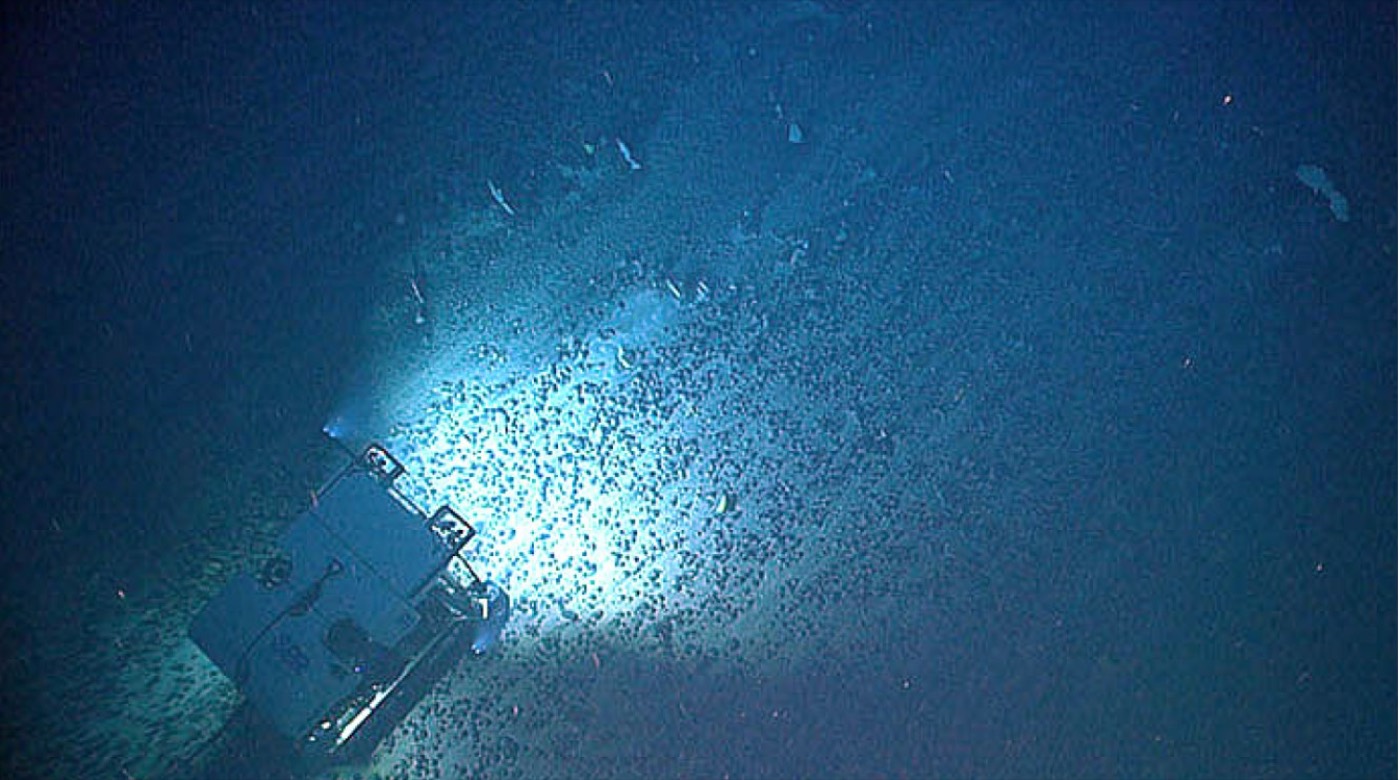
Four thousand metres down, on the floor of the Pacific, the seabed is covered in rocks the size of potatoes. They are not ordinary rocks.
A polymetallic nodule forms when metal dissolved in seawater slowly settles out, layer on layer, around a tiny core — a shark's tooth, a fish bone, a fragment of older rock. It grows only a few millimetres every million years, so a nodule the size of a potato has been forming since before there were grasslands on land.
Inside that slow growth is the reason anyone cares. A nodule is mostly manganese, with meaningful amounts of nickel, copper and cobalt mixed through it — the four metals that go into batteries, wiring and stainless steel. They sit loose on top of the mud rather than buried inside it, which is what makes them possible to collect without digging a mine at all.
This video calls those four metals plainly, because the industry rarely does. Nickel and cobalt go into electric-vehicle batteries. Copper goes into every metre of wiring a clean-energy grid needs. Manganese, the largest share by weight, toughens steel.
That is the prize. What follows is the argument over who gets to take it, and what taking it costs.
2. A gold rush four kilometres down
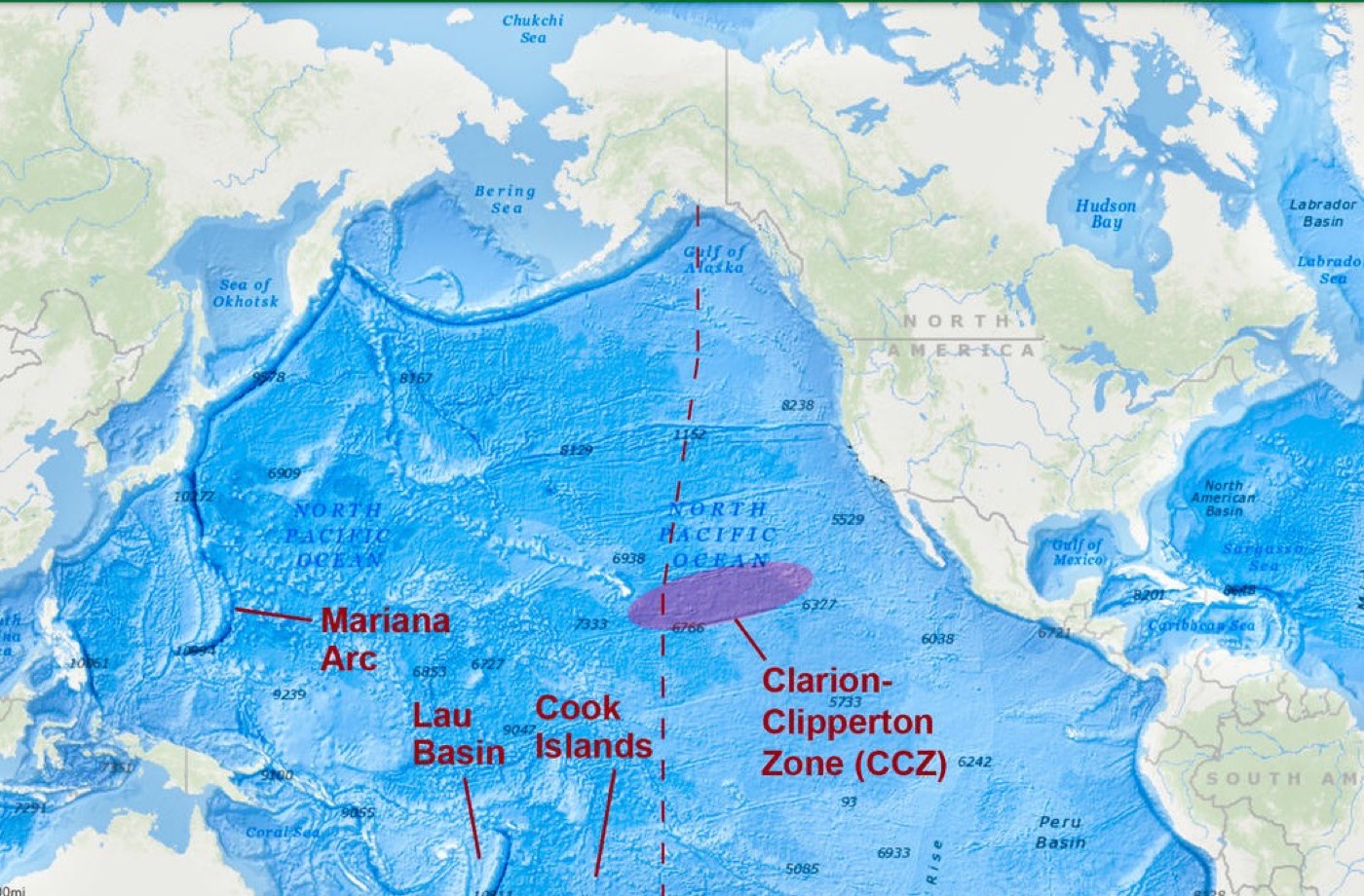
The richest nodule field anywhere lies in a single stretch of the Pacific seabed between Hawaii and Mexico, called the Clarion-Clipperton Zone.
The zone covers about four and a half million square kilometres — roughly the size of the European Union — at a depth of four to five and a half kilometres. It is the densest known concentration of these nodules on Earth, estimated to hold more nickel, cobalt and manganese than every land-based reserve combined.
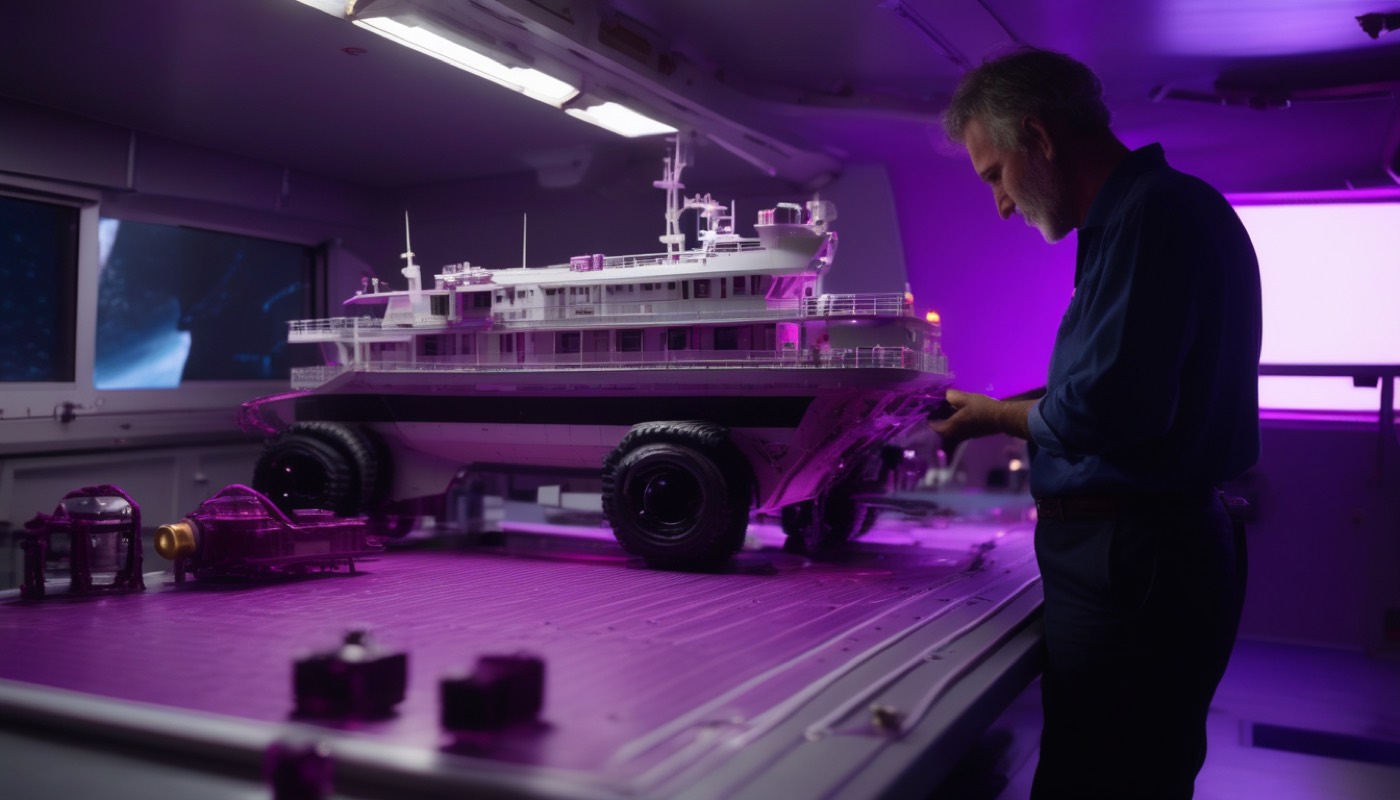
No company plans to send a person down to collect them. The designs instead use a tracked vehicle, roughly the size of a small house, crawling along the seabed on the end of a riser pipe that runs all the way to a ship four kilometres above.
The vehicle vacuums nodules and a slurry of seabed sediment off the bottom, and that slurry is pumped up the riser to the ship, where the nodules are separated out and the waste water and sediment are returned to the ocean. Every part of that process — the vacuuming, the plume it stirs up, the water returned below the surface — is where the environmental argument in this video actually sits.
3. An old idea, a new urgency

Nodule mining is not a new idea. It is an old one that failed commercially once already.
Kennecott Copper ran its first nodule-dredging trip off Mexico's Baja coast in 1962, and by 1974 it had formed a four-company consortium to pursue it seriously. Three other international groups chased the same prize through the 1970s, in what the industry's own historians call its golden age.
By the early 1980s, every one of those groups had shelved the idea. Metal prices fell, the engineering proved harder than expected, and nodule mining stayed a historical footnote for nearly forty years.
What revived it was demand, not a new discovery. Electric vehicles and grid batteries needed nickel and cobalt at a scale land mines alone might struggle to supply, and by the 2020s that demand had made a decades-old idea look urgent again.
The nodules on the seabed had not changed. What changed was how badly somebody wanted them.
4. Whose ocean is this?

Before anyone can mine four kilometres down in international waters, there is a prior question: who is allowed to say yes.
The 1982 UN Convention on the Law of the Sea settled that question for the deep seabed beyond any country's own waters. It called that seabed the common heritage of mankind — resources belonging to no single state, managed for the benefit of all. The convention created a body to run that system: the International Seabed Authority, in force since 1994.
The Authority is the only organisation with the legal power to grant a contract to explore the international seabed, or eventually to mine it. It is also the body meant to share whatever benefits come back from doing so.
One country sits outside that entire system. The United States signed the 1994 implementing agreement but has never ratified the Convention itself, and so is not a member of the Authority at all. That gap is the hinge this video turns on.
5. The rulebook that never arrived

For a nodule contractor to go from exploring to actually mining, the Authority needs one more document: a finished mining code, setting out the environmental rules, who is liable for damage, and how the money gets shared.
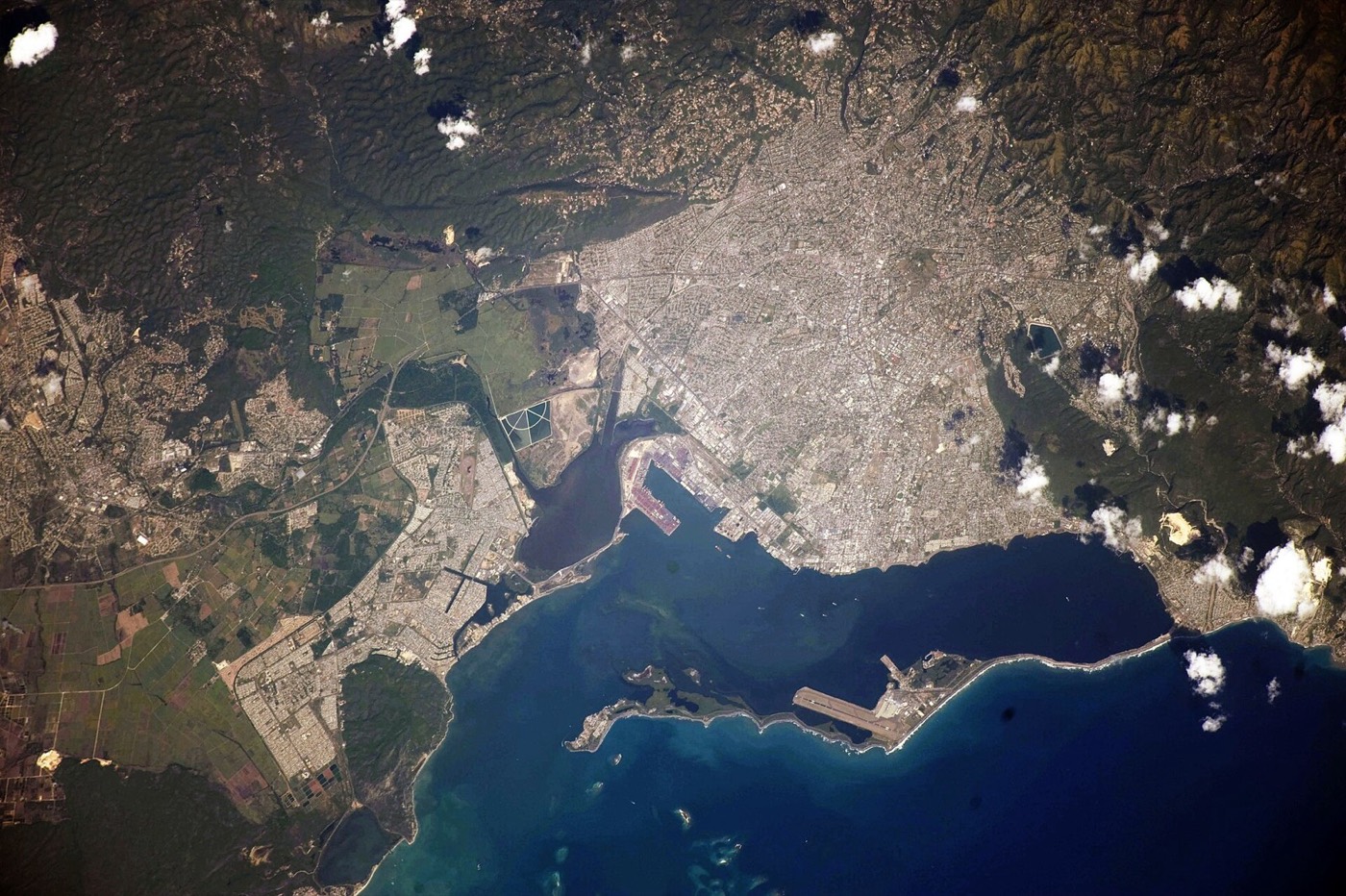
The Authority's Council met in Kingston, Jamaica, from the ninth to the nineteenth of March 2026, to try to finish that code. It did not.
Three questions kept the talks from closing. The first was how much environmental harm counts as too much. The second was who pays when something goes wrong. And the third was how the Authority's member states actually share in minerals taken from what the treaty calls everyone's seabed.
This was not the first time the talks had ended this way. The code has now missed one self-imposed deadline after another since serious drafting began in the late 2010s, and nobody at the Authority currently names a date by which it will be finished.
Without a finished code, the Authority cannot legally approve commercial mining at all — only exploration. Every nodule contract issued anywhere in the world through the Authority is still, formally, a licence to look, not a licence to take.
6. America goes it alone



While the Authority's talks were stalling, the United States had already started building a separate door.
On the twenty-fourth of April 2025, President Trump signed an executive order called "Unleashing America's Offshore Critical Minerals and Resources." It directed NOAA — the US agency that runs ocean policy — to license seabed mining under an existing American law from 1980, in both US and international waters, without going through the Authority at all.
That 1980 law had sat almost unused for decades, because no company had seriously tried to mine outside the treaty system it was written to compete with. The order told NOAA to start using it.
NOAA does not need the Authority's permission to issue that licence, because the United States was never a member of the Authority in the first place.
One country's absence from a treaty forty years ago is what makes this entirely separate licensing route legal today.
7. The company betting on nodules
One company has moved furthest down that American route: The Metals Company, known as TMC.
TMC began under the Authority's own system — its subsidiaries hold exploration contracts in the Clarion-Clipperton Zone sponsored by Nauru and Tonga, two of the Authority's own member states. In April 2025, TMC announced it would apply to NOAA instead, rather than keep waiting for a mining code that showed no sign of arriving.
Its US subsidiary filed a consolidated application in January 2026. It covers about sixty-five thousand square kilometres, and an estimated six hundred and nineteen million tonnes of nodules.
On the ninth of March 2026, NOAA found that application in "substantial compliance" with its rules. That is a procedural finding — the paperwork is complete enough to proceed to formal review — not a decision to grant the licence. NOAA's own process still requires an environmental review, open to public comment, before any licence could be issued.
8. What we know about the damage


Two sets of evidence exist on what nodule mining actually does to the seabed, and both come from real trials rather than from argument.
In 2022, an industrial-scale collector trial in the Clarion-Clipperton Zone recovered more than three thousand tonnes of nodules. Scientists had surveyed the same seabed for two years before the trial and two months after it, so they could separate the mining's effect from ordinary natural variation. Inside the tracks the vehicle had crossed, the number of seafloor animals fell by thirty-seven per cent, and the number of different species fell by thirty-two per cent.
That is the short-term picture. The longer one comes from a trial nobody alive at the Authority today authorised.
In 1979, an early collector left test tracks on the seabed in the same general region. Researchers returned to that exact spot in 2023 — forty-four years later — and the tracks were still visibly there, with little sign the seabed had physically healed itself. Some mobile animals had begun moving back in; many of the smaller, less mobile species groups still had not recovered.
Not every nodule-habitat animal even has a name yet. In 2016, NOAA researchers filmed a small pale octopod near Hawaii and nicknamed it Casper. It is still formally undescribed, one more species nodule fields keep turning up before anyone has catalogued it.
What both trials show together is not that recovery is impossible. It is that nobody yet knows how long it actually takes.
9. The case for going ahead

None of that settles the argument on its own, because the alternative to seabed nodules is not no mining at all. It is mining somewhere else.
Supporters argue that a single nodule already carries four metals in one rock, collected from the surface without blasting, tunnelling or displacing anyone who lives nearby — unlike many land mines for the same metals. They also point to where today's nickel and cobalt refining is concentrated, heavily in China, and argue that seabed nodules could spread that supply chain to more countries at once.
Seen this way, the deep seabed is not a reckless new frontier. It is a lower-impact way to get metals the clean-energy transition needs regardless of where they come from.
The honest version of this argument does not deny the damage already described. It says every source of these metals has a cost, land mining included, and that the seabed's cost has not yet been shown to be the worse one.
10. The moratorium coalition
The opposing case does not ask for seabed mining to be banned forever. It asks for time.
By mid-2026, more than forty countries had formally called for a moratorium or a precautionary pause on deep-sea mining. That is up from just over thirty a few years earlier. Four US states — Hawai'i, Washington, Oregon and California — have gone further and banned it outright in their own waters.
The coalition spans richer and poorer countries alike, which is unusual for an environmental position this specific.
France and Germany have backed a pause, alongside Pacific island states such as Fiji and Palau, whose own waters sit closest to the Clarion-Clipperton Zone. A moratorium would stop the Authority issuing new mining contracts. It would not touch licences a country issues entirely outside the Authority's system — which is exactly the gap the American route uses.
11. A frontier without a referee

So two processes are now running on the same seabed, built on two different sources of authority, at the same time.
The Authority can still only approve exploration, because its mining code remains unfinished. The United States, outside the Authority entirely, is reviewing a licence that does not need that code at all. Two systems, built to never have to agree with each other, are now operating over the same nodules.
Nothing in either system was designed for this. The treaty assumed it would eventually be the only route; the 1980 US law assumed the treaty route would never attract a serious rival.
If both proceed, the Clarion-Clipperton Zone ends up carrying contracts issued under two systems that recognise different rules and answer to different publics. Whether benefits get shared fairly, under either system, is not yet settled. Nobody currently referees a clash between them.
12. Who decides, and what's next
Three open questions are left standing at the end of this video, and none of them has an answer yet.
Will the Authority ever finish a mining code its own members can agree to? Will a US licence survive the legal and diplomatic challenges already aimed at it? And whichever process moves first, what happens to a seabed that has already shown it takes decades to recover from a single pass?
On that second question, a legal fight is already under way. On the thirtieth of September 2026, the Center for Biological Diversity and the Conservation Council for Hawai'i sued NOAA over its handling of TMC's application.
"NOAA short-circuited the law in its haste to jump-start an untested, speculative industry seeking to mine our ocean's most undisturbed places." That is how Earthjustice attorney Chris Eaton described it when the lawsuit was filed.
Whichever side turns out to be right, the seabed itself is not waiting for either of them. It is four kilometres down, largely unmapped, and for now, still untouched.
Sources and credits
Photo credits (Wikimedia Commons)
- Ferromanganese/polymetallic nodules on the seafloor, photographed by NOAA ROV Deep Discoverer: Unidentified NOAA photographer, Public domain - https://commons.wikimedia.org/wiki/File%3ADeep_Discoverer_ferromanganese_nodules_North_Atlantic_2021.png
- Location map of the Clarion-Clipperton Zone in the Pacific: USGS, Public domain - https://commons.wikimedia.org/wiki/File%3ALocation_of_the_Clarion_Clipperton_Zone.png
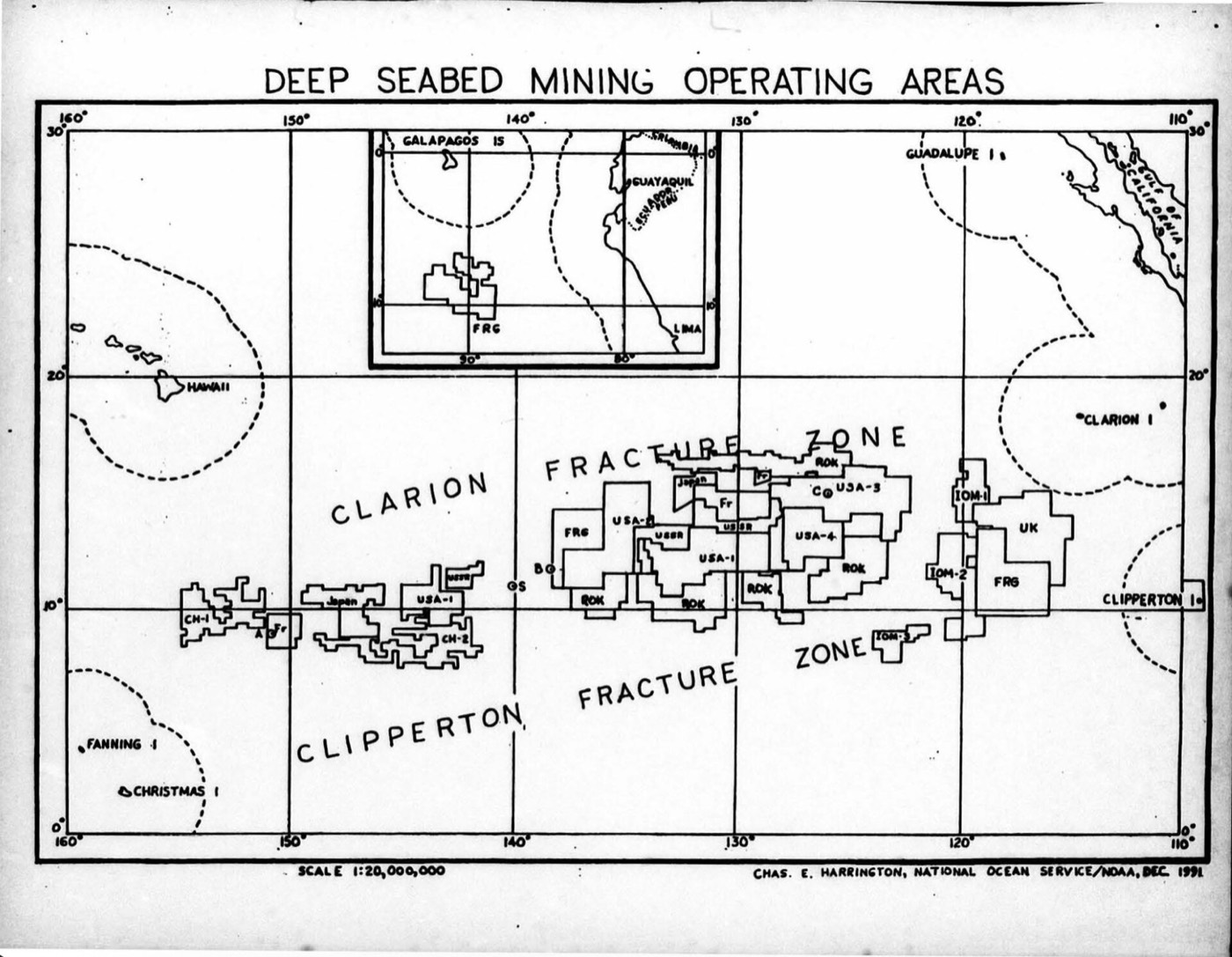
- NOAA map of permit/operating areas within the Clarion-Clipperton Zone (from a 1995 NOAA report to Congress; historical context for how the zone is divided into claim blocks, not the current USA-A/USA-B applications): Chas. E. Harrington, National Ocean Service/NOAA, Public domain - https://commons.wikimedia.org/wiki/File%3ADeep_Seabed_Mining_Operating_Areas_within_the_Clarion-Clipperton_Zone.jpg
- Kingston, Jamaica (seat of the International Seabed Authority), NASA ISS astronaut photograph: NASA Astronauts, Public domain - https://commons.wikimedia.org/wiki/File%3AKingston%2C_Jamaica.JPG
- Donald Trump signing an executive order, April 2025 (a different order, on the coal industry, signed the same month; usable only as a general portrait of the President signing an order, not captioned as the specific offshore-minerals order): The White House, Public domain - https://commons.wikimedia.org/wiki/File%3ADonald_Trump_2025_%28cropped%29.jpg
- The White House, Washington DC: White House (Joyce Boghosian), Public domain - https://commons.wikimedia.org/wiki/File%3AWhite_House_and_Marine_One_in_winter.jpg
- Ghost octopod ("Casper"), a real, newly-recognised abyssal species photographed by NOAA Ocean Exploration: National Marine Sanctuaries, Public domain - https://commons.wikimedia.org/wiki/File%3APMNM_-_Casper_-_New_Octopod_Species_%2830550423053%29.jpg


Primary sources
- The Metals Company, investor releases (investors.metals.co) - January 2026 consolidated NOAA application, ~65,000 sq km, 619 million tonnes estimated resource; April 2025 pivot announcement.
- The White House, 'Fact Sheet: President Donald J. Trump Unleashes America's Offshore Critical Minerals and Resources' (24 April 2025).
- Earth Negotiations Bulletin (IISD), '1st Part of the 31st Annual Session of the International Seabed Authority (ISA) Council'; Oceanographic Magazine, 'No code, no permits' - Kingston, 9-19 March 2026, no finished mining code.
- Center for Biological Diversity, 'Lawsuit Challenges Trump Administration Greenlighting of International Deep-Sea Mining Exploration Permit' (30 September 2026); Courthouse News coverage of the same filing - the Eaton quote.
- marinebio.org, '40 Nations Oppose Deep-Sea Mining as U.S. Pushes Ahead' (April 2026); Center for Biological Diversity, 'Nations Meeting in Jamaica Urged to Maintain Deep-Sea Mining Moratorium' (10 July 2026).
- Nature Ecology & Evolution, 'Impacts of an industrial deep-sea mining trial on macrofaunal biodiversity' (2025) - 2022 trial, -37% density, -32% species richness.
- Nature, 'Long-term impact and biological recovery in a deep-sea mining track' (2025); University of Liverpool release (26 March 2025) - 1979 test track, 2023 re-survey.
- UN, UN Convention on the Law of the Sea (1982) and 1994 Agreement on Implementation; ISA (isa.org.jm), 'About ISA'.
- deepseamining.ac, 'Kennecott Consortium' history page - 1962 first exploration, 1974 consortium formed.
- NOAA Office of Ocean Exploration and Research, 'Newly discovered "Casper" octopod at risk from deep-sea mining' (19 December 2016) - 2016 Okeanos Explorer finding near Hawai'i, kept separate from the CCZ trial surveys.
Not regulated financial advice.