
Space Junk: Are We Filling Orbit Too Fast to Empty It?
Low Earth orbit held a few hundred tracked objects in the 1960s and 70s. By September 2026 it holds somewhere between fifteen and seventeen thousand active satellites, most of them launched since 2019 by mega-constellations - and Starlink alone accounts for roughly two-thirds.
This video traces the warning that this was coming - Donald Kessler and Burton Cour-Palais's 1978 paper on runaway collisional cascades - through its first two real-world proofs: China's 2007 anti-satellite test on Fengyun-1C, and the 2009 collision between Iridium 33 and Kosmos 2251, the first crash between two intact catalogued satellites. It explains the physics of a hypervelocity impact at seven to eleven kilometres a second, why a single collision turns one tracked object into thousands of untracked fragments, and what ESA's Space Environment Report 2026 (published 27 September 2026) found: LEO collision risk up 20% since 2024, with debris growth projected to continue even at zero new launches.
It covers the rise in collision-avoidance manoeuvres - SpaceX's own filings record 148,696 Starlink manoeuvres in six months of 2025 alone - and a 2026 preprint, Hugh Lewis's Critical Sizes of Satellite Constellations, which finds several mega-constellations have already passed the point where their own debris becomes self-sustaining.
Then the response so far: ESA/ClearSpace's PRELUDE and re-scoped ClearSpace-1 missions, and Japan's JAXA/Astroscale ADRAS-J2 - the first machines built to actively capture and deorbit debris - and who is paying for them: government contracts worth tens of millions of dollars, against launch spending in the tens of billions. The video ends by framing low Earth orbit as a shared, finite resource rather than an open frontier, and weighing the options - deorbit rules, removal funding, constellation size limits - against the pace of new launches.
Every figure carries its date and source in the accompanying fact sheet. One figure (the precise multiplier for the decade-long rise in conjunction warnings within one specific altitude band) could not be traced to a single dated source and is flagged as such rather than asserted.
Educational documentary. Not financial or investment advice.
In these topics
Chapters
- An empty sky, once
- Kessler's warning
- The first proofs: 2007 and 2009
- The mega-constellation boom
- How one collision multiplies
- The 2026 alarm
- Conjunction warnings, on the rise
- The runaway threshold
- Cleaning up: the first missions
- Who is paying, and why so little
- A shared resource, not a frontier
- What would actually change the curve
Video notes
1. An empty sky, once
In the 1960s and 1970s, low Earth orbit was nearly empty. Low Earth orbit is the band of space from a few hundred to about two thousand kilometres up, close enough that a satellite circles the planet in about ninety minutes. The people tracking it back then could list every object in it by hand.
A few hundred tracked objects, total, shared the whole of low Earth orbit through those two decades. Weather satellites. Spy satellites. Spent rocket stages. Nothing crowded. Nothing close. An operator who wanted a clear lane simply had one, because almost nothing else was up there to share it with.
That emptiness is the baseline this video needs before anything else makes sense. Everything that follows is the story of what filled it, and what filling it costs.
2. Kessler's warning
The warning came early, and it came from arithmetic, not intuition.
In 1978, NASA scientist Donald Kessler and his colleague Burton Cour-Palais published a paper in the Journal of Geophysical Research called Collision Frequency of Artificial Satellites, subtitled The Creation of a Debris Belt. Their model showed something uncomfortable: past a certain density of objects, collisions would themselves start making more objects to collide with.
Kessler and Cour-Palais were not describing a single accident. They were describing a chain reaction. One collision creates fragments. Those fragments raise the odds of the next collision. That collision creates more fragments still. Run the loop for long enough, and a belt of debris keeps growing on its own, even if nobody launches another rocket.
The paper's own conclusion was specific: under the right conditions, a meaningful debris belt could begin forming within the twentieth century, and become a serious hazard to spacecraft design in the following one. That is the idea this video calls the Kessler syndrome, and in 1978 it was a forecast. It had not happened yet.
3. The first proofs: 2007 and 2009
It stopped being a forecast twice, thirty years later, within twenty-five months of each other.
On 11 January 2007, China tested an anti-satellite missile against its own dead weather satellite, Fengyun-1C, at an altitude of roughly 865 kilometres. The missile closed at about eight kilometres a second and struck it head-on. The satellite did not survive as a satellite. It survived as a cloud.
That cloud is still being counted.
Over three thousand tracked fragments came out of that one intercept — the single worst debris-creating event in the history of spaceflight to that point, from a test nobody outside China's military had approved.
Two years later, the second proof arrived by accident rather than by design.
On 10 February 2009, an active American communications satellite, Iridium 33, collided with a dead Russian military satellite, Kosmos 2251, over Siberia, closing at nearly twelve kilometres a second. It was the first time two whole, working catalogued satellites had ever run into each other. More than two thousand trackable fragments resulted, spreading across a wide band of altitudes within days.
Kessler's arithmetic from 1978 had just been demonstrated twice, by two very different causes: a deliberate test, and an accident nobody at either agency had planned for.
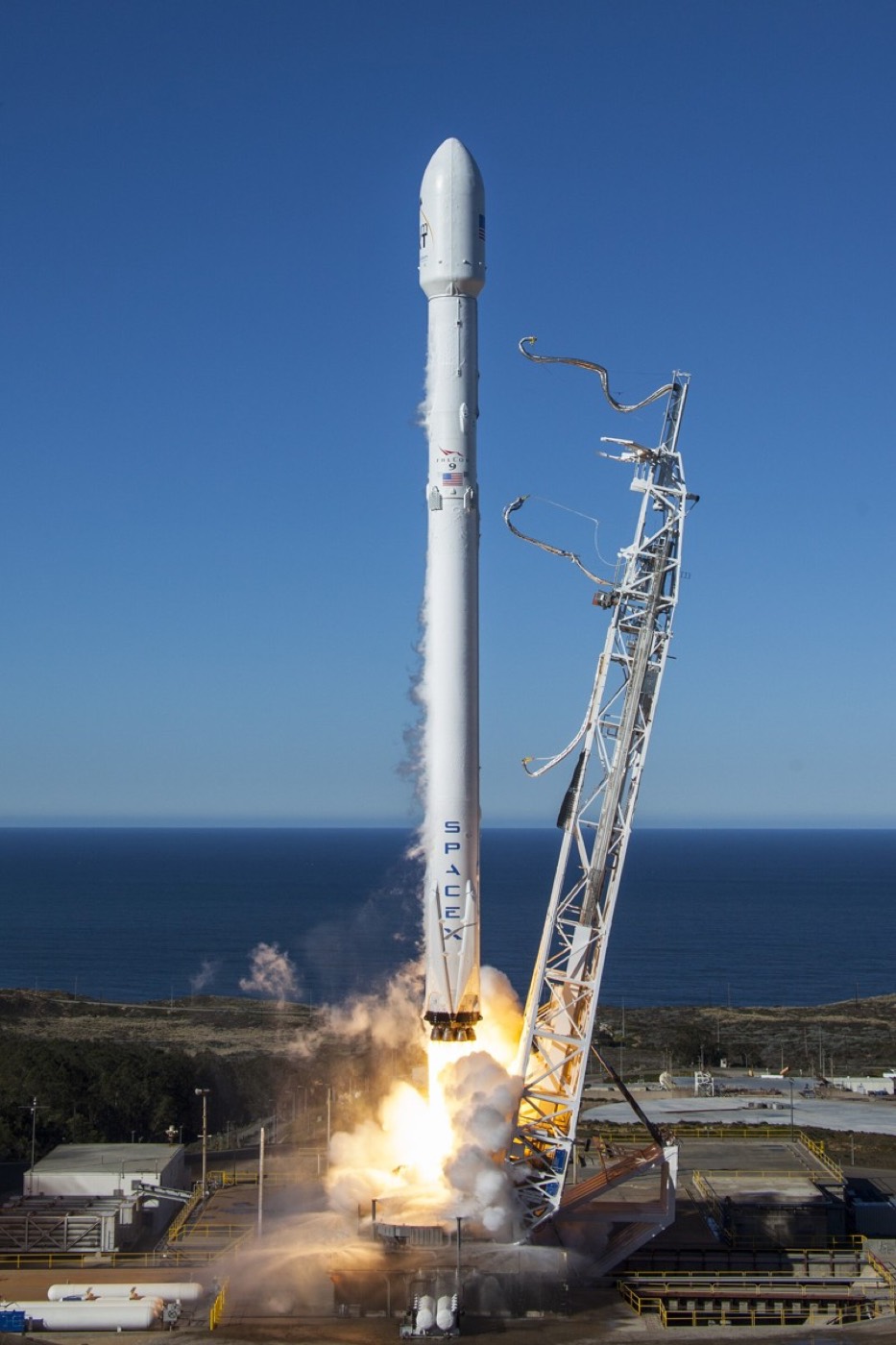
This photograph shows Iridium NEXT satellites, the generation that replaced Iridium 33's constellation, launching aboard a Falcon 9 rocket. The same network keeps flying today, rebuilt on top of the debris field one of its own satellites left behind.
4. The mega-constellation boom

For a decade after that, the crowding grew slowly. Then it did not.
In 2019, fewer than two thousand active satellites orbited the Earth. By September 2026, that number had risen to somewhere between fifteen and seventeen thousand, depending on which tracking catalogue does the counting. Almost all of the increase happened in the last few years, driven by one kind of project: the mega-constellation, thousands of small satellites launched together to blanket the planet with broadband internet.
One company, SpaceX's Starlink, accounts for roughly two-thirds of every active satellite now in orbit. It did that by launching batches of dozens of satellites at a time, on a schedule no earlier single-satellite operator could have matched.
This is not a story about one reckless actor. Rivals are building the same kind of constellation, and regulators have already received applications for far more satellites than are flying today. The boom that started around 2019 is still accelerating in 2026, not slowing down.
This photograph shows a Starlink satellite train crossing the night sky over Tübingen, Germany — dozens of satellites, launched together, still visibly moving in formation before they spread out to their working orbits.
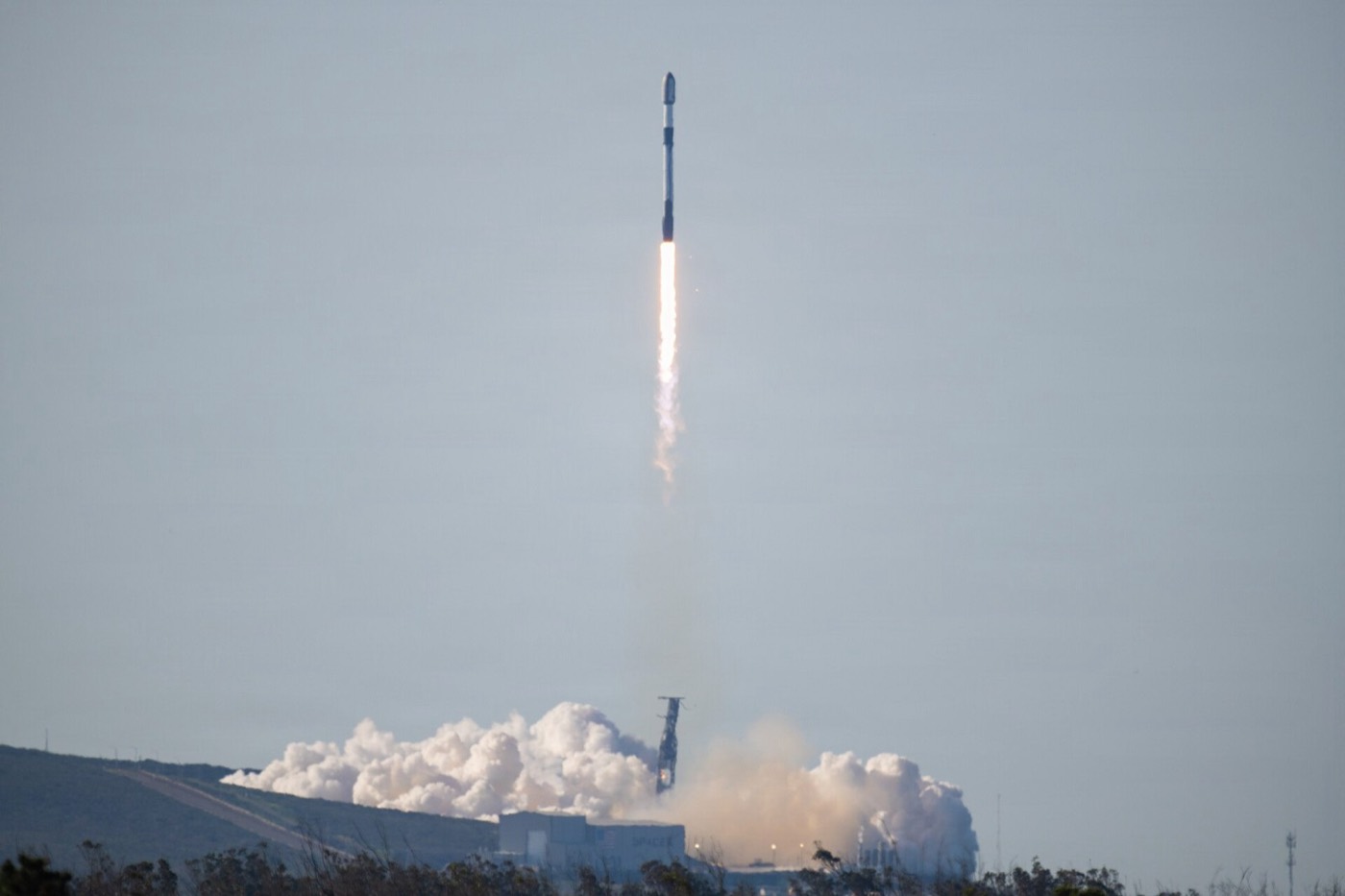
And this is where each batch starts: a Falcon 9 rocket lifting a fresh set of Starlink satellites away from Vandenberg Space Force Base. Launches like this one happen on a schedule measured in days, not years.
5. How one collision multiplies

To understand why this crowding matters, it helps to see what a single collision actually does, in physical terms.
Satellites in low Earth orbit travel at roughly seven to eight kilometres a second just to stay up. When two objects meet on crossing paths rather than travelling together, their combined closing speed can run from about seven up to eleven kilometres a second or more. At that speed, even a fist-sized fragment carries more energy than a comparable weight of high explosive.
A collision at that speed does not dent a satellite. It does not even really break it. It turns it into a spreading cloud, most of which is too small for any tracking system on the ground to see and log individually.
Ground radar and telescopes can reliably track fragments down to about ten centimetres across in low Earth orbit. Below that size, a piece of debris is still moving fast enough to destroy whatever it hits — it is simply invisible to the catalogue that is supposed to warn operators it is coming.
One hit turns one tracked object into thousands of untracked ones. That is the mechanism Kessler described in 1978, playing out exactly as arithmetic said it would.
6. The 2026 alarm

On 27 September 2026, the European Space Agency put a number on how fast that mechanism is now running.
ESA's Space Environment Report 2026 found that collision risk in low Earth orbit has risen twenty per cent since 2024. That is a two-year rise, not a two-decade one. The report projects continued debris growth even in a scenario where every launch on Earth stopped today, because the fragments already up there are now dense enough to keep colliding with each other.
That last finding is the sharpest version of Kessler's original point available. It is no longer a hypothetical density. It is a measured one.
The same report counts roughly one point two million untrackable debris fragments crowding the busiest orbital shells — objects too small to catalogue, but large enough to end a working satellite's life in an instant.
ESA also shortened its own projection window, from two hundred years out to one hundred, because a forecast that far ahead had stopped being reliable at the rate things are currently changing.
7. Conjunction warnings, on the rise
Every one of those fragments generates paperwork before it generates a headline: a conjunction warning, the alert an operator gets when something is calculated to pass close to their satellite.
SpaceX's own report to U.S. regulators recorded 148,696 Starlink collision-avoidance manoeuvres in just six months, from June to November 2025 — one manoeuvre roughly every two minutes, across the whole constellation, around the clock. In 2019, that number was close to zero, because Starlink barely existed yet.
Industry analysts describe that rise, across the whole of the crowded five-hundred to nine-hundred kilometre band where most mega-constellations fly, as running into the five-to-tenfold range over the past decade — a trend every operator in that band now plans around, even where the exact multiple is debated.
This is the Space Fence radar system on Kwajalein Atoll, one of the ground stations behind every one of those warnings — watching continuously for objects on a path to cross a working satellite's own.
And this is a GEODSS ground-based telescope, part of the same tracking network the U.S. Space Force uses worldwide to follow fainter, more distant objects that radar alone cannot see clearly.
A near miss, at these speeds, gives an operator hours to days of warning, and a fuel budget that was never designed to be spent dodging thousands of times a year.
8. The runaway threshold
The question this raises is not whether crowding is getting worse. It plainly is. The question is whether some constellations have already crossed the point where the crowding sustains itself.
A 2026 study called Critical Sizes of Satellite Constellations — a preprint, not yet peer-reviewed — calculated exactly that threshold for real constellations. Its author, Hugh Lewis, found that several planned or already-flying mega-constellations have already passed the size at which their own debris population becomes unstable, in altitude bands wider than earlier models like Kessler's had assumed.
That is a specific and testable claim, not a vague one: this particular constellation, at this particular size, in this particular altitude band, has passed the point where removing debris keeps up with creating it.
Regulators have not slowed the trend the paper describes. Filings already on record for new constellations propose more than one point two million additional satellites — a number that, if it ever flew, would dwarf everything currently in orbit combined.
9. Cleaning up: the first missions

Against all of that, two space agencies have built the first machines meant to physically remove debris, rather than just track it.
The European Space Agency, working with the Swiss company ClearSpace, is flying PRELUDE: two small CubeSats testing how one spacecraft can approach, inspect and grab hold of another, planned to launch in 2027. It is a rehearsal for the harder job that follows it.
That harder job is ClearSpace-1, and it has already changed shape once, for a reason that proves the video's own point.
ClearSpace-1 was originally built to capture a spent rocket part. In 2023, before it could launch, an untracked piece of debris struck that exact target, adding new debris of its own. ESA and ClearSpace re-scoped the mission around a different dead satellite, PROBA-1, now targeting 2028.
Japan is running a parallel effort.
JAXA, Japan's space agency, contracted Astroscale in August 2024 to build ADRAS-J2 — a spacecraft designed to rendezvous with a defunct Japanese rocket stage, grab it, and pull it down to burn up in the atmosphere. It is one of the first missions anywhere built to remove a large piece of debris that nobody planned to recover.
10. Who is paying, and why so little


Building the first machine of a new kind is expensive. Removing debris at the scale Kessler's arithmetic describes would be far more expensive still.
JAXA's contract with Astroscale for that rocket-stage removal mission is worth roughly thirteen point two billion yen, signed in August 2024. Separately, Japan's government awarded Astroscale a grant of up to eighty million U.S. dollars, in stages running to March 2028, for a different mission that inspects rather than captures a dead satellite. These are two different contracts, for two different spacecraft, not one large fund.
Set that beside what the other side of this story spends.
Mega-constellation operators have flown well over five hundred rocket launches since 2019 carrying satellites into orbit, each one costing tens of millions of dollars. Government debris-removal contracts, worldwide, are still counted in the tens of millions total — not per launch, but for entire missions, built once, flown once.
This is the European Space Operations Centre in Darmstadt, Germany — ESA's own hub for tracking satellites and coordinating collision avoidance today. Facilities like it fund watching. What almost nobody is funding yet is removal at the pace the crowding demands.
Two governments, on opposite sides of the planet, are carrying almost the whole of this effort between them: Japan, funding both of Astroscale's missions, and Germany, home to the European Space Operations Centre that coordinates ESA's own side of the work.
11. A shared resource, not a frontier

Every chapter so far has described a piece of physics or a piece of money. This one is about how to think about the whole thing.
Open sky was never scarce. A pilot flying over one country does not use up airspace another pilot needs somewhere else. Low Earth orbit does not work that way. Its usable altitude bands are finite, and a fragment created by one operator's satellite can end the working life of a satellite belonging to someone else entirely, on the other side of the planet, years later.
That is the definition of a commons: a resource anyone can use, that gets worse for everyone the more any one user takes without limit. Fisheries work this way. Groundwater works this way. Low Earth orbit, this video has now shown with three separate lines of evidence — the 2026 collision-risk rise, the runaway-threshold study, and the conjunction-warning trend — now works this way too.
Treating an orbit like an open frontier, when the numbers already describe a commons under strain, is the mismatch this video set out to explain.
12. What would actually change the curve

None of that means the situation is fixed. It means the options on the table can be weighed honestly, against the pace of what is actually happening.
Three levers are on the table right now: stricter rules requiring dead satellites to deorbit within a set number of years, faster and larger funding for removal missions like ClearSpace-1 and ADRAS-J2, and hard limits on how large a single constellation is allowed to grow before its own debris risk becomes somebody else's problem.
Weighed against those levers is the pace already measured in this video: satellite numbers up roughly eightfold since 2019, collision risk up twenty per cent in the last two years alone, and constellations already past the size Hugh Lewis's 2026 study calculates as self-sustaining.
The sky that held a few hundred objects in the 1970s now holds tens of thousands, and the fragments too small to count outnumber the satellites themselves many times over. Whether that curve bends depends on choices being made, or delayed, right now — not on anything settled by the physics alone.
Sources and credits
Photo credits (Wikimedia Commons)
- Iridium NEXT satellites launching aboard a Falcon 9 rocket, 2017 (same Iridium constellation as the Iridium 33 satellite destroyed in the 2009 Iridium-Cosmos collision): SpaceX, CC0 - https://commons.wikimedia.org/wiki/File%3AIridium-1_Launch_%2832312419215%29.jpg
- A Starlink satellite train crossing the night sky over Tübingen, Germany: Dktue, CC0 - https://commons.wikimedia.org/wiki/File%3AStarlink_%C3%BCber_dem_Rathaus_in_T%C3%BCbingen.jpg
- A Falcon 9 rocket launching a batch of Starlink satellites from Vandenberg Space Force Base: U.S. Space Force SLD30 by 2nd Lt. Andrew Taller, Public domain - https://commons.wikimedia.org/wiki/File%3AStarlink_17-19_Launches_Aboard_Falcon_9_Rocket_from_Vandenberg_Space_Force_Base_%289499202%29.jpg
- The Space Fence radar system on Kwajalein Atoll, the U.S. Space Force's orbital debris-tracking radar: Lt. Kristen Shimkus, Public domain - https://commons.wikimedia.org/wiki/File%3ASpace_Fence_declared_IOC_and_OA_%28200327-F-CB405-001%29.jpg
- A GEODSS ground-based telescope used by U.S. Space Command to track satellites and debris: NASA Orbital Debris Program Office, Public domain - https://commons.wikimedia.org/wiki/File%3AAEOS_MSSS_GEODSS.jpg
- European Space Operations Centre (ESOC), Darmstadt, Germany - ESA's satellite operations and space-debris coordination centre: Telecineguy at English Wikipedia, Public domain - https://commons.wikimedia.org/wiki/File%3AEuropean_Space_Operations_Centre%2C_Darmstadt-_entrance.jpg


Primary sources
- European Space Agency, 'ESA Space Environment Report 2026', esa.int, published 27 September 2026 - LEO collision risk up 20% since 2024, continued debris growth at zero new launches, ~1.2 million untrackable fragments.
- Kessler, D.J. & Cour-Palais, B.G., 'Collision Frequency of Artificial Satellites: The Creation of a Debris Belt', Journal of Geophysical Research, vol. 83, issue A6, pp. 2637-2646, 1 June 1978.
- Secure World Foundation, fact sheets on the 2007 Fengyun-1C ASAT test and the 2009 Iridium-Cosmos collision, swfound.org; NASA, 'The Collision of Iridium 33 and Cosmos 2251', ntrs.nasa.gov.
- Jonathan McDowell, Jonathan's Space Report / General Catalog, planet4589.org, updated 13 September 2026; azmth.space satellite statistics, September 2026 - active satellite and Starlink counts.
- Hugh G. Lewis, 'Critical Sizes of Satellite Constellations', arXiv:2607.29644, submitted 31 July 2026 - A PREPRINT, NOT PEER REVIEWED.
- JAXA, CRD2 Phase II contract announcement, 20 August 2024, global.jaxa.jp; Astroscale press releases, 20 August 2024 and October 2023 (MEXT $80M grant).
- SpaceX biannual orbital debris report to the FCC, via space.com reporting, 2026; AIAA, 'Collision Avoidance Manoeuvres by Starlink Satellites Increasing Exponentially', 7 July 2023.
Not regulated financial advice.