
Bridge Collapse: Is Infrastructure Falling Behind?
On 26 March 2024, the containership Dali lost power in Baltimore harbour and struck a pier of the Francis Scott Key Bridge. The span collapsed in seconds. Six road workers died.
This video traces how a bridge is actually engineered to survive exactly that - the load path from span to pier to foundation, the pier-protection structures called dolphins that Sunshine Skyway's 1980 disaster forced the industry to invent, and the fatigue-cracking failure that brought down Minneapolis's I-35W bridge in 2007 for a different reason entirely: a gusset plate half as thick as it needed to be, missed for thirty years.
Then 2025 and 2026: the NTSB's December 2025 final report, which traced Key Bridge's collapse to a single mislabelled wire; its finding that Key Bridge's own risk had been almost thirty times over the acceptable threshold; and its order that 30 owners of 68 US bridges test their own vulnerability to a modern ship strike. The Mackinac Bridge is the first to clear that test, in July 2026.
And then the cost of getting it wrong: Maryland's Key Bridge rebuild, re-tendered in 2026 at $4.3-5.2 billion with a 2030 reopening, and a very different kind of failure in August 2026, when a brand-new bridge under construction in Old Town, Maine, partially collapsed mid-pour - a reminder that building something new carries its own risk.
The video closes by weighing 2026's incidents against the inspections and rebuilds now under way, to ask whether bridge engineering is keeping pace with the age of the world's bridge stock and the size of modern ships, or falling behind both.
Educational documentary. Not financial or investment advice.
In these topics
Chapters
Video notes
1. Six seconds
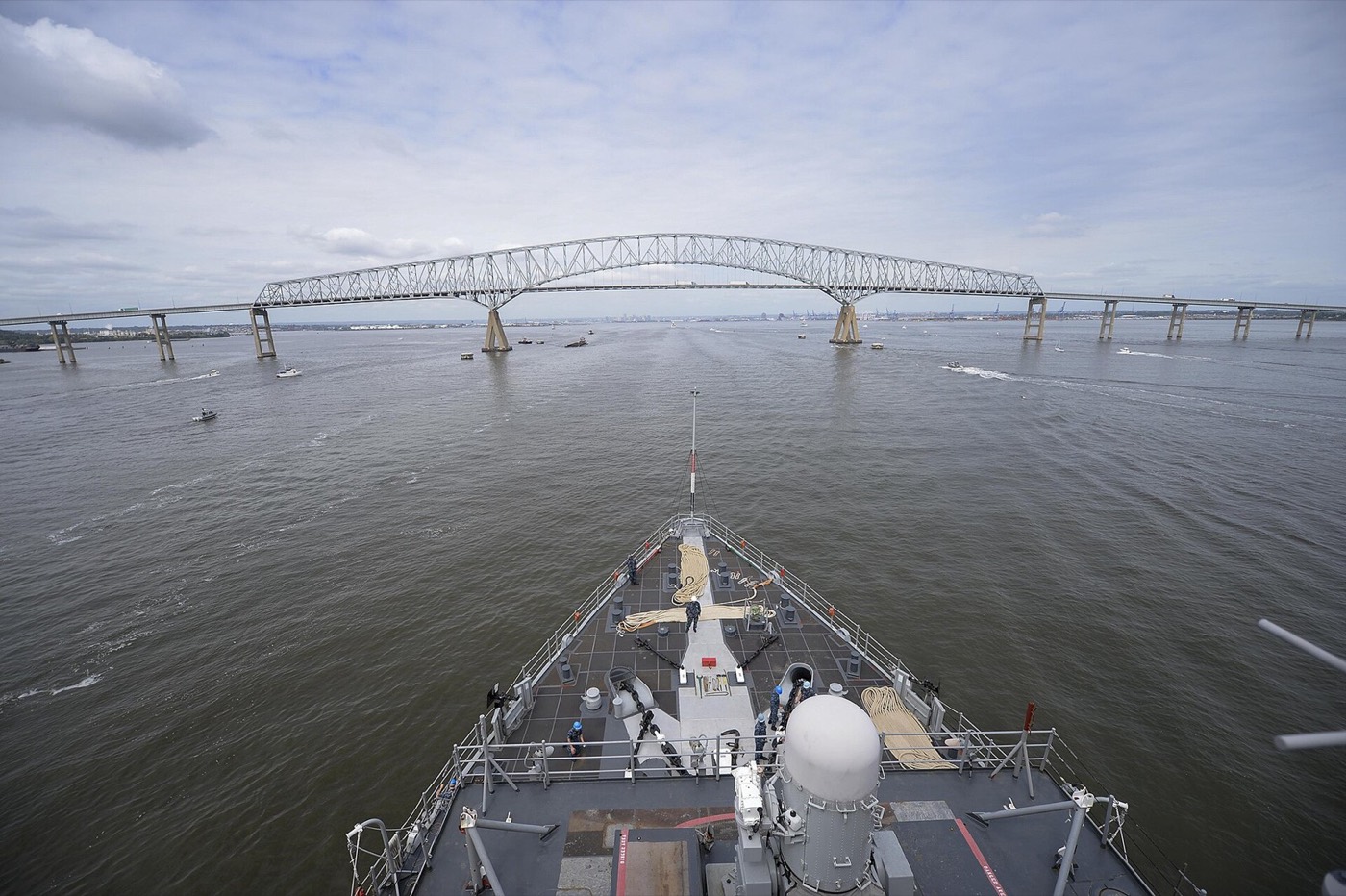
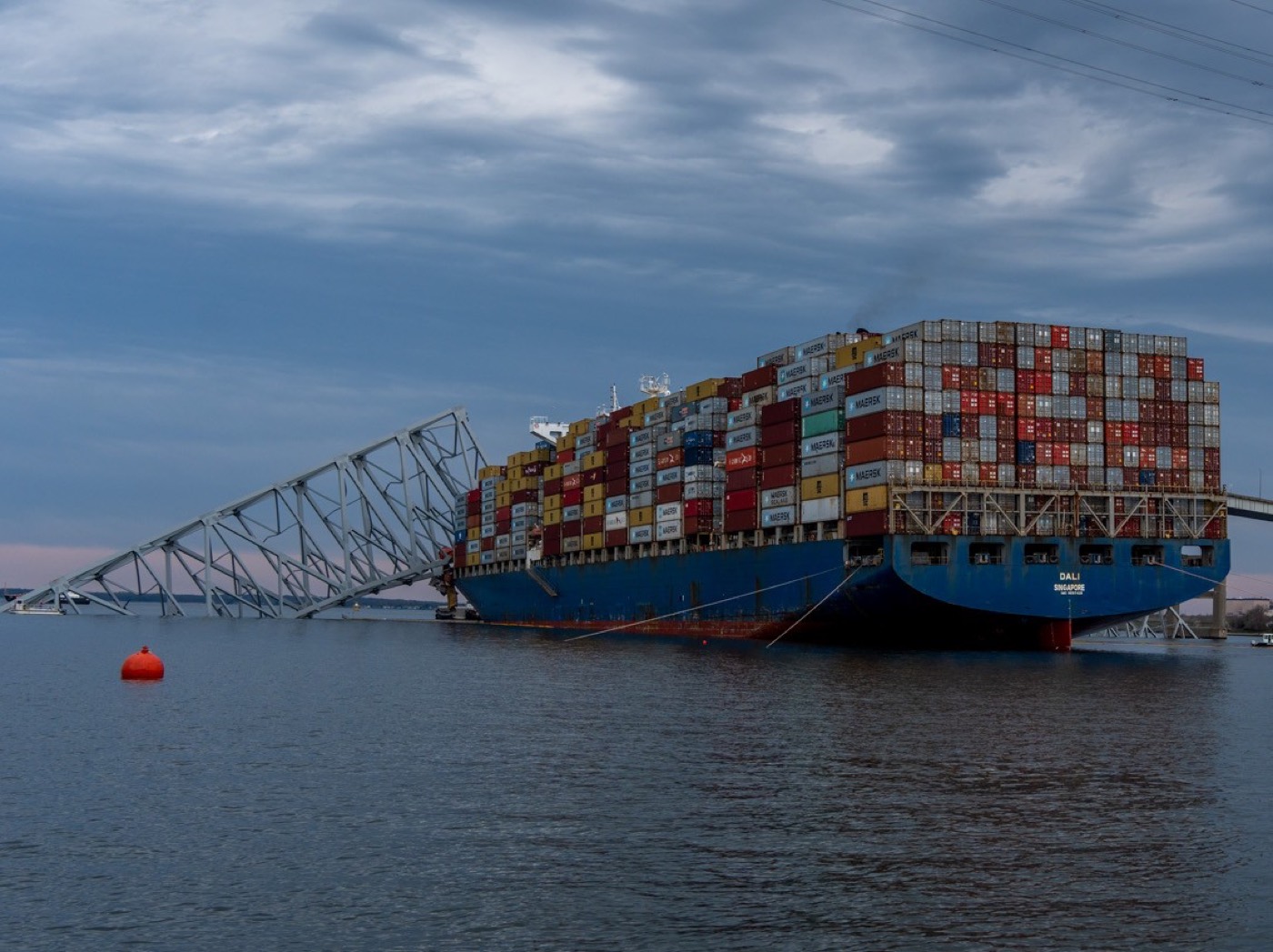
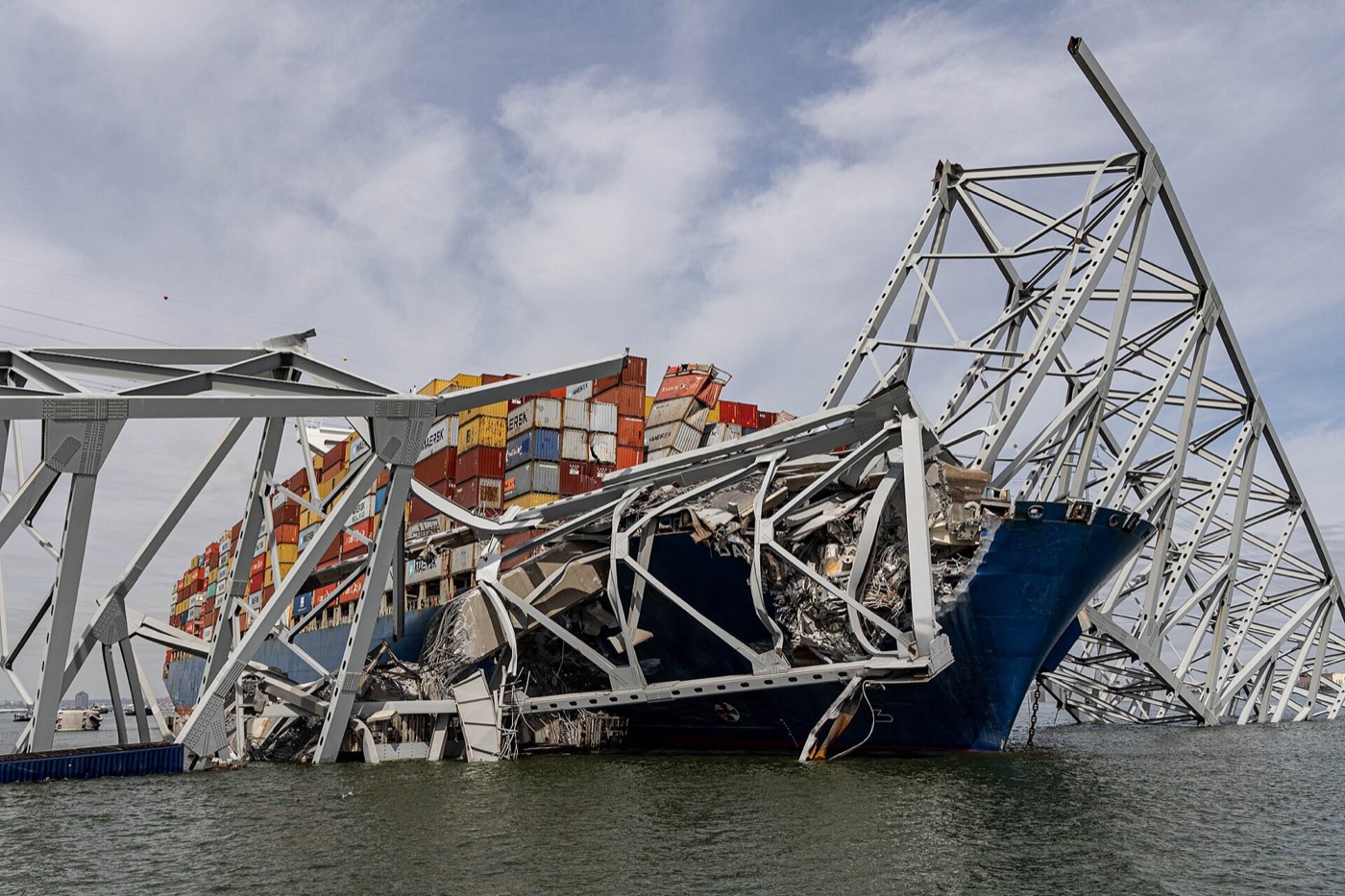
It is 1:28 in the morning on 26 March 2024, and a container ship called the Dali is easing out of Baltimore harbour, loaded and outbound for Sri Lanka.
This is the bridge the Dali is heading toward: the Francis Scott Key Bridge, photographed a decade before that night, carrying traffic across the harbour the way it had for almost fifty years.
Then the lights go out.
The Dali loses propulsion and steering at once — a full blackout, on a fully loaded ship, in a shipping channel with a bridge pier standing in it. The crew tries to recover power and drop anchor. Neither happens fast enough. The ship keeps moving, on momentum alone, straight toward a pier of the Francis Scott Key Bridge.
This is what was left afterward: the Dali, stopped dead, sitting beside the wreckage of the span it had just brought down.
Eight men were on that bridge, patching potholes on the overnight shift. Two survived. Six did not.
Six road workers killed, out of an eight-person overnight crew — the whole of the human cost of one ship losing power for a matter of seconds.
And this is what was left of the span itself: steel and roadway pulled from the harbour in the days after, a piece of what had been standing a few hours before.
The main span came down within seconds of the strike. This video exists to answer one question: why did a fully modern American bridge fail that quickly, and that completely, from one ship losing power?
The next eleven chapters explain how a bridge is built to survive exactly this, and how one bridge in 1980 first forced the question. All of it starts from those six words: a ship went dark, and a bridge fell.
2. How a bridge stands up
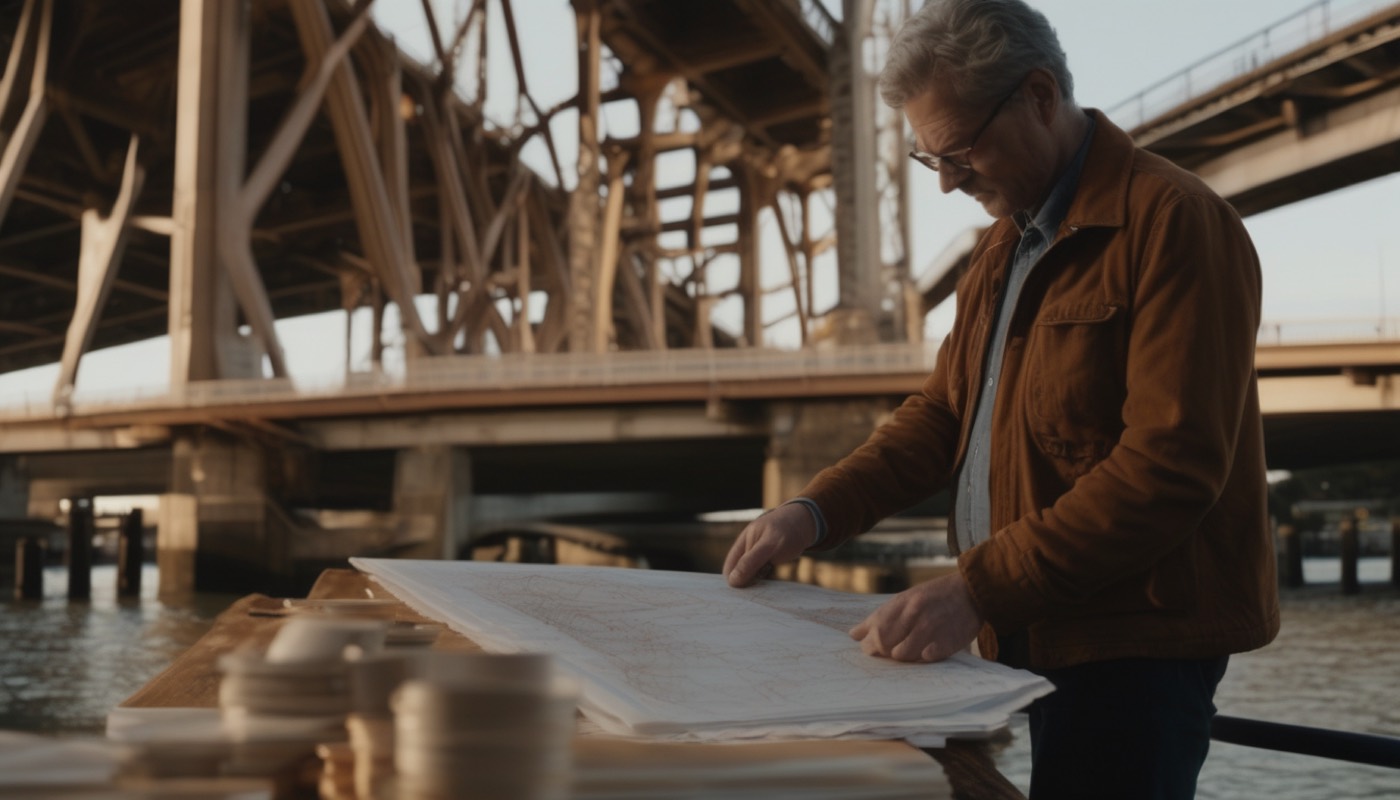
Before asking why a bridge fails, it helps to know what keeps one standing.
Picture a bridge crossing wide water. Vertical columns called piers rise from the riverbed or seabed to hold the roadway up. The sections of roadway between piers are called spans. Every span's weight — plus the traffic crossing it — travels down through the span, into the piers, and into the ground beneath them. That downward path is the load path, and it is the one thing every bridge design, whatever it looks like above the water, has to get right.
A truss bridge — a lattice of steel triangles — carries that load along the lattice itself. A cable-stayed bridge, like the original Key Bridge, hangs the roadway from cables anchored to tall towers, and those towers carry the load down to the piers instead.
Both designs work. Both depend on the same thing: every pier staying exactly where it is, able to carry its share of the load, for the bridge's entire working life. Break that one assumption, at any pier, and the load path above it has nowhere left to go.
3. What actually kills a bridge
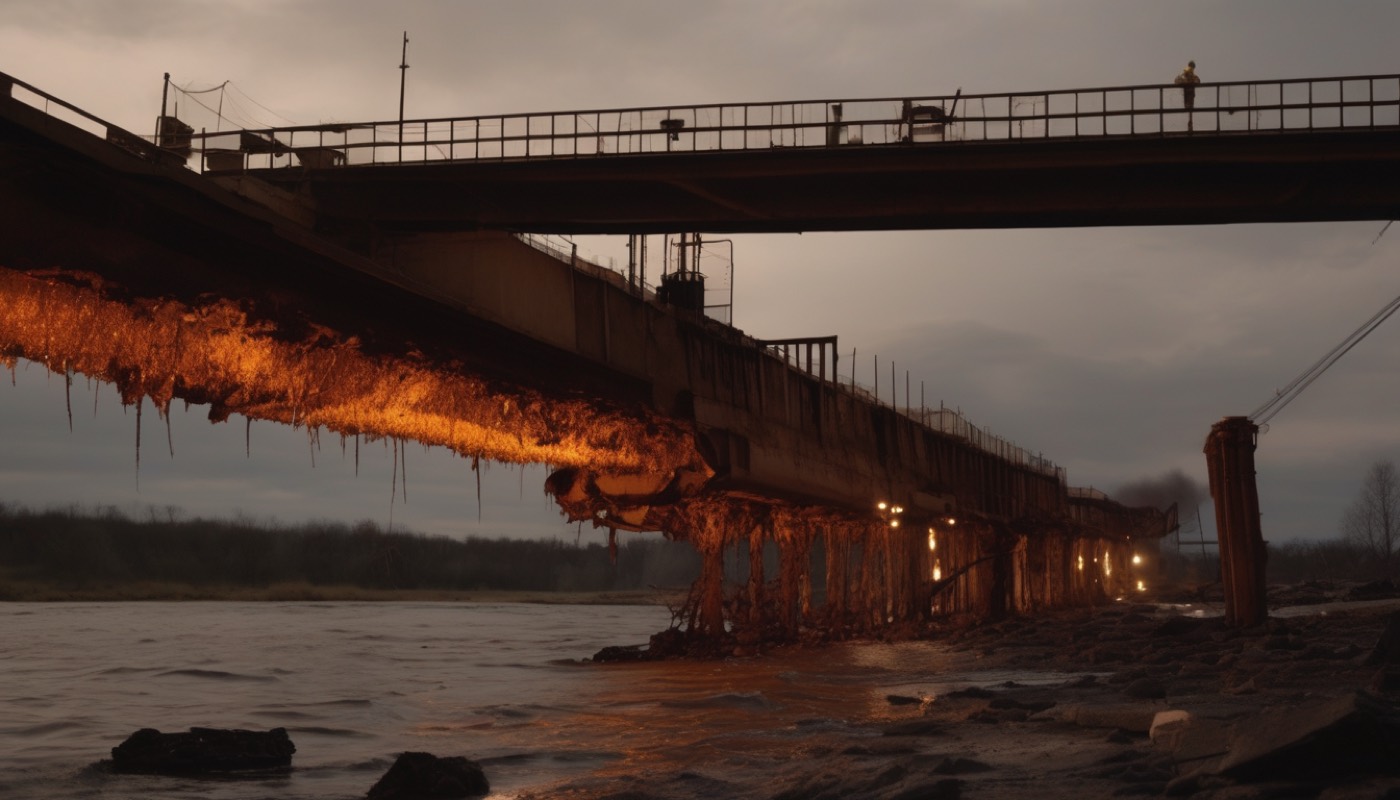
So what actually breaks that assumption? Engineering investigators keep returning to three answers.
The first is impact — a ship or a vehicle striking a pier hard enough to move or shatter it, the way the Dali did. The second is fatigue cracking: steel that has flexed under traffic millions of times develops tiny cracks that grow, invisibly at first, until a critical piece finally gives way. The third is scour — moving water slowly digging away the riverbed or seabed around a pier's foundation, until the pier is no longer resting on solid ground at all.
Three different mechanisms. One shared result: a pier that can no longer do its one job, and a load path with nowhere to go.
This video follows two of those three in detail, because two of them are what actually took down the bridges in this story — impact, and fatigue. Scour is the quieter threat, working underwater, and it is the reason bridge inspectors check what a pier is standing on, not just what it is made of.
4. 1980: the first wake-up call
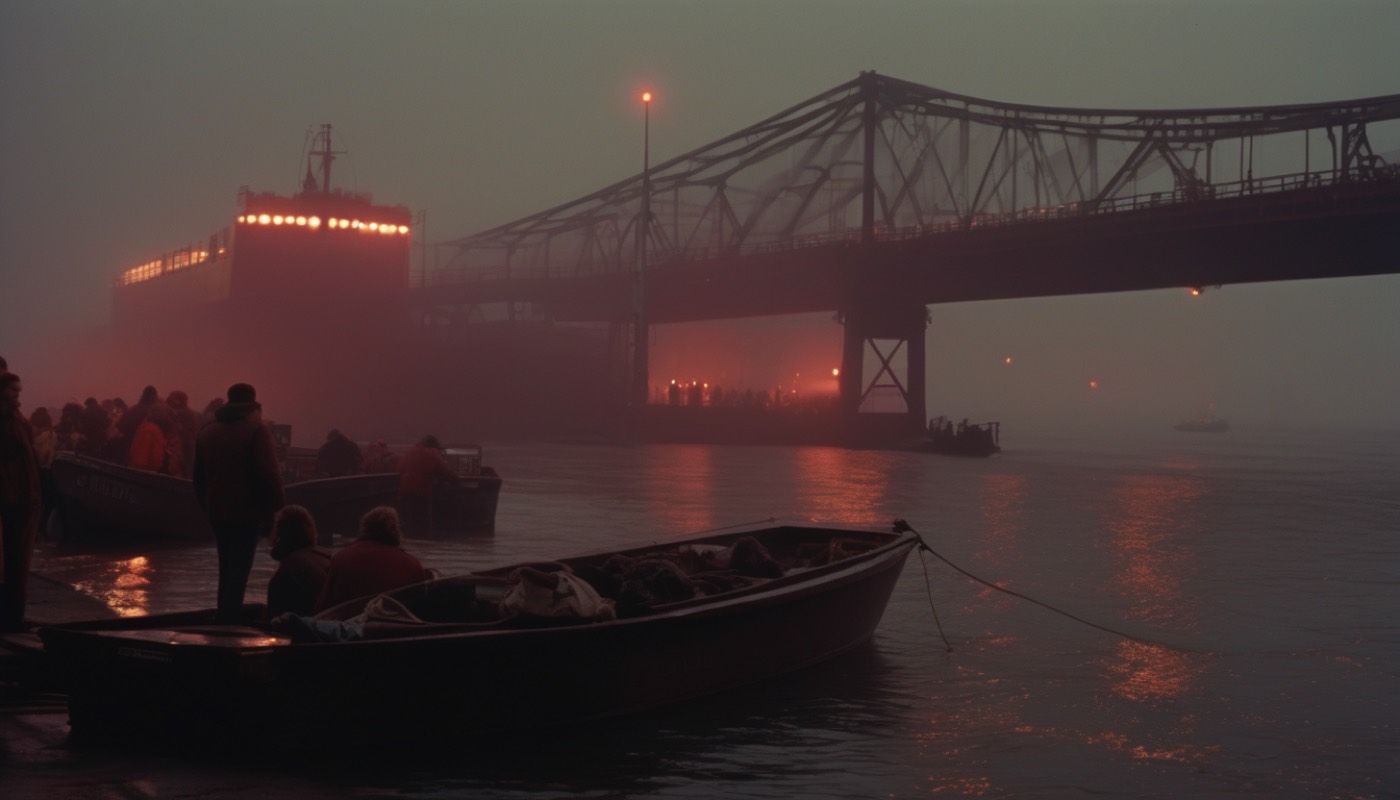
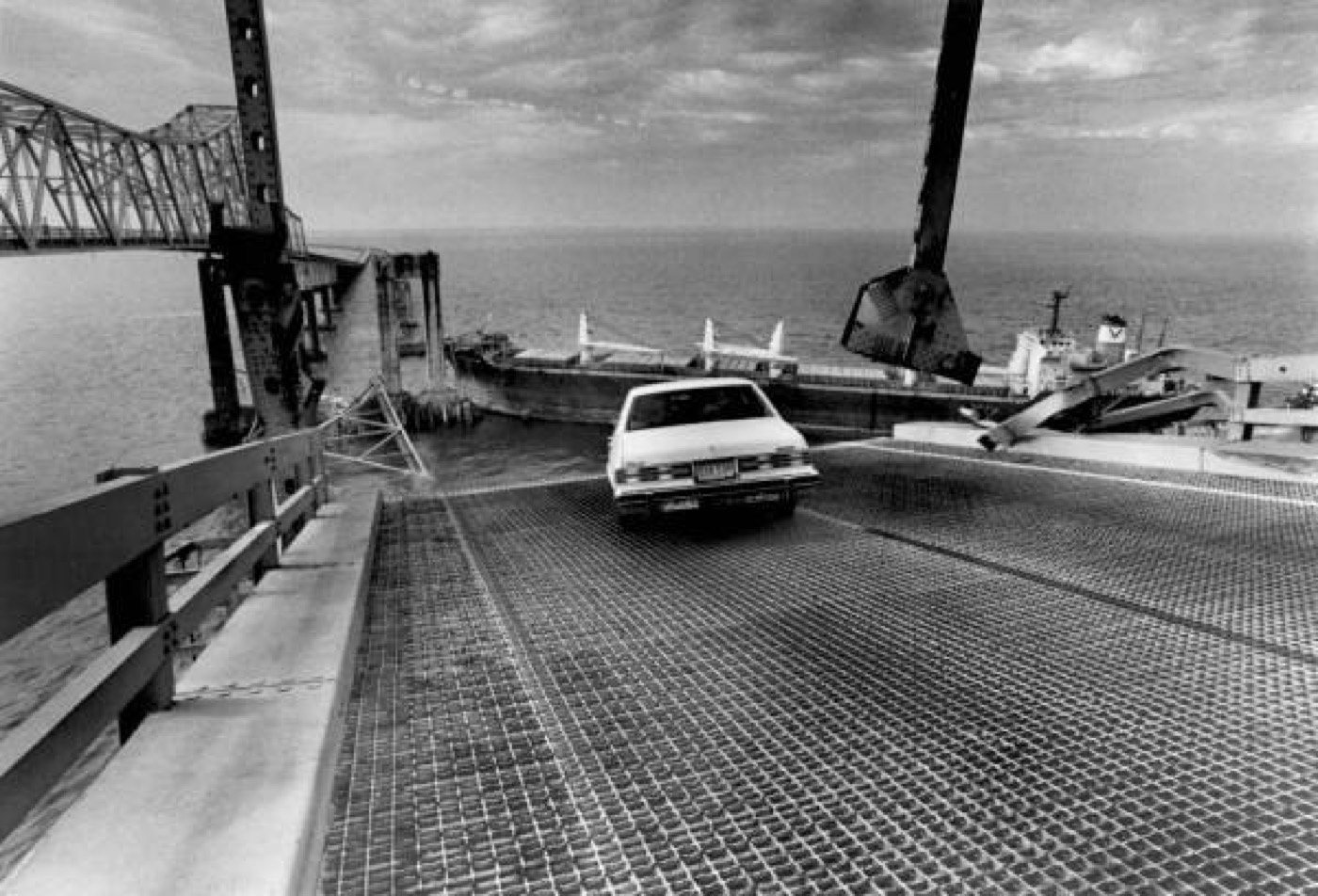
Baltimore was not the first time a ship found an unprotected pier.
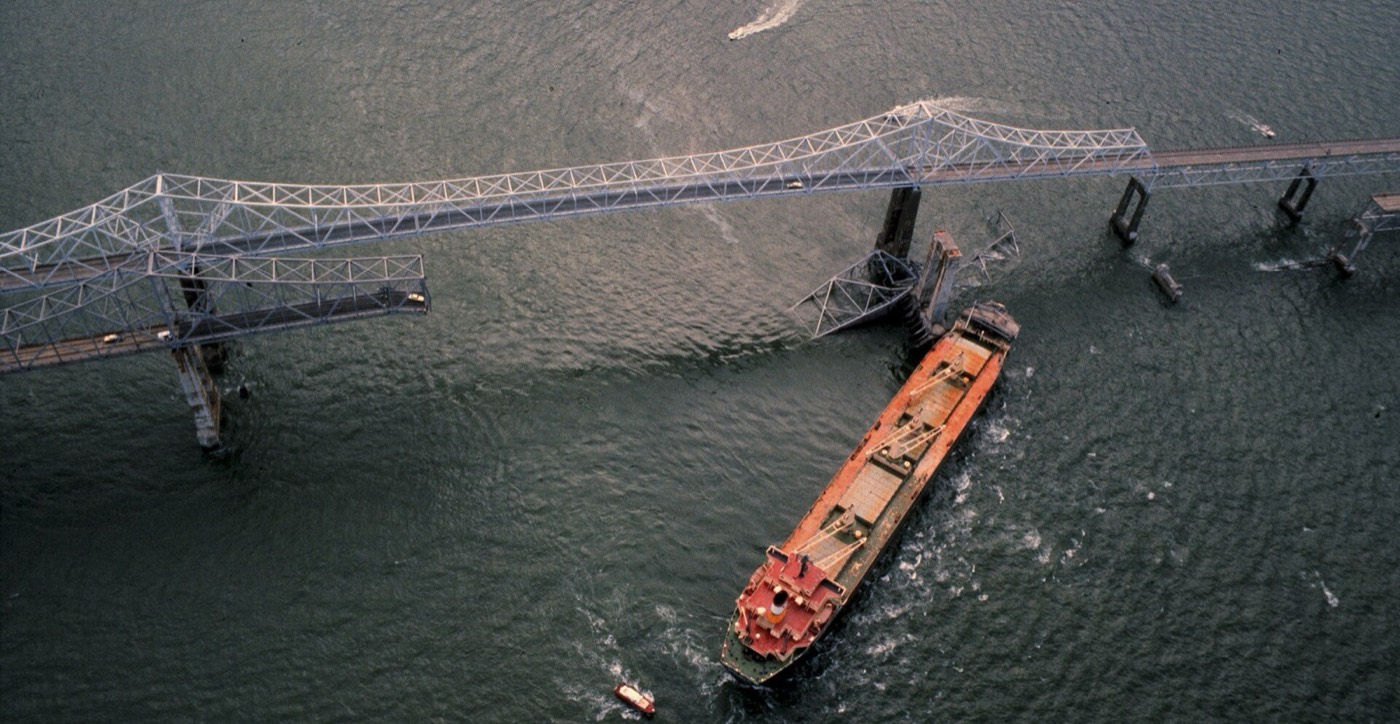
On 9 May 1980, a sudden squall dropped visibility to almost nothing over Tampa Bay. A freighter called the Summit Venture was inbound under the old Sunshine Skyway Bridge when the storm hit. Blind, and unable to stop in time, it struck one of the bridge's piers dead on.
A span more than a thousand feet long dropped into the bay. Thirty-five people died.
Cars drove into the gap in the dark and the rain, unable to see that the road no longer existed.
The investigation afterward found what Baltimore's investigation would find again, forty-four years later: that pier had never been built to survive being hit by anything. Nothing about the bridge's design assumed a ship could reach it at all.
Sunshine Skyway became the moment American bridge engineering had to answer a question it had never seriously asked: what do you build around a pier to stop a ship reaching it in the first place?
5. Protecting a pier
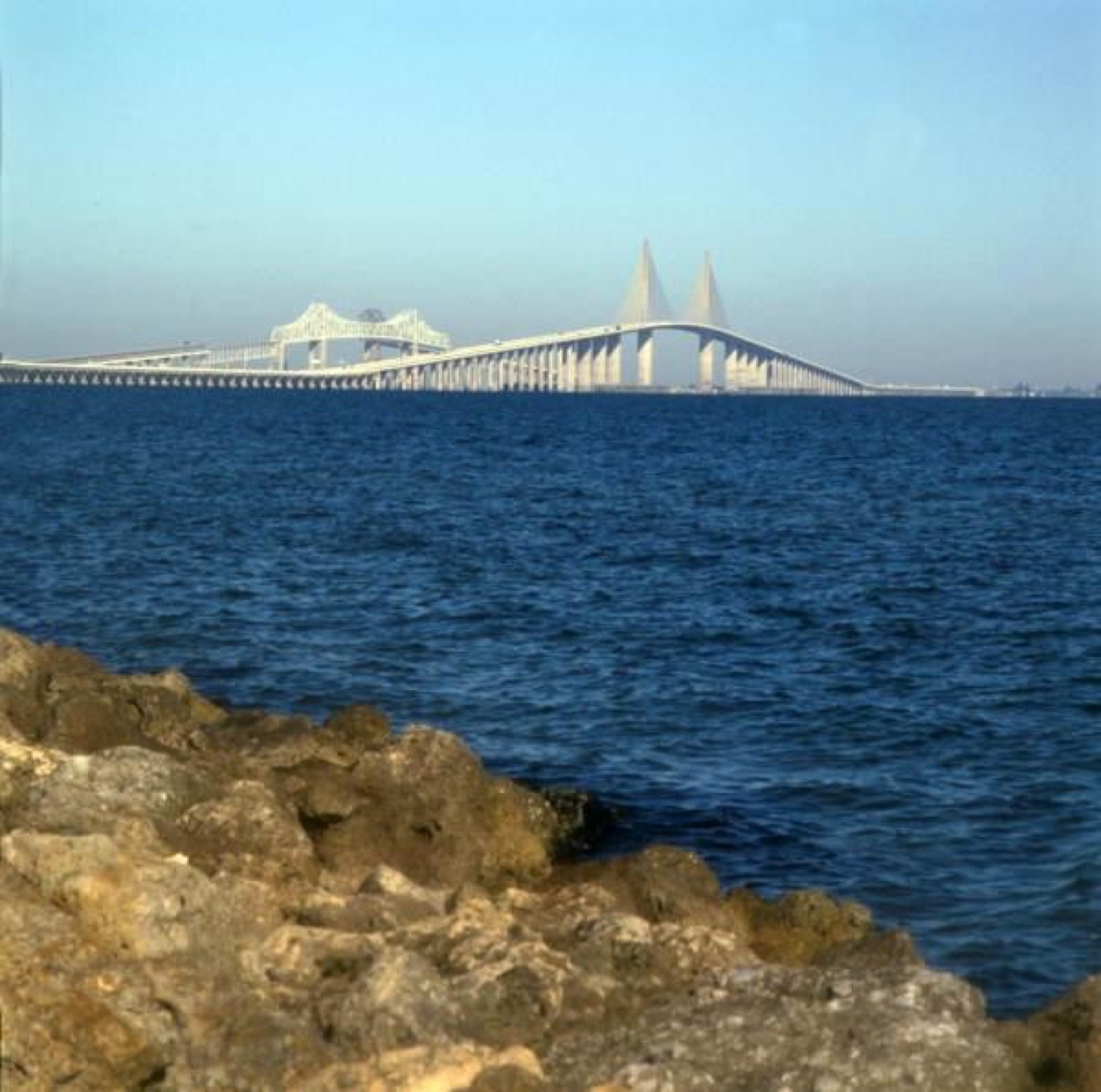
The answer the industry settled on is called a dolphin — not the animal, but a standalone protective structure. It usually takes the form of a ring of piling or a filled concrete island, built out in the water a short distance from the pier itself. A ship on a collision course hits the dolphin instead of the bridge, and the dolphin is built to absorb or deflect that hit, sacrificing itself if it has to. Fenders do a smaller version of the same job, cushioning a pier directly. Protective islands do it with rock and earth instead of steel.
The rebuilt Sunshine Skyway opened in 1987, ringed with thirty-six of them. Four large dolphins guard its two main towers, and thirty-two smaller ones are spaced along the approach piers to either side.
That is what protection looks like when a bridge is built around the threat from the start. Most bridges over shipping channels were not. They were designed and built years, sometimes decades, before anyone wrote down a standard for how big a ship a pier ought to survive. The protection, if it exists at all, was usually added later — and often it was never added at all. Key Bridge, opened in 1977, was one of the bridges where it never was.
6. 2007: when steel is the weak link
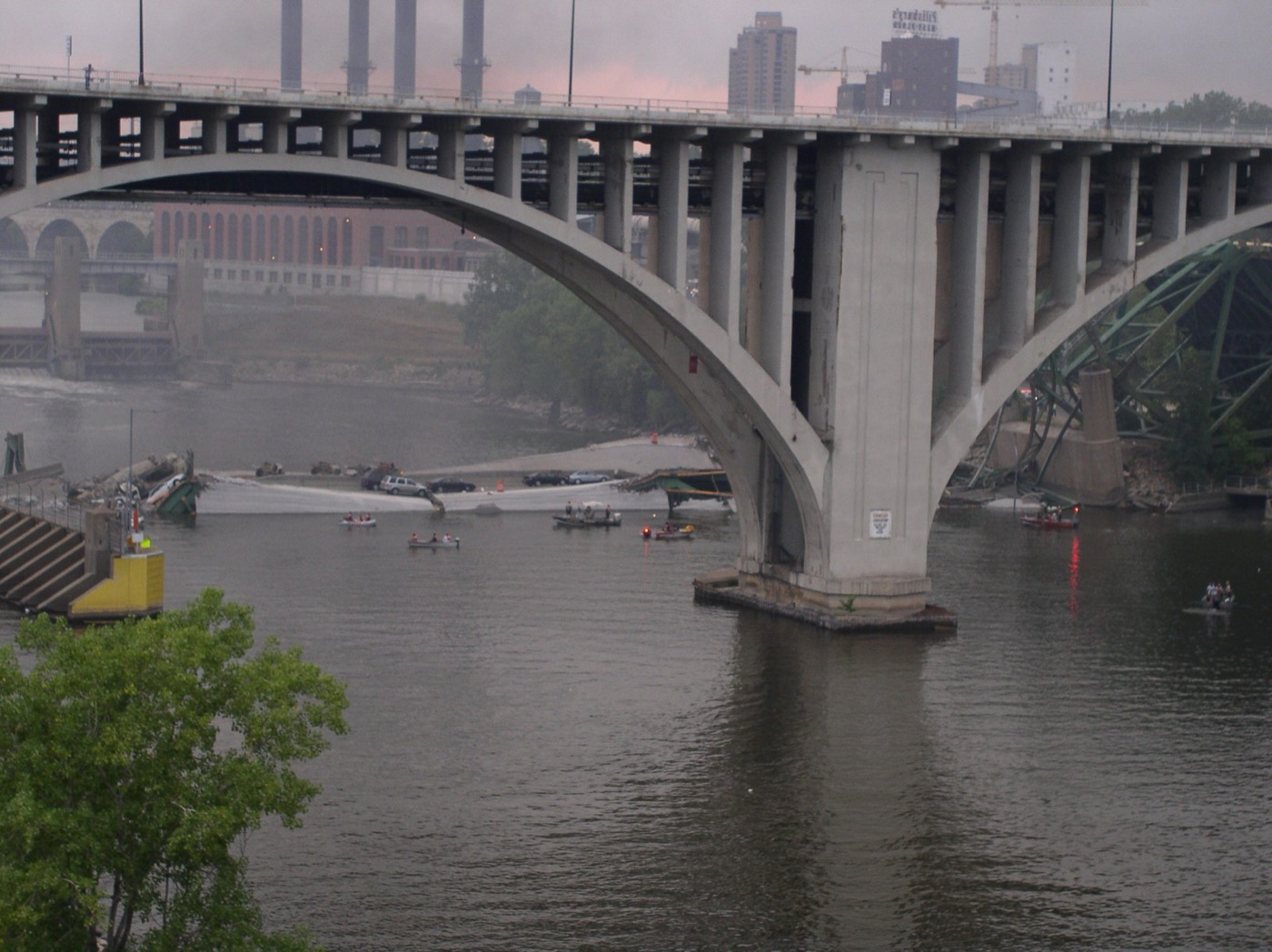
Not every collapse starts with something hitting the bridge. Sometimes the bridge fails on its own.
On 1 August 2007, the I-35W bridge in Minneapolis collapsed during the evening rush hour, under nothing more dramatic than ordinary traffic and a construction crew working on the deck above. Thirteen people died.
Investigators found the fault thirty years after it was built into the bridge. A truss like I-35W's is held together at its connection points, called nodes, by steel plates called gussets. In the 1960s, engineers specified gusset plates at several of those nodes roughly half as thick as the load actually required. Nobody caught the error through the original design review, and the undersized plates went into the bridge anyway.
For decades, that mistake sat quietly inside the structure, carrying less margin than the bridge's own drawings claimed it had. Then the bridge got heavier — resurfacing and other modifications added weight the original design never accounted for — and on the day it failed, construction equipment and materials were sitting on the deck directly above those same undersized plates. The combination was enough. One connection gave way, and because the truss had no alternate path for the load to take, the whole span went down with it.
Vessel impact removes a pier from outside. A bad gusset plate removes a joint from inside. Different mechanisms, the same lesson: a bridge is only as strong as its single weakest connection, and a weak one can hide for a very long time.
7. How inspectors catch it early
So how is a hidden flaw like that supposed to be caught before it fails?
Federal rule requires every bridge in the country to be physically inspected at least once every twenty-four months — a standard called the National Bridge Inspection Standards. A bridge rated in poor condition cannot go longer than that between inspections; a bridge in better condition can sometimes go longer, but never past forty-eight months without a fresh look.
Each inspection produces a condition rating for the bridge's major parts. For years, the worst of those ratings was called "structurally deficient" — a label that sounds like a bridge about to fall down, which is not what it actually means. The term was retired in 2018 in favour of plainer language: a bridge in "poor" condition. It means a component needs attention or repair, not that collapse is imminent.
By that standard, the Federal Highway Administration tracks more than six hundred thousand bridges nationwide. As of 2025, roughly six point seven per cent of them were rated poor. That works out to a little over forty thousand bridges needing that level of attention.
None of that caught Key Bridge's problem, because a twenty-four-month inspection checks the condition of steel and concrete. It was never designed to check whether a pier could survive being hit by a ship the size the shipping channel now carries.
8. The wire label
So if the bridge itself was not the failure in Baltimore, what was?
The NTSB's final report, issued in December 2025, traced the Dali's blackout to a single point of failure, in the report's own words.
"A loose signal wire connection to a terminal block, stemming from the improper installation of wire-label banding."
A wire tag, fitted wrong, worked itself loose enough to break a connection — and that was enough to black out a fully loaded containership.
Investigators found a second factor made it worse. The ship's high-voltage breakers were set to manual restart rather than automatic. Automatic mode would have cut the blackout from fifty-eight seconds down to roughly ten — enough time, potentially, for the crew to recover power and steering before the ship ever reached the pier.
And the pier itself had nothing waiting for it. No dolphin, no fender, no protective island — the same gap Sunshine Skyway exposed back in 1980. That gap was still open at Key Bridge in 2024. And it is still on the record, in the NTSB's own report from December 2025.
9. The 68-bridge check

One failure exposes one bridge. The NTSB's response was to ask how many others share the same gap.
In March 2025, the agency calculated that Key Bridge's own risk of collapse from a vessel strike had been almost thirty times above the threshold engineering guidance treats as acceptable for a critical bridge — and nobody had known that, because nobody had calculated it. So the NTSB ordered thirty owners of sixty-eight bridges, across nineteen states, to run the same calculation on their own structures and build a plan if they came up short.
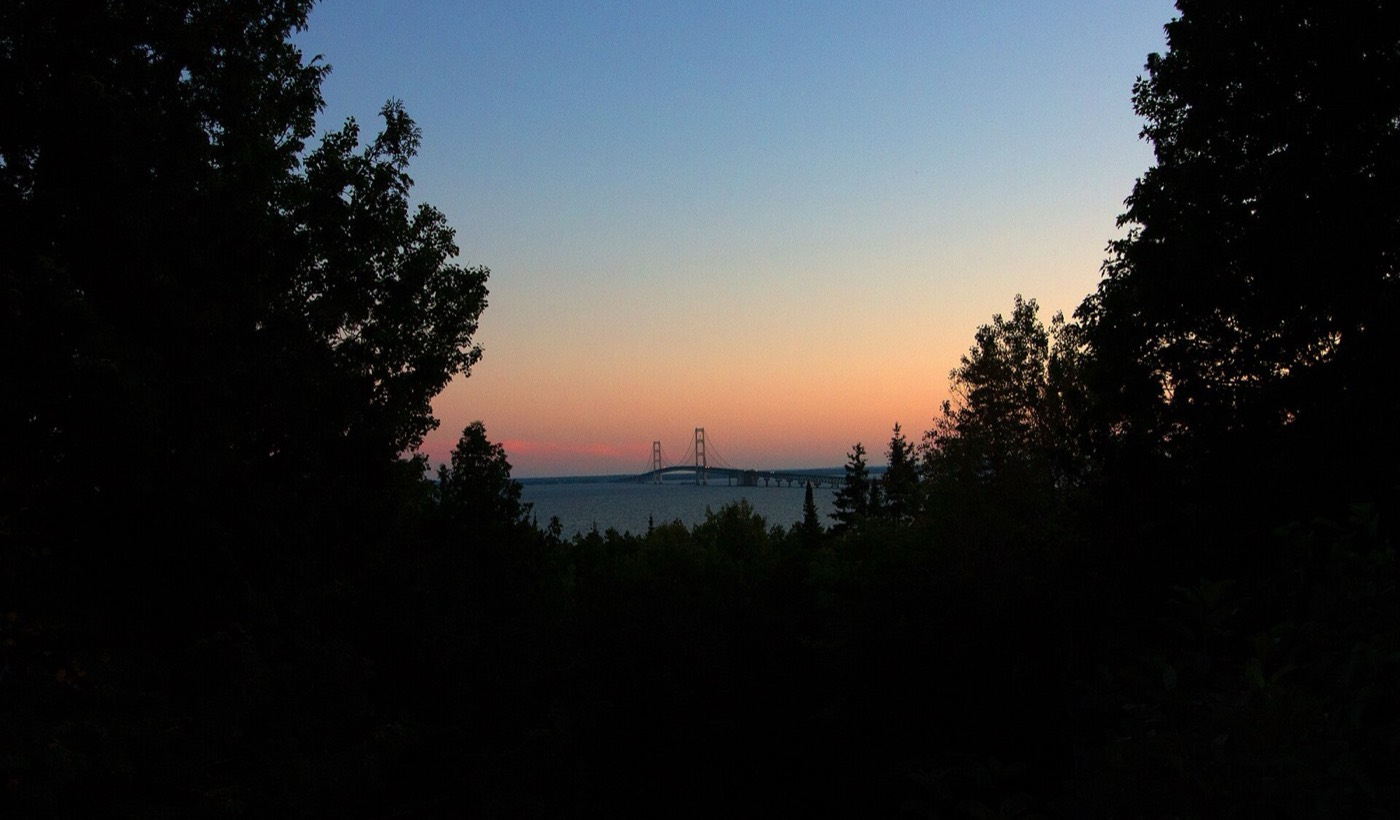
The list includes some of the country's best-known crossings: the Golden Gate. The Brooklyn, Manhattan, Williamsburg, George Washington and Verrazzano-Narrows bridges in New York. The Sunshine Skyway itself. And the Mackinac Bridge, spanning the Straits of Mackinac in Michigan.
Mackinac was the first to finish. In July 2026, its assessment came back with a collapse frequency of roughly one in ten thousand, three hundred and fifty years — comfortably below the acceptable threshold. One bridge, cleared. Sixty-seven still being worked through.
10. Rebuilding at 2026 prices
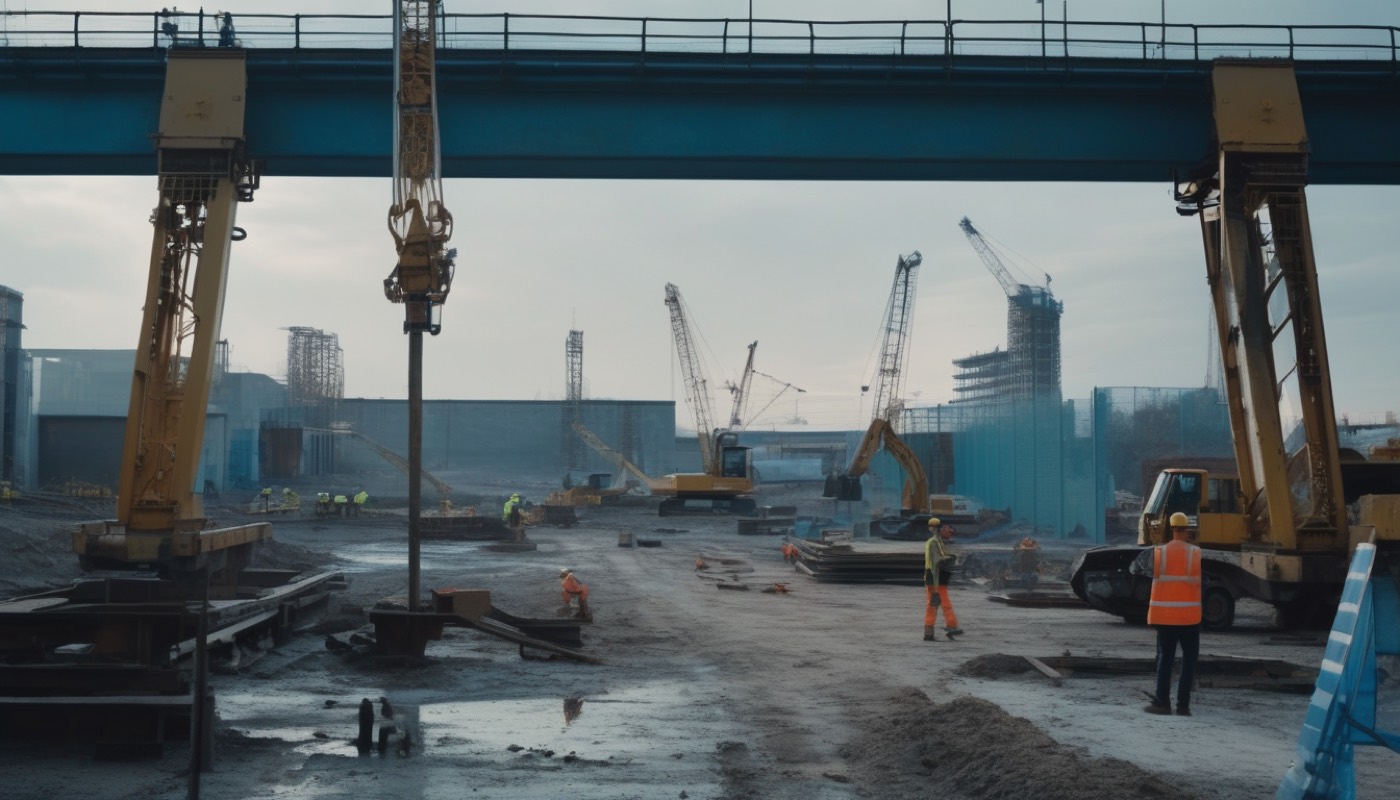
While the risk list works through its checks, Baltimore is still rebuilding the one bridge that already failed — and discovering what replacing a modern bridge actually costs.
The current estimate is four point three to five point two billion dollars. It has stood since late 2025, unchanged through the middle of 2026. The rebuilt bridge is not expected to reopen before 2030. In April 2026, Maryland dropped its original contractor after its bid came in far above that estimate. The following month, the state re-tendered the project as four separate contracts instead of one: demolition, two approach spans, and the main span. The hope was that smaller, more competitive packages would hold the price down.
By late August 2026, the demolition and marine-work contract had gone out to bid, with construction targeted to begin that fall — more than two years after the ship first went dark.
Four billion dollars and roughly six years, at minimum, to replace one bridge that a single loose wire brought down in seconds. That imbalance — how fast a bridge falls, against how long and how much it costs to put back — is most of the argument for building the protection in the first place.
11. A new bridge, a new failure
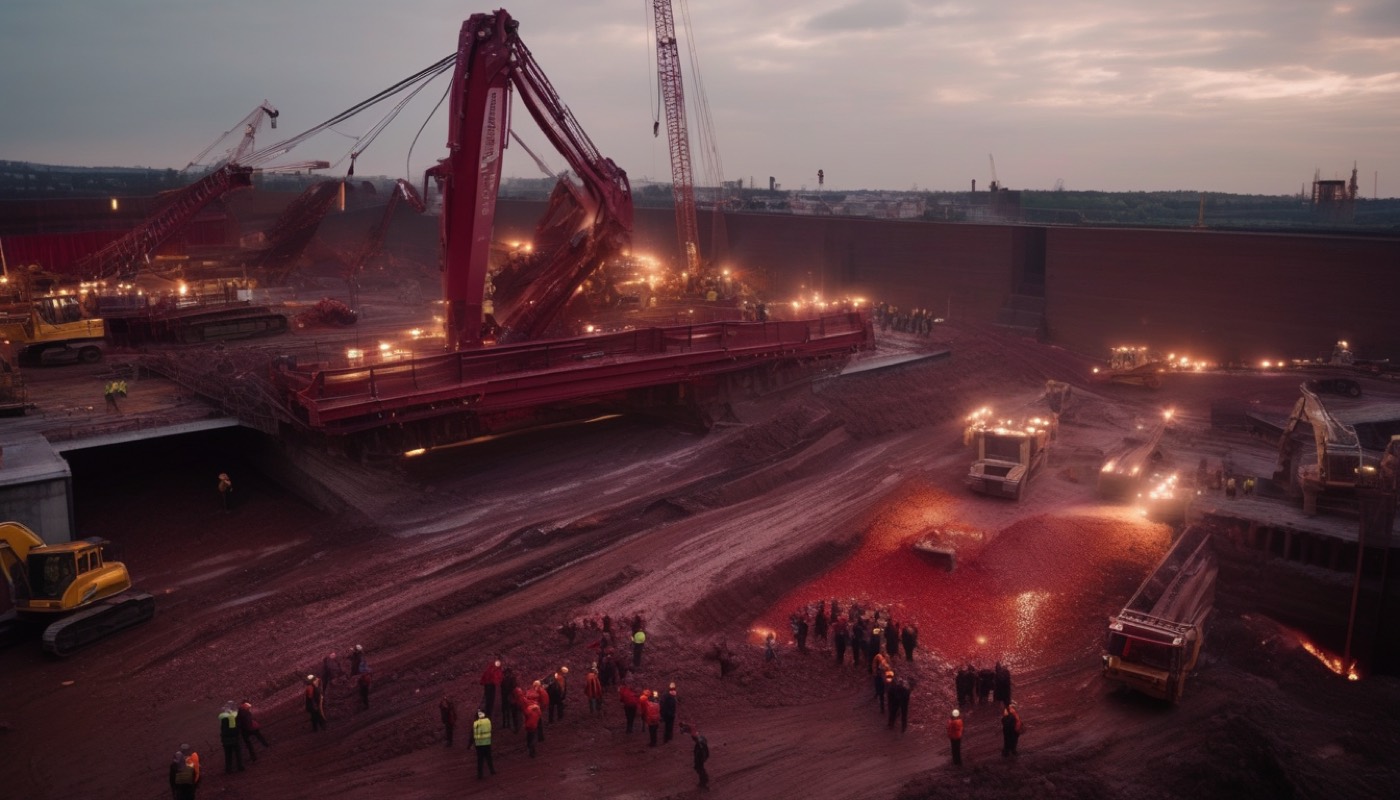
Rebuilding old bridges safely is one half of the problem. Building new ones safely turned out to be its own test.
On 14 August 2026, part of a bridge under construction in Old Town, Maine, came down mid-build. The Llewellyn Estes Bridge, not yet open to traffic, partially collapsed while crews were pouring concrete for its deck. Workers on site were injured; officials say none of the injuries was life-threatening.
This bridge was not old, and nothing about it had spent decades hiding a flaw. It was being built with an experimental material: fibre-reinforced composite girders, licensed only recently for real bridges.
Those girders were developed at the University of Maine, not far up the road from Old Town itself. Investigators have not yet said what caused the collapse.
What Maine's transportation department did say, on 24 September 2026, is that it is finishing the bridge with conventional steel girders instead, while the investigation into the collapse continues.
Its own commissioner called that switch "the most expeditious option" to keep construction moving — explicitly not a verdict on what went wrong.
A ninety-nine-year-old bridge and a nine-month-old one, in the same year, for reasons that have nothing to do with each other. One argument says infrastructure is falling behind on inspecting and protecting what already exists. This chapter is the reminder that building something new carries its own risk, and that risk does not go away just because the steel is younger.
12. Falling behind, or catching up?
So: is bridge engineering keeping pace, or is it behind?
Both things are true at once, and that is the honest answer. Behind: sixty-seven of sixty-eight flagged bridges are still waiting on an assessment more than a year after it was ordered. Most bridges built before modern shipping still carry no pier protection, and Key Bridge's own replacement will not open until roughly six years after it fell. Catching up: the assessments exist and are running, one has already cleared its bridge, and Maryland's rebuild — whatever it costs — is actually under construction rather than stalled.
What connects every chapter in this video is the same lesson, learned twice forty-four years apart: a pier without protection is a bridge waiting for a ship it was never built to survive. Sunshine Skyway forced that lesson in 1980. Key Bridge forced it again in 2024. The question this video leaves open is whether the sixty-seven bridges still waiting will get their answer before something forces it a third time.
Sources and credits
Photo credits (Wikimedia Commons)
- Francis Scott Key Bridge, Baltimore, before the collapse (2014): U.S. Navy photo by Mass Communication Specialist 3rd class Laura Hoover, Public domain - https://commons.wikimedia.org/wiki/File%3AFrancis_Scott_Key_Bridge_at_Baltimore_in_September_2014.JPG
- MV Dali next to the collapsed Francis Scott Key Bridge, 30 March 2024: Charles Delano / U.S. Army Corps of Engineers, Public domain - https://commons.wikimedia.org/wiki/File%3ADali_and_the_Francis_Scott_Key_Bridge_on_30_March_2024_%28cropped%29.jpg
- Wreckage from the Key Bridge collapse, Baltimore, March 2024: David Adams / U.S. Army Corps of Engineers, Baltimore District, Public domain - https://commons.wikimedia.org/wiki/File%3AWreckage_from_Key_Bridge_Collapse_%28240326-A-SE916-9511%29.jpg
- Aerial view of the Sunshine Skyway Bridge disaster, 9 May 1980: Weaver Tripp Jr. (-1994) [1], Public domain - https://commons.wikimedia.org/wiki/File%3ASunshine_Skyway_Bridge_Disaster_Aerial_View.jpg
- Richard Hornbuckle's Buick stopped on the edge of the collapsed Sunshine Skyway Bridge, 1980: Jeffrey Lynch, Public domain - https://commons.wikimedia.org/wiki/File%3ARichard_Hornbuckle_Buick_on_the_edge_of_the_collapsed_Sunshine_Skyway_Bridge.jpg
- Old and new Sunshine Skyway bridges, St Petersburg, Florida, 1987 (new bridge's protective dolphins visible): Stewart, H. Milo, CC0 - https://commons.wikimedia.org/wiki/File%3AView_of_the_old_and_new_Sunshine_Skyway_bridges_from_St._Petersburg%2C_Florida%2C_1987.jpg
- I-35W Mississippi River bridge collapse, Minneapolis, 1 August 2007: Tomruen at English Wikipedia, Public domain - https://commons.wikimedia.org/wiki/File%3AI-35W_bridge_collapse_TLR2.png
- Mackinac Bridge, Straits of Mackinac, Michigan: ksblack99, Public domain - https://commons.wikimedia.org/wiki/File%3AMackinac_Bridge_at_Sunset.jpg


Primary sources
- NTSB, 'Board Summary: Contact of Containership Dali with the Francis Scott Key Bridge', adopted 18 November 2025, issued 10 December 2025.
- NTSB press release nr20250320, 20 March 2025 - the ~30x AASHTO risk finding and the 68-bridges/30-owners/19-states recommendation, quoted directly.
- NTSB, Highway Accident Report HAR-08/03, I-35W bridge collapse, adopted 14 November 2008 - the undersized gusset plate finding, corroborated by Commercial Carrier Journal and New Civil Engineer summaries.
- NTSB, Marine Accident Report MAR-81-3, Ramming of the Sunshine Skyway Bridge, 1981; WUSF, 'Sunshine Skyway set the standard for bridge protections. They weren't present in Baltimore', 29 March 2024 - the 35 dead and the 36-dolphin figure.
- Michigan.gov/MDOT press release, 8 July 2026.
- eCFR 23 CFR 650.311, current version; Federal Register, National Bridge Inspection Standards final rule, 6 May 2022 - the 24-month inspection interval.
- Maryland Matters, 17 November 2025 and 3 June 2026 ('Transportation officials hold firm on $5.2 billion price tag'); WYPR, 28 April, 1 May and 26 August 2026; Construction Dive, May 2026; MDTA news release, 19 May 2026 - the Key Bridge cost and re-tendering timeline.
- Maine DOT, official update, maine.gov/dot/news, August 2026 - the 14 August 2026 collapse date and injury statement, used as primary over conflicting secondary reports.
- Bangor Daily News, 'Old Town bridge will now use conventional steel girders after partial collapse', 24 September 2026 - the GBeams-to-steel decision and the Commissioner's quote.
Not regulated financial advice.